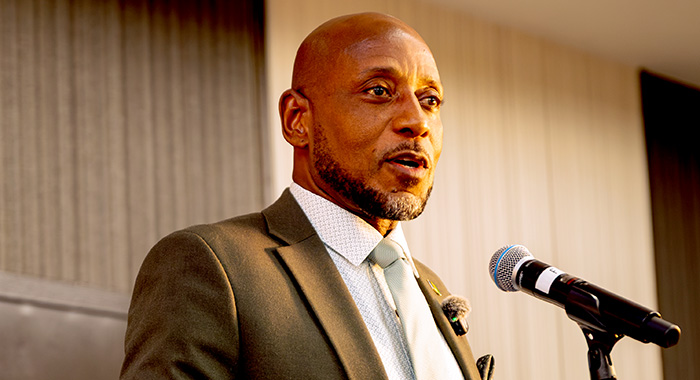
At a diaspora-focused investment gathering held Saturday in New York City, Dwight Fitzgerald Bramble, St. Vincent and the Grenadines’ Minister of Foreign Affairs, Foreign Trade, Foreign Investment and Diaspora Affairs, positioned the nation’s global Vincentian community as indispensable central partners, not distant peripheral supporters, in the push to build a more resilient, inclusive domestic economy.
The event, themed “Reconnect, Reinvest, Rebuild: Turning Vincentian Global Success into Local Opportunity”, framed Bramble’s address, which opened with a straightforward acknowledgment of the decades-long history of Vincentian migration. Many who left St. Vincent and the Grenadines (SVG) carried little more than a suitcase of belongings, a store of hope, and the well-wishes of loved ones, building new lives in the United States and other nations. Despite the challenges of resettlement, these migrants persevered, growing into successful homeowners, industry professionals, entrepreneurs, and community leaders — all while holding tight to their Vincentian identity, passing down cultural traditions, food, language, and values to generations born abroad, Bramble noted.
But today’s economic and social context demands more than nostalgic connection to homeland, Bramble argued. For the SVG government, meaningful reconnection requires building active, structured, long-term engagement between the national government and the global Vincentian diaspora. To advance this goal, his ministry is expanding the mandate of its dedicated diaspora desk and the nation’s global diplomatic missions: to center the concerns and ideas of overseas Vincentians, keep the community updated on domestic development opportunities, and streamline processes for investment, return migration, and collaborative projects. “You are not outsiders. You are Vincentians,” Bramble emphasized, adding that the nation’s foreign, trade, and investment policies will be updated to reflect this core reality.
Turning to the theme’s second pillar — reinvestment — Bramble acknowledged the deep emotional bond that ties most overseas Vincentians to their homeland, noting that the government values this connection deeply, but aims to translate that emotional loyalty into tangible enterprise and local opportunity. Contrary to common assumptions, he explained, reinvestment does not require large-scale capital commitments from diaspora members. Smaller actions, from a professional overseas partnering with a local SVG entrepreneur to scale their small business, to individual diaspora members mentoring young Vincentians via digital platforms, to groups of overseas Vincentians launching collective investment clubs focused on key domestic sectors including tourism, agriculture, technology, and renewable energy, all count as meaningful reinvestment. Bramble also highlighted the underutilized role diaspora members can play in connecting SVG products and services to global markets via trade missions and international business expos.
Against a backdrop of intensifying global competition for capital, skilled talent, and cutting-edge technology, Bramble noted that every small developing state is vying for these critical resources — but SVG holds a unique advantage: a global network of people already deeply invested in the nation’s success. The government’s core task, he said, is to align the diaspora’s existing goodwill with actionable, viable investment opportunities on the ground. To that end, the administration is working to streamline regulatory processes to improve the ease of doing business, identify bankable, high-impact projects across key sectors, strengthen investor support and aftercare services, and develop new frameworks to formally recognize diaspora investors as core development partners. “When you return to invest, we do not see you merely as ‘foreign investors’… We see you as members of our extended national family, coming home to help build the house,” Bramble said.
Addressing the third pillar of the event’s theme — rebuilding — Bramble reframed the concept not as an acknowledgment of SVG’s vulnerability, but as a declaration of the nation’s inherent resilience. Like other small island developing states, SVG sits on the frontlines of climate change impacts and volatile global economic shifts, and has faced significant hardship. But through decades of challenge, the nation has demonstrated consistent courage, creativity, and faith, Bramble said.
Any meaningful rebuilding effort must center on a clear vision for the future SVG economy: one that is more diversified to reduce vulnerability to external shocks, more inclusive to expand opportunities for women, young people, and rural communities, more innovative to leverage technology as a transformative driver of growth, and more sustainable to protect the nation’s iconic natural beauty and resources. In this economic transformation, Bramble positioned diaspora engagement as a central pillar of the national rebuilding agenda. The diverse skills diaspora members hold across engineering, medicine, finance, marketing, logistics, and digital technology, paired with their exposure to global best practices, can help modernize core domestic sectors, avoid costly developmental missteps, and accelerate access to emerging global opportunities, he explained.
Bramble was careful to clarify that the government is not asking overseas Vincentians to shoulder the full burden of national rebuilding. “When we say ‘rebuild,’ we are not asking you to come and do everything,” he said. “We are inviting you to partner with our people at home, with our businesses, our institutions, and our government, in a spirit of mutual respect and shared responsibility.”
Today, the Vincentian national story spans the globe, with thriving communities across New York, Toronto, London, Miami, and the wider Caribbean. Overseas Vincentians have succeeded in highly competitive global environments, gained hard-won professional experience, built robust global networks, and earned strong reputations in their fields. The critical question now, Bramble argued, is how to convert this global success into concrete opportunity for communities back home. This work begins with conversations like the New York gathering, but must quickly move to formal collaboration and shared commitment, he said.
Bramble pledged that over the coming months and years, his ministry, working in lockstep with other government agencies, will develop clearer, more accessible pathways for diaspora investment and business partnership. The administration will also expand cross-border knowledge exchange programs that connect diaspora experts with domestic counterparts for training and advisory support, grow youth-focused initiatives that pair young Vincentians with mentors living abroad, and create formal programs to celebrate and recognize outstanding contributions from the diaspora — a move designed both to honor existing work and signal to the wider global community that engagement with SVG is meaningful and valued.
“We want you to see St. Vincent and the Grenadines not only as the place of your birth or heritage,” Bramble said, “but as a serious place to do business, to innovate, and to make a difference.”
Closing with a personal reflection, Bramble reminded attendees that each person in the room carried a unique journey: one that led them from a small Caribbean nation to one of the world’s great global cities. These community members know firsthand what it means to build something meaningful from humble beginnings, to make sacrifice for long-term gain, and to hold fast to hope even through challenge. “Imagine what we can achieve if we align your experience, your resources, and your vision with the aspirations of our people at home,” he said. “Imagine a St. Vincent and the Grenadines where a talented young person, instead of feeling that they must leave to succeed, feels that they can also return, or stay, and thrive — because the diaspora has helped to open up new paths. That is the essence of our theme: to reconnect hearts and minds; to reinvest resources and knowledge; to rebuild a stronger, more inclusive, more resilient St. Vincent and the Grenadines.”