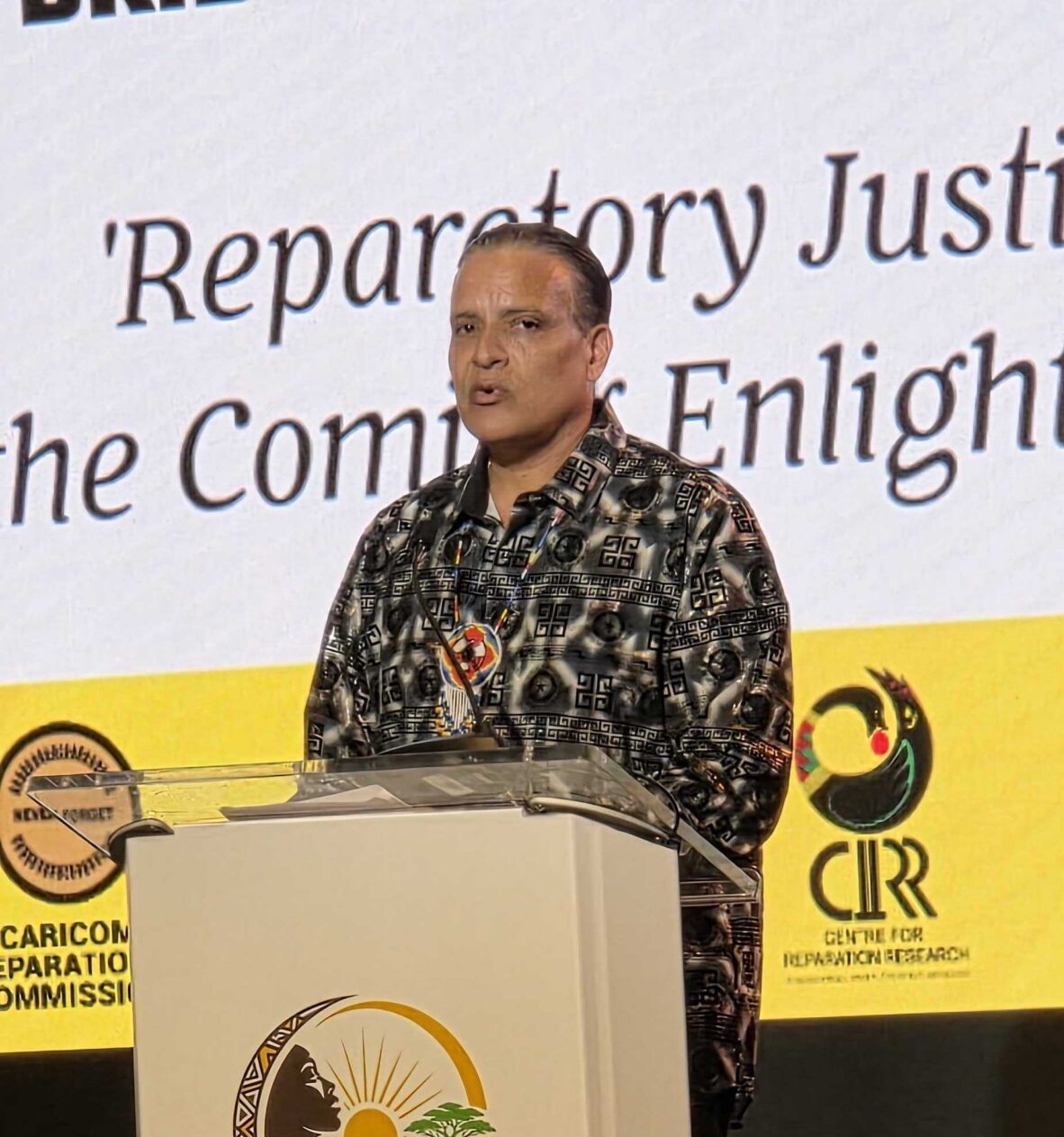
At the opening of the third international reparations conference hosted under the Caribbean Community (CARICOM) initiative, a top Caribbean indigenous leader has issued a urgent call: indigenous communities must occupy a core, central role in the region’s fight for reparations for colonial crimes, rather than being sidelined as an afterthought in political and public relations processes.
Delivering the address on behalf of Ricardo Bharath Hernandez, chair of the Caribbean Organisation of Indigenous Peoples (COIP), Damon Gerard Corrie—Taíno Chief, leader of the Barbados Chapter of the United Confederation of Taíno People, and co-president of the Caribbean Amerindian Development Organisation—brought the collective demands of the region’s original inhabitants to the gathering. The conference itself forms a key part of CARICOM’s long-running campaign to secure reparations for two interconnected crimes of colonialism: the transatlantic trafficking and enslavement of African peoples, and the systematic genocide of the Caribbean’s native populations that followed European invasion in the 15th and 16th centuries.
Corrie framed the push for historical reparatory justice as a unified struggle, linking the experiences of indigenous survivors and the descendants of enslaved Africans. He opened his remarks by acknowledging the ancestral nature of the land hosting the conference, paying homage to indigenous ancestors who built the Caribbean’s first thriving civilizations before European arrival.
The devastating toll of European conquest cannot be overstated, Corrie emphasized. Invasion brought systemic violence, forced displacement, chattel enslavement, widespread disease, and the complete destruction of indigenous political and social structures, triggering catastrophic population collapse across the Caribbean and neighboring Guyana. While indigenous communities and their descendants survived centuries of oppression, many continue to face systemic marginalization today: insecure land tenure, lack of formal recognition for customary territorial claims, exclusion from consultation for extractive industry projects on traditional lands, and unequal access to basic public services. In Guyana, these struggles remain particularly acute, tied directly to ongoing conflicts over mining access and control of ancestral territories.
Corrie paid tribute to the traditional indigenous chiefs, or Kaikhs, who led centuries of resistance against colonial violence, pushing back against efforts to erase the realities of the atrocities that accompanied European contact. He linked historical genocide to the intergenerational trauma that continues to shape indigenous communities today. “Many of our peoples were utterly destroyed in genocidal warmongering launched by Christopher Columbus and the European colonizers who followed him,” Corrie said. “The unimaginable horrors our ancestors suffered throughout the centuries still linger in us. We are their descendants, carrying unresolved intergenerational trauma. Standing together with our African brothers and sisters, we unite in demanding reparatory justice, for we are all the living evidence of the greatest crime in recorded human history.”
The conference’s focus on reparatory justice must act as a active call to action, not just symbolic rhetoric, Corrie argued. While he praised CARICOM for its consistent political and financial support for the CARICOM Reparations Commission (CRC) since the body was established in 2013—positioning the regional bloc on the right side of history, he noted—he issued a sharp caution to national governments: indigenous leaders must not be reduced to window dressing for public relations campaigns.
“Reparations must start in the territories of the indigenous survivors,” Corrie stressed. “Please do not merely invite us into the process as a public relations afterthought.”
Corrie also challenged widespread historical misconceptions about indigenous enslavement, pointing out that Amerindian peoples were not only the first populations subjected to chattel slavery in the Western Hemisphere, but also among the last. He highlighted the system of forced indigenous labor on European rubber plantations in the Amazon’s Putumayo province, which continued well into the 20th century, only ending in 1926.
Despite the existence of international frameworks designed to protect indigenous rights, Corrie noted that indigenous voices across the Caribbean remain systematically suppressed, leaving communities marginalized and disproportionately landless. He called on CARICOM member states to fully implement International Labour Convention 169 and the 2007 American Declaration on the Rights of Indigenous Peoples as mandatory minimum standards for governance of indigenous affairs.
“Survivors of these crimes against humanity remain traumatized, often landless, and are the most marginalized social group within the region,” Corrie said. “We submit that despite international declarations, the indigenous voice remains largely ignored, and more often than we want to believe, aggressively suppressed.”
As CARICOM prepares to relaunch its revised 10-point reparations plan, Corrie called for a dedicated indigenous peoples development program to be fully integrated into every level of the regional strategy. Such investment, he said, is essential to address centuries of systemic neglect and create conditions for indigenous communities to thrive. He also appealed to regional governments to launch public education and advocacy campaigns to build broad public support for the reparations cause across Caribbean society.
“We call on CARICOM governments, who are charged with the responsibility to initiate reparatory justice programmes, to educate, motivate, and inspire the people of our collective and united Caribbean civilisation,” Corrie said. “We must ensure that present and future generations realise the full benefit from the human efforts being made on their behalf.”
To contextualize the ongoing struggle, the Taíno—an Arawakan-speaking indigenous group—migrated to the Caribbean from northern South America more than 2,000 years ago. By the time of European contact, Taíno communities were the dominant population across the Greater Antilles, the Bahamas, and parts of the northern Lesser Antilles, building settled, complex societies centered on cassava cultivation, fishing, trade, craft production, and traditional chiefly governance.
Barbados, the host of this year’s conference, sits at the eastern edge of the historical indigenous Caribbean world. Archaeological evidence documents successive waves of Amerindian settlement across the island, from Chancery Lane in Christ Church to Heywoods in St Peter, with remains of Saladoid, Troumassoid, and later Suazoid cultural traditions. Historians and archaeologists note that pre-colonial Barbados had its own distinct, evolving cultural patterns, so the island cannot be simplified as solely a “Taíno island.” By the time English settlers colonized Barbados in 1627, no indigenous population remained on the island.