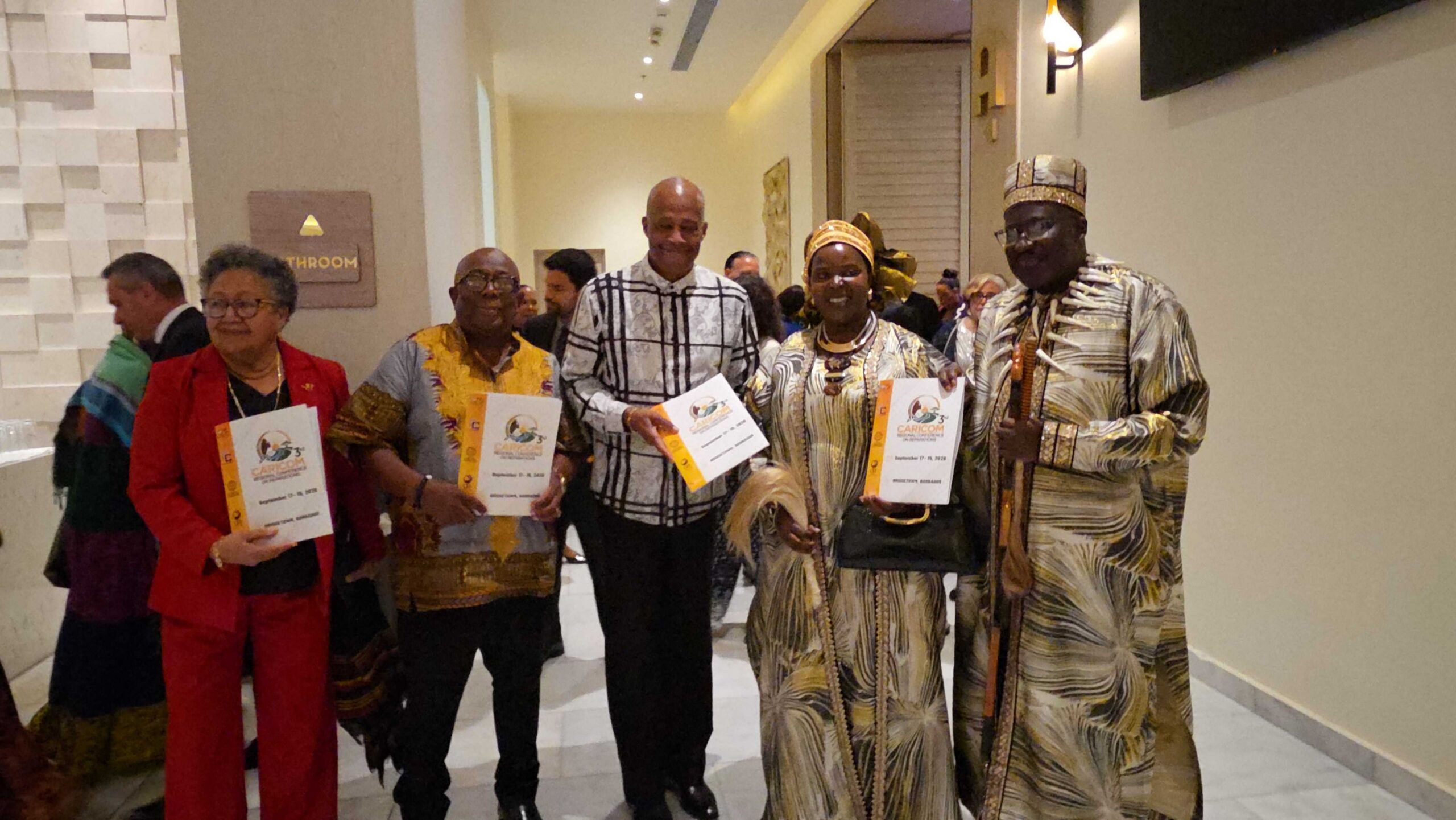
On Thursday evening, at the opening of the Third CARICOM Regional Conference on Reparations hosted at the Wyndham Grand Sam Lord’s Castle, Professor Sir Hilary Beckles, chair of the CARICOM Reparations Commission, made a landmark announcement: the Caribbean’s decades-long movement for reparatory justice has reached its final stage, with the current generation fully committed to securing what they frame as full and irreversible justice for centuries of systemic harm.
A leading historian of Caribbean slavery and colonialism, Beckles framed the current push for reparations not as a narrow regional grievance over historical injustice, but as a global moral imperative that will shape the future of equity and human rights for all peoples. He contextualized the modern campaign as the fifth major “eruption” of reparations organizing across Caribbean history, tracing earlier waves of resistance back to the era of chattel slavery itself.
Previous efforts, from enslaved people demanding compensation for stolen labor to post-Emancipation petitions for land redistribution, were either violently suppressed or allowed to fade into inaction over generations, Beckles explained. But this moment marks a permanent shift, he told assembled delegates. “This century is going to be the century of impartial justice,” he said. “Historically the reparations debate crescendoed, declined, crescendoed and declined. We are now in the fifth wave, and our position is this is it. There will be no other rise and fall. This is the final eruption of this movement, and we are not going to retreat and let it go into a slumber for the next generation.”
Beckles grounded the regional claim for reparations in the unique and unprecedented harm European colonial powers inflicted on the Caribbean. He emphasized that chattel slavery, the legal system that classified human beings as transferable non-human property, was invented in the Caribbean as an economic tool of mass extraction. “It was the first time in human history that an ethnic group of people, racially identified, were classified in law as property, as non-human,” he noted. “No other race on this planet has ever been classified in law as non-human property, chattel, and real estate.”
Citing demographic data from two major former slaveholding colonies, Barbados and Jamaica, Beckles argued that the system amounted to deliberate genocide. Over the centuries of slavery, more than 600,000 enslaved Africans were trafficked to Barbados, but by the formal abolition of slavery in 1834, only 83,000 remained alive—a survival rate of less than 20 percent. In Jamaica, the toll was equally staggering: 1.5 million trafficked Africans left a population of just 300,000 at Emancipation. “How do you reduce 600,000 people over 200 years to 83,000? That is also a definition of genocide,” Beckles said. “So we need to understand it was not only chattel slavery, but genocide. Why? Because it was opportunity — you burn it up, you use it, and you replace it.”
He also detailed the systematic eradication of the Caribbean’s Indigenous populations, noting that by the time British forces claimed Barbados in 1655, earlier Spanish and Portuguese raids had already depopulated the island’s entire network of Indigenous villages.
The revised 10-point reparations plan unveiled at the conference is the product of 10 years of public consultation, academic analysis, and empirical review. One of the most significant updates, Beckles explained, is the explicit centering of the gender-specific violence and exploitation endured by enslaved Black women. “Chattel slavery was an institution that was built on the existence of Black women,” he said. “The laws of slavery were built around and framed around centering the Black woman as the seed of slavery. It was her womb that was enslaved. It was the enslavement of the Black woman that enabled slavery to go from generation to generation because the laws were clear: only an enslaved woman can give birth to a slave child.”
This system of reproductive exploitation created a persistent demographic shift: Barbados became the first society in the Western Hemisphere where women outnumbered men, a majority status that has endured for more than 300 years. “We can no longer speak about slavery in generic, neutral terms,” Beckles argued. “The experiences of Black women were fundamentally different from those of men.”
Beyond addressing historical atrocities, the updated plan reframes the reparations movement through a universal moral lens rooted in the African philosophy of Ubuntu—”I am because we are.” Beckles stressed that the Caribbean’s fight for reparations carries a broader global responsibility: to entrench global equity and prevent the systematic degradation of any marginalized group in the future. “We have a higher responsibility to the world,” he said. “We are not struggling for reparatory justice only because of our personal ethnic situation; we have a duty to humanity. Justice for us, security for humanity — that is the framework.”
Beckles pointed to a recent United Nations General Assembly resolution as proof that the global community has already validated the historical and moral case for reparations. On March 25, 123 UN member states voted in favor of a resolution classifying the transatlantic slave trade as the “gravest crime against humanity.” For Beckles, this vote means the foundational work has been completed, and it is time for formal negotiations with European powers that built their wealth on Caribbean slavery. “The case for reparatory justice has been made,” he declared. “The United Nations is the court; they have said the case is made, the guilt is clear, the responsibility is clear. Let the negotiations begin.”
Following Beckles’ opening address, Jasmine Mickens, director of the Global Africa Reparations and Restitution Fund and master of ceremonies for the conference, praised the CARICOM campaign as the most significant political movement of the 21st century. “Movements require both political imagination and unapologetic intellectual leadership, which Professor Beckles has always provided,” Mickens said. “Reparations is a conversation about the imagination of new worlds. It is a project of both preserving memory, but also deciding whose version of the future do we want to live in.”