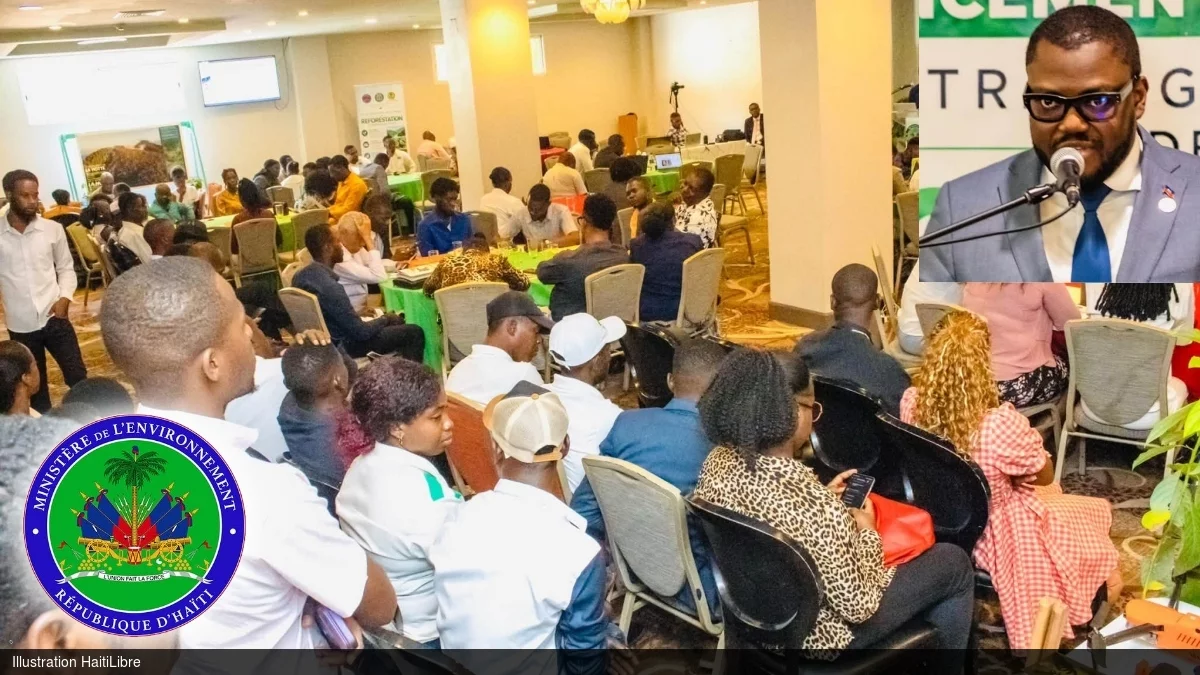
On September 17, 2026, Haiti’s Ministry of Environment, led by Minister Valéry Fils-Aimé and implemented through the country’s Directorate of Forests and Renewable Energy (DFER), officially inaugurated the National Community Reforestation Strategy – a landmark national initiative designed to reverse decades of landscape degradation while tying ecological restoration to inclusive local economic development. The launch ceremony brought together multiple cabinet ministers, senior representatives from public agencies, private sector stakeholders, environmental nonprofits, and international development partners, with Haiti’s Minister of Agriculture Marcelin Aubourg addressing attendees remotely via pre-recorded video. At the core of the new strategy is a paradigm shift: moving beyond short-term, cost-centered environmental action to build a long-term, productive “restoration economy” that directly benefits marginalized groups including young people, women, and rural smallholder producers. Minister Fils-Aimé emphasized this shift in opening remarks, noting that natural resource protection should not be treated as a purely charitable expenditure, but as an investment that generates shared, sustainable economic opportunity for the local communities that steward these resources. In addition to outlining the strategy’s core vision, Minister Fils-Aimé also announced an upcoming collaborative initiative with the Ministry of Interior to develop a network of new communal forests across underutilized state-owned land. Speaking from his remote address, Minister Aubourg stressed that successful reforestation cannot be reduced to a one-off tree-planting exercise. Instead, he argued, it requires a holistic territorial approach that integrates watershed management, soil regeneration, expanded vegetation cover, and the scaling of climate-smart agroforestry practices. This approach, he added, depends on far stronger coordination between national public institutions, local municipal governments, rural communities, and development partners to avoid fragmented, ineffective interventions. Aubourg also highlighted the critical need to center smallholder farmers in decision-making, including their input on selecting which landscapes to prioritize and which tree and crop species to plant, to align projects with local ecological conditions, agricultural needs, and economic goals. DFER Director Agr. Eder Audate followed with a detailed presentation of the strategy’s full framework, laying out its overarching vision, core objectives, strategic priority areas, expected outcomes, and on-the-ground implementation mechanisms. Audate outlined the guiding principles that will shape the strategy’s rollout: local community ownership and governance, selection of ecologically appropriate native and useful species, integration of agroforestry to support local livelihoods, delivery of direct economic benefits to participating communities, and ongoing rigorous monitoring and evaluation of all interventions. The strategy sets out bold, measurable targets to be achieved by 2031: restore more than 50,000 hectares of severely degraded landscapes across Haiti, establish or strengthen 100 community-run tree nurseries distributed across all 10 of the country’s departments, directly engage more than 50,000 rural households in implementation, and create or support more than 10,000 full-time green jobs. Beyond landscape and economic goals, the strategy also includes provisions to strengthen long-term monitoring of all restored areas. This monitoring work will improve outcome tracking, increase transparency around intervention activities, and document the strategy’s contributions to Haiti’s national climate change and environmental protection commitments made under international agreements. Joseph Emmanuel Philippe, Coordinator of the Technical Secretariat of the General Directorate of the Ministry of Environment, closed the ceremony by issuing a call to action, urging technical and financial partners, environmental organizations, private sector businesses, academic and scientific institutions, and all relevant stakeholders to join in supporting the strategy’s national rollout. The initiative already receives core support from three major international development actors: the United Nations Development Programme (UNDP), the Food and Agriculture Organization of the United Nations (FAO), and Heifer International. For Haiti’s Ministry of Environment, the strategy represents a unified effort to align public, community-led, and partner interventions around a shared national ambition: restore degraded ecosystems, strengthen the climate and economic resilience of rural communities, and position large-scale ecological restoration as a sustained driver of inclusive economic opportunity across the country.