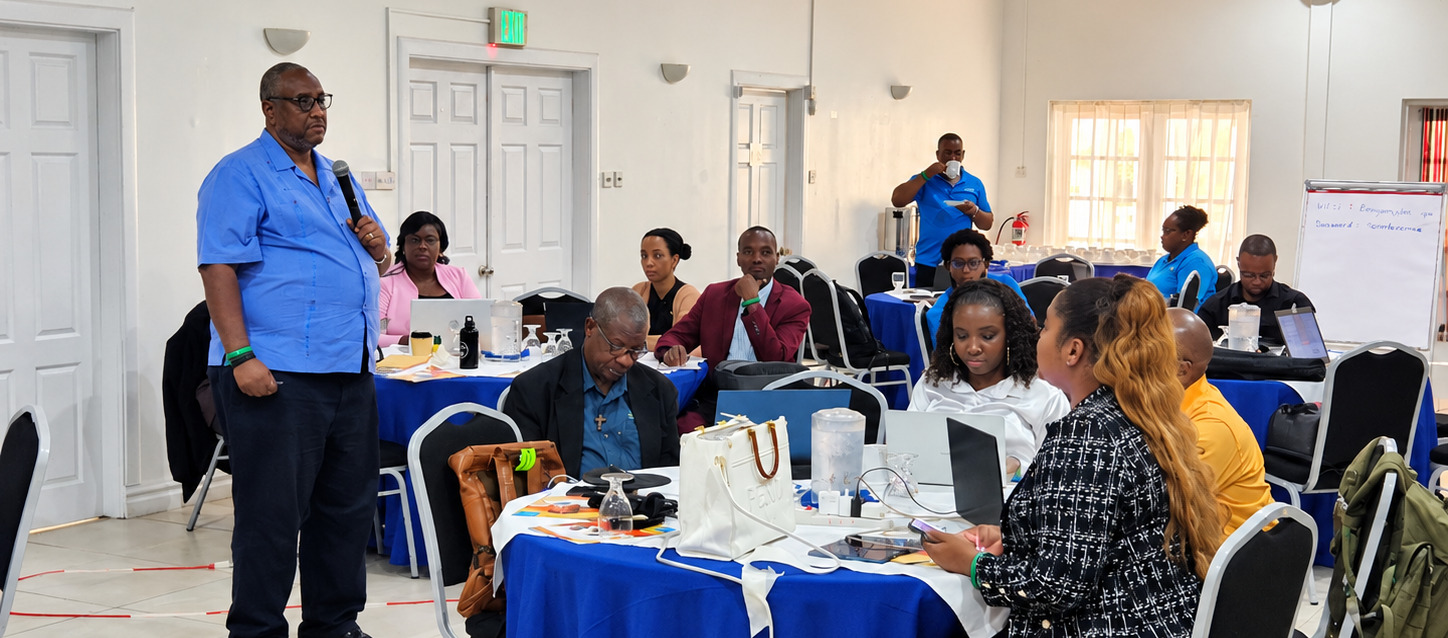
As climate change intensifies the frequency and severity of natural disasters across the Caribbean, a landmark two-day regional training workshop held in Saint Lucia has called on local journalists to rethink long-held disaster reporting practices, shifting the focus from breaking speed to ethical protection of at-risk populations, particularly children.
Organized with support from regional humanitarian and development partners, the workshop brought together 17 journalists and information officers from eight Caribbean nations: Antigua and Barbuda, Barbados, Dominica, Grenada, St Kitts and Nevis, Saint Lucia, St Vincent and the Grenadines, and Trinidad and Tobago. The training concluded on Thursday, designed to address a long-overlooked gap in responsible disaster coverage.
Julius Gittens, a veteran Caribbean journalist and principal consultant of Herald Media Partners Limited who facilitated the workshop, opened the gathering by challenging the core narrative that has guided newsroom disaster coverage for decades. He emphasized that disasters are not just newsworthy events to be claimed by the fastest outlet—they are human crises that demand respect for the rights, dignity, and privacy of the people affected. This responsibility, he stressed, carries extra weight when reporting on children, who are disproportionately harmed by disasters and uniquely vulnerable to traumatic re-exposure through irresponsible media coverage.
“Disasters are not merely events to be covered. They involve very vulnerable groups,” Gittens said during the workshop. “In the case that has brought us here for this workshop, children, they have a right to the protection of their persons. They have a right to dignity and, in particular circumstances, they certainly have a right to privacy.”
Gittens outlined core principles for ethical reporting, arguing that all decisions around interviewing child survivors, obtaining informed consent, and sharing traumatic experiences must prioritize the child’s well-being, not a media outlet’s audience or scoop. “We are mindful of operating always in the best interest of the child, not in the best interest of the media house,” he told local outlet Barbados TODAY in an interview after the workshop.
Beyond child protection, Gittens also pushed back against the long-standing newsroom culture that prioritizes being the first to publish a story during emergencies. In the chaotic aftermath of a disaster, when access to affected areas is limited and accurate information is critical for survival, rescue, and recovery, Gittens argued that credibility and shared access matter far more than speed. “It is not important to be first or to be the only media house covering that story. It’s important that everyone has access to that information and that that information is credible,” he said.
He also noted that professional journalists now work in a fragmented media landscape where misinformation and deliberate disinformation spread rapidly across unregulated social media platforms. A common tactic bad actors use, he explained, is recycling old images from past disasters to inflate current damage and spread panic. In response, the workshop provided participating journalists with hands-on training in tools and techniques to verify user-generated content and information submitted by members of the public before publication.
Many participants left the training with a new perspective on gaps in their own past disaster reporting. Demion McTair, a veteran disaster reporter and founder of St Vincent-based One News, who covered events including 2024’s Hurricane Beryl, shared that he had long avoided including children in his coverage out of uncertainty about how to approach them ethically. “Most of my coverage didn’t include children because I didn’t really know how to cover them,” McTair told Barbados TODAY. “This workshop opened my eyes as to how many things we miss when we don’t cover children, and children are some of the most impacted people in the aftermath of disasters.”
McTair added that the training also raised his awareness of how small editorial choices, such as the angle of a photograph of a child survivor, can shape harmful public perceptions and harm the child long after the disaster ends. He recommended that similar specialized training be extended to photojournalists, who often make critical on-the-ground decisions about representing vulnerable survivors.
Seigonie Mohammed, Climate Change Editor at Trinidad and Tobago’s CNC3, echoed McTair’s feedback, noting that the workshop pushed participants to strike a better balance between the public’s right to information and the moral obligation to protect the most vulnerable survivors. “It really does push us to be better journalists and be better for the people that we serve and give them the information that they need while protecting those that we need to protect the most,” she said.
Keith Goddard, Communications and Public Relations Specialist at the Caribbean Disaster Emergency Management Agency (CDEMA), praised the high level of engagement from participating journalists, who brought candid perspectives on gaps in collaboration between media and humanitarian organizations during emergencies. The discussions, Goddard said, provided responding agencies with valuable feedback on what support journalists need from humanitarian groups to do their work effectively during crises.
Looking ahead, Goddard said the next critical step is to expand the training to newsroom leadership, as editors and managers ultimately make the final calls on what coverage gets published and what editorial standards are enforced. “We need to begin to take this information or take this training forward, focus more on the editors and managers of the newsroom,” he said.
Clive Murray, UNICEF’s Climate, Environment, Energy and Disaster Risk Reduction Specialist for the region, described the workshop as “very engaging and thought-provoking,” particularly its focus on balancing timely public information with ethical reporting that protects child survivors’ rights. Murray added that UNICEF was encouraged by the strong interest journalists showed in the organization’s research on climate change’s impacts on the region, which was presented on the workshop’s first day, and the subsequent cross-regional media coverage of those findings.
“We look forward to continuing the engagement and strengthening the partnership with the media on important matters such as climate change impacts on children, young people and families across the region,” Murray said.