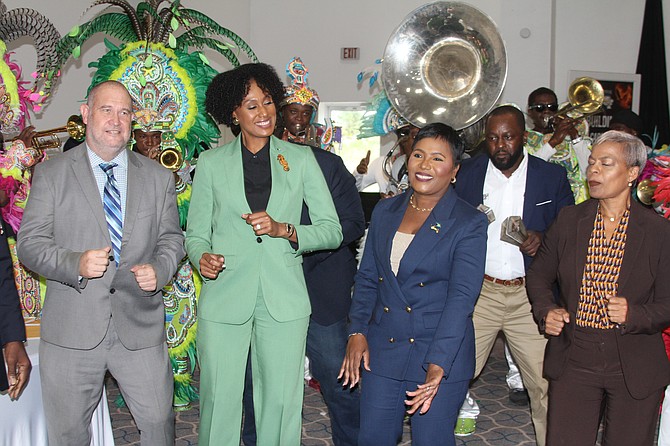
The recently established National Junkanoo Authority has announced a substantial increase in seed funding for Grand Bahama-based Junkanoo groups ahead of the 2026/2027 parade season, injecting more than $100,000 into the iconic cultural celebration while acknowledging that full funding parity with larger New Providence groups has not yet been achieved.
At an official contract signing ceremony held at Kingdom Worship Center, the authority formalized agreements with 10 competing groups set to participate in this year’s Explorer’s Way parade. The roster of contracted groups includes five top-tier A Groups, four B Groups, and one community-focused Fun Group. Most notably, the base funding for A Groups has been raised by $3,000, growing from the previous allocation of $12,000 to $15,000 per group, driving the overall increase in total regional funding.
National Junkanoo Authority Chairman Dr. Christopher Curry emphasized that the funding bump is an intentional step to address longstanding funding gaps between New Providence and out-island Junkanoo communities. The organization’s core mission, he explained, is to work toward full parity and build a more equitable distribution of seed funding across all participating groups across the country. Even so, Dr. Curry confirmed in response to reporter questions that Grand Bahama groups still do not receive the same level of funding as the largest Junkanoo collectives based in Nassau.
The increased investment has been broadly welcomed by Junkanoo group leaders, who have long described the steep cost of parade participation as a persistent financial burden that has forced organizers and members to cover preparation costs out of their own pockets for years. Chauncey Gray, leader of the Superstar Rockers – the 2025 parade’s winning group – called the creation of the National Junkanoo Authority a win that groups have advocated for over many years.
“It is something we had been asking for,” Gray noted. “It’s taxing on the leaders to have to go out there and look for funding. And so, with the Authority it is going to help out a lot with the funding.” Gray added that the constant financial strain has directly contributed to declining membership across Grand Bahama’s Junkanoo community, as many participants can no longer afford to contribute personal funds to put on the parade. “We need for the members in the groups to stop digging in their pockets to put the parade on,” he said. “So more people now will get involved because we lose a lot of people every year because people just can’t find the funding and Junkanoo is very expensive. This is a move in the right direction, and we all welcome it with open arms.”
Thomas Curry, leader of the Platinum Knights Junkanoo Group, echoed that sentiment, calling the additional funding “a step in the right direction.” Curry shared that his group had already spent four months preparing for the upcoming parade using personal funds from members, as they did not wait for delayed government funding to get started. He welcomed the $3,000 funding increase and shared his hope that full parity with Nassau-based groups will be achieved in coming years.
Addressing concerns about the delayed timing of this year’s funding distribution, Dr. Curry explained that the authority only held its inaugural board meeting roughly four weeks ago, and a more structured, predictable funding timeline will be implemented for future seasons. With contracts now finalized, he said groups can move forward full steam with preparations, including advancing the construction of elaborate parade costumes and performance pieces in their workshops.
The contract signing ceremony also marked the official launch of the 2026/2027 Junkanoo season on Grand Bahama. Leslia Miller-Brice, Minister of Culture, Arts and Heritage, said her ministry centered stakeholder input in its work, starting with listening sessions with group leaders to gather data on group sustainability and the condition of workshop spaces, ensuring government policy is tailored to the actual needs of the Junkanoo community. She laid out five core commitments for the authority’s first term: “to listen, to protect, to professionalize, to expand, and to empower.”
These commitments include formal protection of Junkanoo shacks as dedicated creative centers, expanding Junkanoo programming beyond the traditional single annual parade season, and empowering the multigenerational stewards who have kept the cultural tradition alive. Miller-Brice emphasized that Grand Bahama has a distinct Junkanoo identity separate from Nassau’s traditional Boxing Day and New Year’s Day celebrations, noting “Grand Bahama has its own sound, its own talent, its own Junkanoo story, and its own stage.”
Ginger Moxey, Minister for Grand Bahama, praised the Grand Bahama Junkanoo community for its resilience in keeping the tradition alive through repeated hurricane damage and ongoing economic hardship. She added that the creation of the National Junkanoo Authority provides a critical formal regulatory and organizational framework to “protect, support, and advance” the beloved cultural tradition across the country.
Dr. Curry confirmed that the authority, which has only recently become fully operational, will continue holding listening sessions and consultations with Junkanoo groups across all islands as it refines its policies and long-term funding strategy.