On September 8, 2026, Cuban President Miguel Díaz-Canel Bermúdez, who also serves as First Secretary of the Central Committee of the Communist Party of Cuba, convened a high-level meeting at the Palace of the Revolution with more than 30 leaders of top-performing state-owned economic entities. The gathering centered on advancing the country’s sweeping 176-point economic and social transformation agenda, a reform package designed to level the playing field between state-owned enterprises and other economic actors across the island.
The meeting was co-led by other senior Cuban leadership, including Prime Minister Manuel Marrero Cruz, Vice President Salvador Valdés Mesa, Central Committee Organization Secretary Roberto Morales Ojeda, and Deputy Prime Minister Inés María Chapman Waugh. Moderated by Roberto Ricardo Marrero, head of the National Institute of State Business Assets, the discussion offered space for participating business leaders to share on-the-ground results from early reform implementation, as well as to unpack existing strengths, emerging threats, and ongoing challenges facing the state-owned enterprise sector.
Multiple enterprise representatives highlighted tangible early progress from the reforms. Alberto Vicente Águila Abreus, general manager of the National Beekeeping Company, noted that working groups have tailored reform rollout to the specific needs of the beekeeping sector, with new flexible financing policies already enabling faster interim payments to primary producers. Wilson Ramírez Peña, president of the Agricultural Logistics Business Group (Gelma), which operates across most Cuban municipalities, acknowledged that the radical scope of the changes has sparked uncertainty among frontline workers, underscoring the critical need for ongoing open dialogue and experience-sharing to build broader buy-in.
Oscar Carvajal Serrano, general director of the Automotive Group under the Ministry of Transportation, reported that the new flexibilities have already put his sector on a strong financial footing. He confirmed that no subsidiary company will end 2026 with a loss, with projections for growth in both tax contributions and corporate profits. “Our companies now face no structural barriers to progress, and we have the autonomy to resolve our own problems,” Carvajal Serrano said, adding that the reforms represent a critical long-term leap forward that will require sustained effort to deliver full results.
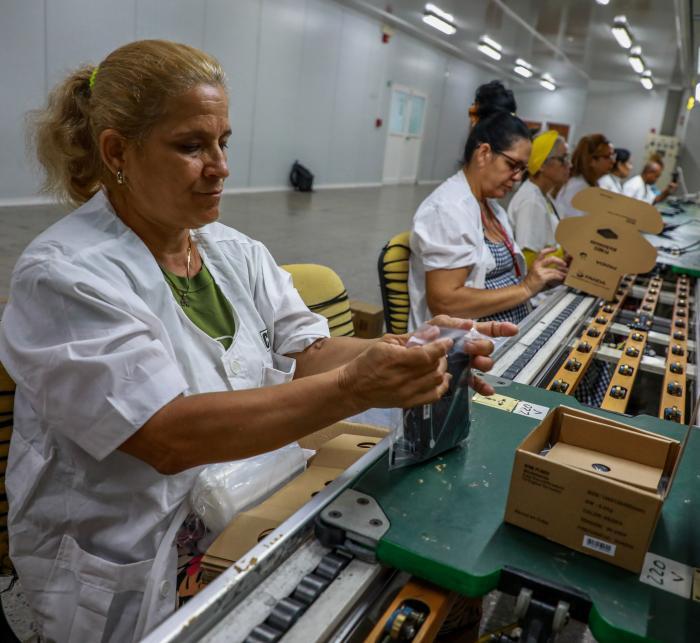
Leaders from other key sectors, including pharmaceutical giant Labiofam, the hydraulics industry, and the electronics sector, echoed these observations. Edel Gómez Gómez, general director of the Comandante Camilo Cienfuegos Electronic Industrial Company, emphasized that the reforms fulfill a longstanding demand of state-owned enterprises: equal operating status alongside non-state and private actors. “These changes remove long-standing bureaucratic obstacles and barriers, allowing us to move faster to generate the wealth our country needs right now,” Gómez Gómez explained.
In closing remarks, President Díaz-Canel noted that the meeting followed a similar gathering just days earlier with representatives of Cuba’s non-state business sector, and that regular cross-sector meetings will continue moving forward. Future discussions will include leaders from state-owned, non-state, and cooperative business segments, with the goal of integrating all groups into a unified national business system aligned with Cuba’s broader economic and social model.
Díaz-Canel explained that a large share of the 176 transformation measures, which are organized into 23 thematic areas, already have full legal backing through new regulations and laws published in the Official Gazette. However, he urged enterprises not to wait for final regulatory approval to begin designing their own local implementation strategies, noting that dozens of the most proactive pioneering companies have already developed their roadmaps and are well-positioned to accelerate progress after taking early risks.
The president stressed the urgent need to update outdated leadership and management styles across the state sector, emphasizing that all reform efforts must center on frontline worker participation. He highlighted two key priorities for the remainder of 2026: company-level debates on the 176 transformations, and collaborative development of the 2027 national economic plan. “If workers do not embrace the transformations, there will be no transformation,” Díaz-Canel said, noting that reform is an iterative process that should welcome worker suggestions and course corrections identified by on-the-ground teams. For the 2027 plan, he added, priorities should emerge directly from worker input, reflecting the new autonomy granted to state enterprises.
He also pushed back against a common misperception among some local leaders that the reforms are primarily focused on immediate salary increases, reminding attendees that sustainable wage growth depends entirely on increased productivity and domestic wealth creation.
Framing the socialist state-owned enterprise system as Cuba’s core economic actor, Díaz-Canel reaffirmed the government and party’s full confidence in the sector’s ability to lead national economic recovery amid ongoing external economic pressure. “We must build productive sovereignty, strengthen connections between all economic actors, and leverage the national political will to help the state-owned enterprise system deliver on its promise to the Cuban people,” he stated.
The meeting ended with a collective call to action for sector leaders to embrace internal change and drive the reform agenda forward, cementing the role of state enterprises as the engine of Cuba’s ongoing economic evolution.