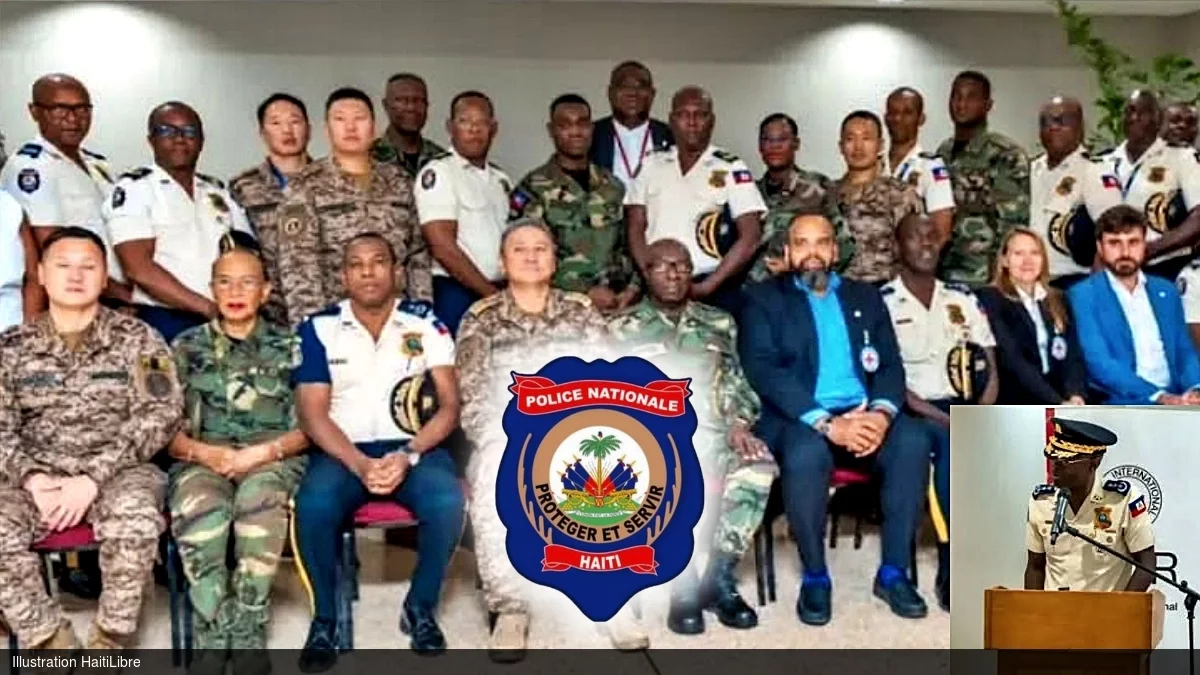
On September 16, 2026, senior security leaders from across Haiti gathered for the opening of a landmark inter-agency workshop focused on embedding international legal standards for the use of force into ongoing counter-gang security operations. Jointly organized for the Haitian National Police (PNH), the Armed Forces of Haiti (FAd’H), and the Gang Suppression Force (GSF), the event centered on aligning operational practices with the frameworks of International Human Rights Law (IHRL) and International Humanitarian Law (IHL), with technical and logistical support from the International Committee of the Red Cross (ICRC) delegation in Haiti.
In his opening keynote address, Acting PNH Director General Vladimir Paraison opened by acknowledging the critical support the ICRC has provided to Haiti’s security sector, framing the workshop as a strategically vital initiative for upholding the legitimacy of Haiti’s ongoing campaign to stabilize the country.
Paraison acknowledged that Haiti currently faces one of the most complex security crises in its modern history, noting that PNH, alongside military and GSF partners, has been waging an unremitting ground campaign to reestablish public order and protect vulnerable civilian communities from widespread gang violence. He emphasized that while courage and resolve remain foundational to these operations, the unique complexity of Haiti’s current security landscape demands more than just tactical skill: it requires coordinated, shared adherence to clear legal standards governing when and how force may be used.
Whether security operations fall under public order mandates governed by IHRL, or fall into hostile contexts where IHL applies as a complement to human rights frameworks, Paraison stressed that the core guiding principle must remain unchanged: all operations must prioritize upholding the rule of law and protecting innocent civilian populations. Frontline commanders, operational planners, and intervention teams confront high-stakes tactical decisions every day, he noted, making it essential that abstract legal principles are translated into instinctive, consistent operational practices — the core goal of the workshop.
Outlining four non-negotiable pillars that all security personnel must follow when deploying armed force, Paraison made clear that arbitrary use of force has no place in Haiti’s security operations. The first pillar is legality: all actions must be carried out strictly within the bounds of national and international law. Second is necessity: force may only be used when no other alternative exists to address a given threat. Third is proportionality: the intensity of any security response must be directly calibrated to match the severity of the threat being confronted. The fourth and final pillar is precaution: all operations must be planned in advance to avoid or minimize collateral harm and injury to innocent civilians.
Paraison emphasized that the true institutional strength of Haiti’s republican security bodies — including PNH, FAd’H, and GSF — lies not in firepower alone, but in their ability to restore order while upholding exemplary respect for human rights. Contrary to arguments that legal constraints limit operational effectiveness, he noted that adherence to these standards actually boosts public trust in security institutions and reinforces the legitimacy of their work, a key factor in long-term stabilization.
Addressing participating officers from all three security bodies, Paraison called on attendees to engage fully with the workshop’s programming, which includes hands-on case studies, tactical simulations, and interactive cross-agency discussions. He urged participants to openly identify on-the-ground operational challenges, assess gaps in existing training, and develop concrete actionable proposals to update Haiti’s security doctrine and guide future operations. Attendees were selected specifically for their role as key intermediaries within their respective command structures, putting them in a position to disseminate new standards across the broader security force.
Concluding his address, Paraison expressed hope that this inter-institutional forum, established with ICRC support, will become a permanent platform for aligning operational practices and strengthening Haiti’s security sector. He closed by affirming that through shared commitment to the rule of law and professional rigor, Haiti’s security forces will succeed in restoring lasting peace and security for all Haitian citizens.