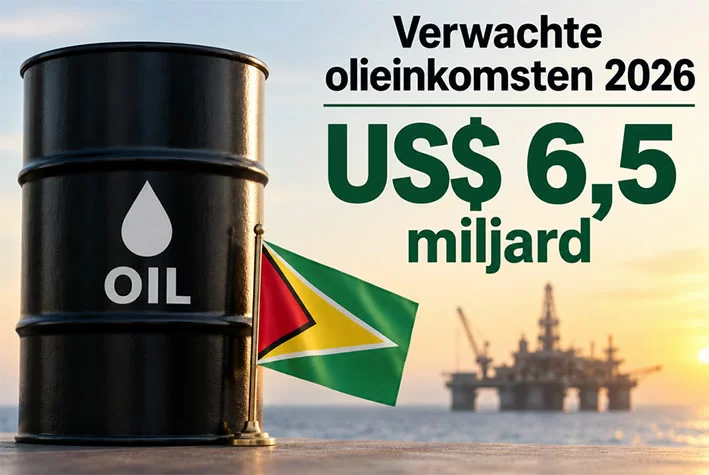
South American nation Guyana has drastically upgraded its 2026 petroleum revenue projection, now expecting to draw in nearly $6.5 billion from oil and gas operations this year — a figure far higher than its initial budget estimate, according to the country’s 2026 Mid-Year Report. The sharp upward revision comes on the back of three key drivers: rapidly rising crude output, higher global benchmark oil prices, and an increased share of profit oil allocated to the Guyanese government. The updated forecast puts total annual petroleum receipts at $6.4976 billion, marking a 136.8% jump from the revenue assumption built into the country’s original 2026 national budget. Of the projected total, approximately $5.97 billion will come from sales of the government’s share of profit oil, with another $508.1 million generated from royalty payments.
The rapid expansion of Guyana’s oil sector is already evident in the country’s first-half trade and production data. Between January and June 2026, Guyana exported $15.05 billion worth of crude oil, an 82.1% year-on-year increase from the same period in 2025. Overall national export earnings rose 76.4% year-on-year to hit $16.2 billion in the first half, underscoring the outsized impact of oil growth on the country’s trade balance.
Production volumes have grown sharply as new floating production storage and offloading (FPSO) units come online at the Stabroek Block, Guyana’s core offshore oil development. In the first six months of 2026, total crude output reached 163.3 million barrels, up from 115.7 million barrels in the first half of 2025. That growth pushed average daily production from roughly 639,000 barrels per day (bpd) to more than 902,000 bpd. Export volumes climbed 40% year-on-year over the period, while the average realized oil price rose 28.9% compared to the first half of 2025, combining to drive explosive revenue gains.
Most of the production growth traces back to full operations of four FPSOs operating simultaneously across the Stabroek Block for the entire first half of 2026. The One Guyana FPSO, which began production in August 2025, is still ramping up output, and a fifth FPSO — the Errea Wittu — is on track to produce its first crude in the final quarter of 2026, laying the groundwork for further output expansion in coming quarters.
Another key factor behind the higher revenue forecast is a sharp increase in the number of profit oil cargoes the government expects to collect this year. Initial budget projections assumed 309 total oil cargoes from the Stabroek Block, of which just 40 would go to the Guyanese government. The updated estimate puts total cargoes at 326 for the full year, with the government now set to receive 84 of those cargoes, directly boosting revenue inflows.
As of the end of June, Guyana has already deposited roughly $2 billion in petroleum revenue into its sovereign Natural Resource Fund (NRF) in the first half of 2026. After $1.02 billion in withdrawals from the fund over the first six months, the NRF’s closing balance stood at $4.29 billion at the end of June.
The ongoing boom in Guyana’s oil sector continues to act as the primary engine driving the country’s extraordinary economic expansion. Real gross domestic product (GDP) grew an estimated 33.3% year-on-year in the first half of 2026, with even non-oil sectors posting robust double-digit growth of 10.1%. For the full year 2026, the country now projects overall economic growth of 20.8%, cementing its position as one of the fastest-growing economies in the world.