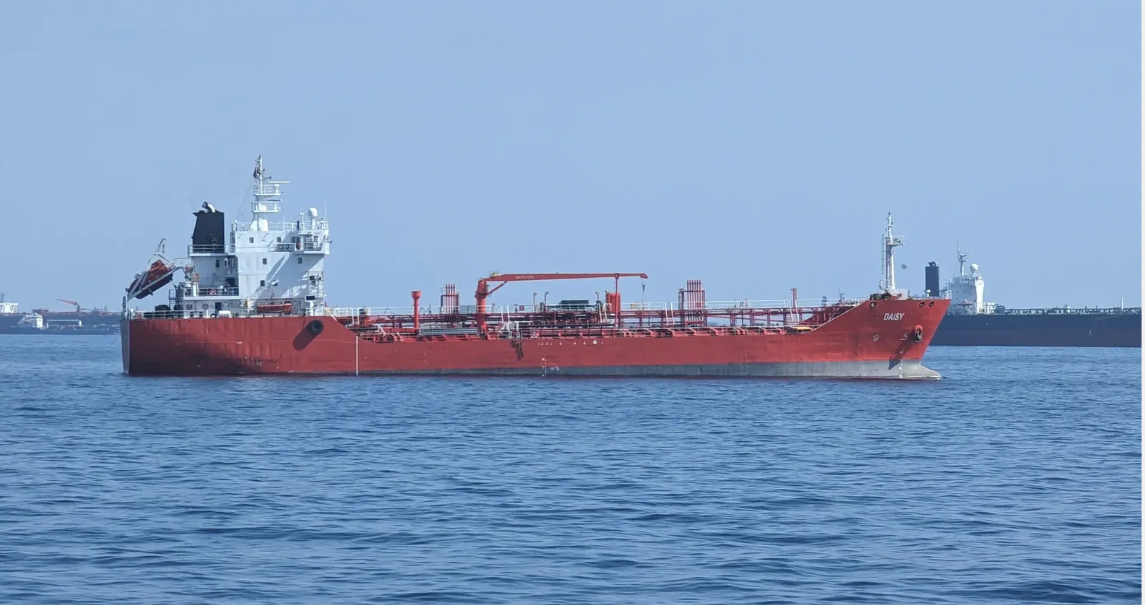
On August 5, 2026, a ballistic missile explosion took place just meters away from the oil tanker *Daisy*, a commercial vessel registered under the flag of the Commonwealth of Dominica, as it transited westward through the strategically vital Gulf of Aden. The Yemen-based Houthi movement quickly issued a statement claiming full responsibility for the strike, asserting their weapon had directly hit the tanker and forced it to reverse course. However, independent maritime accounts have painted a far more nuanced picture of what unfolded that afternoon.
Local time around 5:30 PM, the *Daisy*’s captain reported a deafening explosion in the immediate vicinity of the vessel, according to data from the United Kingdom Maritime Trade Operations (UKMTO). The regulatory body confirmed the blast’s shockwave caused only superficial damage to the hull, and all crew members emerged from the incident unharmed. Maritime security firm Vanguard Tech further clarified the explosion occurred roughly 40 meters off the tanker’s port side, placing the incident 95 nautical miles southeast of Aden, Yemen. To date, the Houthi claim of a direct missile hit and forced course reversal has not been verified by any independent third party.
While the *Daisy* was able to continue its scheduled voyage to Djibouti without further incident, the attack has sent ripples across global maritime and geopolitical circles, particularly for the small Caribbean island nation of Dominica. Thousands of kilometers removed from the Middle East conflict, Dominica maintains an open ship registry that places hundreds of commercial vessels under its flag, plying every major international trade route including the high-risk waters surrounding the Arabian Peninsula. The Gulf of Aden, which links the Indian Ocean to the Red Sea via the Bab el-Mandeb Strait, carries roughly 10 percent of global trade annually, making it one of the world’s most economically critical yet increasingly dangerous maritime corridors.
The incident gained new gravity more than a month later, when Human Rights Watch (HRW) released a formal assessment on September 15, 2026, concluding that recent Houthi attacks on commercial shipping in the region – including the strike on the *Daisy* – likely constitute war crimes under international humanitarian law. HRW researchers documented that the Houthi movement had knowledge, or should have had knowledge, that the *Daisy* and three other targeted vessels (the *Encelia*, *Tihamah*, and *Amzan*) were civilian commercial ships carrying non-military cargoes. The organization noted the Houthis have failed to produce any credible evidence to prove the vessels qualified as legitimate military targets, a requirement under international law for attacks on shipping in conflict zones.
“Deliberate or reckless attacks against civilian crews violate core principles of the laws of war, and can be prosecuted as war crimes,” explained Niku Jafarnia, HRW’s lead researcher on the case. The organization emphasized that while its legal assessment is authoritative, it does not equate to a formal judicial conviction; no international court has yet issued a ruling on the *Daisy* incident. HRW has also called on the Houthi movement to immediately halt all unlawful attacks on civilian shipping in the Red Sea and Gulf of Aden.
The strike on the *Daisy* comes as part of a marked escalation of Houthi attacks on commercial shipping in the region. In July 2026, the group announced a self-declared maritime embargo against Saudi Arabia, and claimed responsibility for at least nine separate attacks on vessels between July 20 and August 24, four of which have been confirmed by independent authorities. This expansion of attacks beyond the Houthi’s traditional Red Sea operating area has raised the risk profile for all civilian vessels transiting the region, regardless of their nationality or connection to the ongoing Middle East conflict.
For small island flag states like Dominica and other Caribbean nations, the incident has exposed a critical gap in global maritime security: how can vessels registered in states thousands of kilometers from conflict zones be protected when they transit high-risk international waters? Unlike military or large commercial fleets backed by major powers, most ships registered in small open registries lack armed escorts or dedicated security support, leaving them vulnerable to spillover from distant conflicts.
Though the *Daisy* escaped without casualties or major structural damage, the incident serves as a stark warning for the global shipping community. In an era of unprecedented interconnectedness, where a vessel can carry the flag of a Caribbean island and transit waters off the coast of Yemen, the ripple effects of regional conflict extend far beyond the borders of the states directly involved. What began as a close call for one tanker and its crew has now become a central case in the growing global debate over protecting civilian shipping amid rising geopolitical tensions.