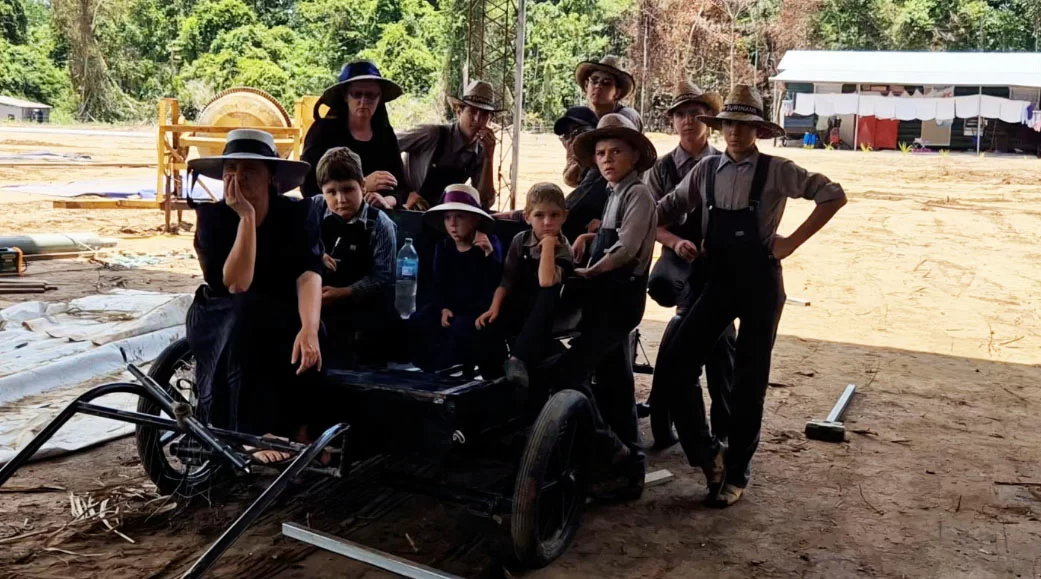
On a Monday visit to the Tibiti region of Suriname’s Para district, a delegation led by opposition NDP Members of Parliament Rabin Parmessar and Jennifer Vreedzaam, accompanied by journalists, security personnel and environmental activist Erlan Sleur, uncovered a tangled, conflicting land dispute that has left a group of Mennonite immigrants from Belize in legal and existential limbo.
After initial attempts to communicate through German and Spanish fell flat, the group was able to speak with Peter Petersen, a Mennonite community representative who speaks both English and Spanish. What began as a routine fact-finding trip quickly revealed a chasm between what the Mennonites were promised before relocating and the legal reality on the ground in Suriname.
Petersen told the delegation that his community had been invited to settle in the Para district by local agents Ruud Soeverein and Lionel Blokland, who assured the group that sufficient land was available for large-scale agricultural development. Acting on these promises, the entire community sold all of their property and businesses in Belize, shipped heavy farm machinery to Suriname, and invested significant time and capital clearing the Para district land for cultivation. Work has been paused for months, however, as the Mennonites wait for promised official government permits to resume operations, according to Petersen.
The delegation delivered a shocking revelation to Petersen that the community had never been informed of: the land the Mennonites have already invested in is state-owned domain land that was previously granted as a logging concession to Bruynzeel. Logging operations on the site were halted years ago to allow the native forest to regenerate, and the entire parcel falls within legally recognized Indigenous traditional residential and subsistence territory. Most critically, a court eviction order has already been issued ordering the Mennonite group to vacate the land – a document the community says it never received.
Petersen explained that the group agreed to pay $150 USD per hectare for the land, with the current Para site slated to cover more than 9,000 hectares, planned for large-scale production of corn, soy, livestock feed and meat for commercial markets. This is just the first phase of the community’s planned relocation: the two additional Mennonite settlement sites would require three to four times more land, with around 30 Mennonite families already residing in Suriname’s capital Paramaribo, and more than 100 additional families waiting to move once the land situation is resolved.
The delegation clarified that Surinamese government policy restricts large-scale agricultural development to suitable lands along the coastal plain, not in the inland forested territories that hold sensitive ecological and Indigenous land rights claims. Indigenous and tribal land rights have remained one of the most intractable policy issues facing successive Surinamese governments and parliaments for decades, adding an extra layer of complexity to the dispute.
By the end of the site visit, it was clear that two entirely separate narratives about the settlement existed with no overlap. On one side, the Mennonite community acted in good faith on promises they received, liquidating their old lives abroad to build a new future in Suriname. On the other, the land is already claimed by Indigenous communities, protected for forest regeneration, and the settlement was never approved by any competent government authority.
During the visit, Parmessar contacted Lionel Blokland, one of the agents who arranged the settlement, by phone, and secured a commitment that Blokland will provide official documentation of all agreements made with the Mennonites to the Surinamese National Assembly. These documents will be critical to clarifying the exact terms of the deal, which lands were promised, the nature of the $150 per hectare payment, and who had the authority to make these commitments in the first place.
When the delegation departed the site, they left behind more open questions than they arrived with, and Petersen remains stuck in limbo, still waiting for the official permits he was promised, unaware until the visit that an eviction order was already issued against his community. The delegation, which had set out to investigate allegations of illegal settlement activity, returned to Paramaribo that evening stunned and uncertain, with far more questions about the controversial Mennonite settlement than answers.