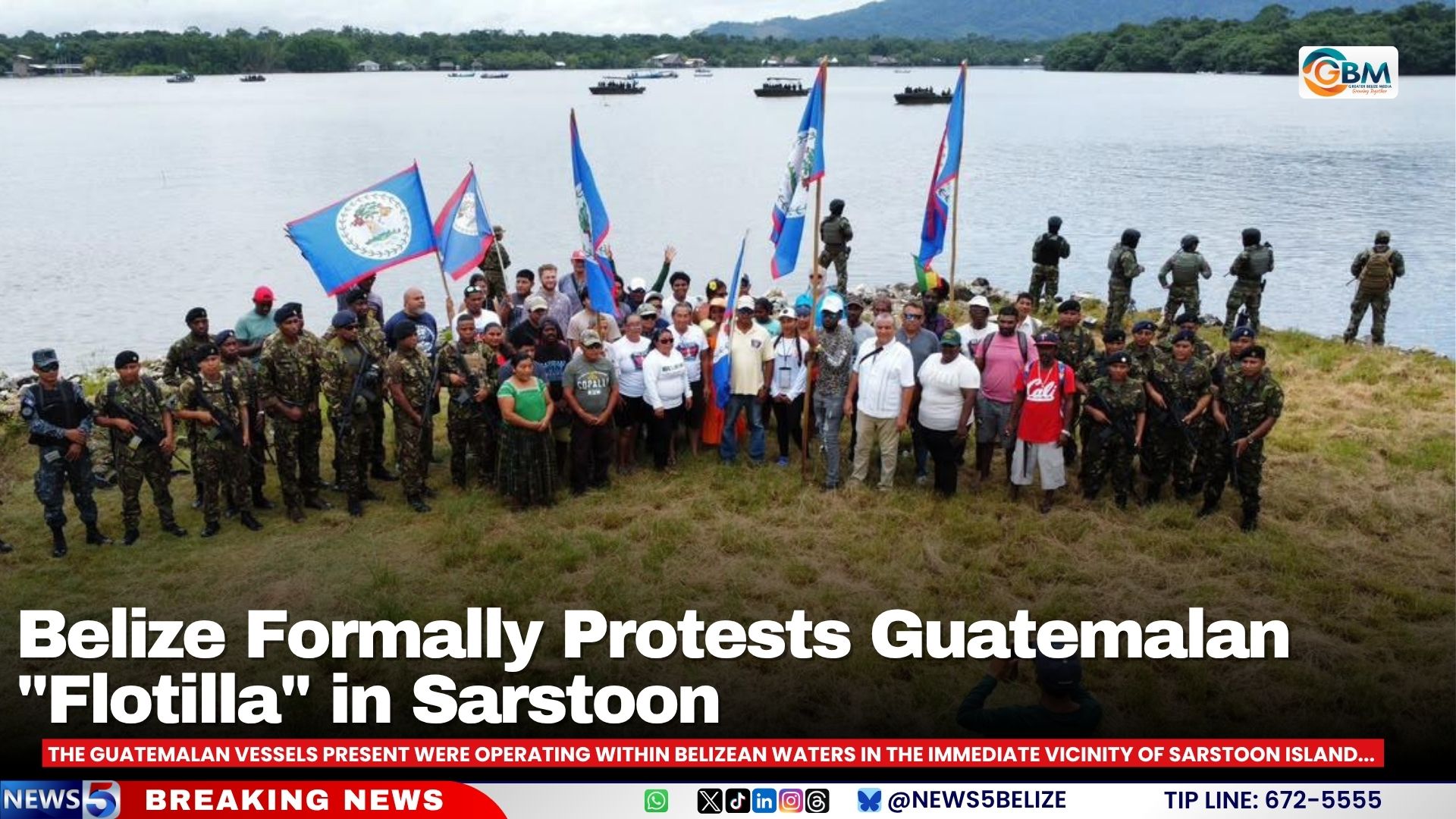
On September 14, 2026, Belize’s Ministry of Foreign Affairs announced a formal diplomatic protest against Guatemala after an unauthorized flotilla of 18 mixed military and civilian Guatemalan vessels entered Belizean territorial waters adjacent to Sarstoon Island.
The incident unfolded four days prior, on September 10, when a group of Belize Territorial Volunteers embarked on their annual circumnavigation of Sarstoon Island, escorted by official Belize Defence Force and Belize Coast Guard units. During the expedition, the Guatemalan flotilla entered the contested waters near the island, directly entering territory Belize claims as its sovereign territory.
Belize grounded its position in long-standing international treaty law. Under the 1859 Boundary Agreement signed between Great Britain, then the governing authority of Belize, and Guatemala, the international border between the two nations runs along the mid-channel of the Sarstoon River. Per this treaty, Sarstoon Island falls fully within Belizean territory, while the river’s navigation channels are guaranteed equal access for vessels from both nations.
Belize’s foreign ministry condemned the Guatemalan deployment as a clear violation of its sovereignty and a deliberate obstruction of the legal passage of unarmed Belizean citizens, saying the action ran counter to Guatemala’s existing treaty obligations. Officials added that embedding civilian vessels within a military flotilla marked an unwelcome escalation of tensions in an already sensitive border region.
In response to the incursion, Belize’s government took multiple diplomatic steps to address the incident. A formal Note Verbale was sent to Guatemala’s Ministry of External Affairs, registering the strongest possible protest. Belize has also officially notified all its international partners, as well as the Organization of American States, of the incident and its potential risks to regional stability.
Additionally, Belize has formally requested a direct explanation from Guatemala’s ambassador to Belize regarding the military’s aggressive actions. To advance discussion of the incident, the government is arranging a bilateral meeting between Belize Prime Minister John Briceño and Guatemalan President Bernardo Arévalo, scheduled to take place on the sidelines of the upcoming United Nations General Assembly next week.
Even amid the escalating tensions, Belize has reaffirmed its long-standing commitment to resolving the broader territorial dispute through the International Court of Justice (ICJ), the internationally recognized arbitration body for the conflict. The government called on Guatemala to avoid any unilateral actions on the ground that could prejudge the ICJ’s final ruling or put civilian and security personnel from both sides at unnecessary risk.
“Belize reaffirms its full confidence in the International Court of Justice process as the appropriate mechanism for the final resolution of Guatemala’s territorial, insular, and maritime claim,” the ministry’s statement read. Belize has also instructed its legal agent office to coordinate with its international legal team to ensure the incident, along with any similar future provocations, are formally raised during upcoming ICJ hearings on the dispute.