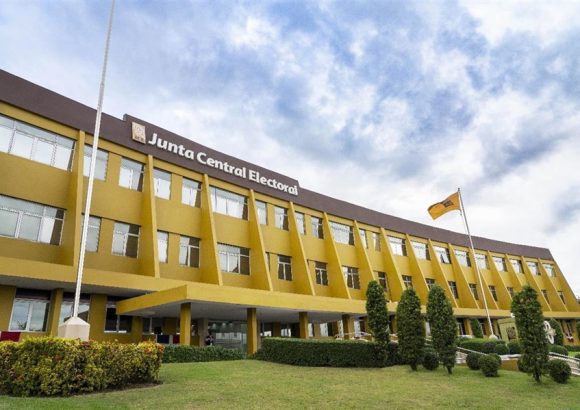
A major legal and financial dispute has put the Dominican Republic’s Central Electoral Board (JCE) in an unprecedented position: its Manhattan office assets are set to be seized and potentially auctioned off to satisfy an unpaid court judgment that has ballooned to nearly $1 million when including accumulated interest and legal fees.
The order for asset seizure was issued by New York City Marshal Martin A. Bienstock, and formal notification was delivered to the JCE on September 6 via a Notice of Attachment and Sale, filed under case number M 373516. All assets listed for seizure are located at the JCE’s New York office at 1501 Broadway, Suite 410 in Midtown Manhattan. The catalog of targeted property covers nearly all the office’s functional and decorative items, including desktop and laptop computers, printing equipment, general office hardware, other electronic devices, work tables, seating, televisions, full office furniture sets, framed artwork, and permanent office fixtures.
Unless the full outstanding debt is settled no later than 72 hours before the scheduled sale date, a public auction of all attached assets will be held on the morning of October 1, 2026.
The roots of this conflict stretch back to late 2023, when the JCE entered into a $1 million service contract with New York-based event firm Latin Events, LLC. The agreement was tied to a high-profile Dominican baseball exhibition series: the November 2023 matchup between the country’s iconic Águilas Cibaeñas and Tigres del Licey held at Citi Field in Queens. The contract tasked Latin Events with delivering a range of services tied to a voter registration drive targeting Dominican expatriates living in New York and neighboring Northeastern states. Specifically, the scope of work included $600,000 allocated to printing 15,000 game tickets, providing 20,000 boxed lunches for attendees, and running a targeted voter registration advertising campaign across local media.
According to court filings, Latin Events only received $230,000 in payment from the JCE after completing the contracted work, leaving an initial unpaid balance of $770,000, before interest and legal costs were added. When the JCE failed to resolve the payment dispute, Latin Events formally filed suit in the U.S. District Court for the Southern District of New York, with the case assigned the number 1:25-cv-02830-PKC.
In a ruling issued November 26, 2025, the court sided with Latin Events and handed down a default judgment ordering the JCE to pay $838,337.50 in damages and fees to the plaintiff. Julio Cury, an attorney based in the Dominican Republic who represents Latin Events in local proceedings, explained that the outstanding total has grown to $982,261.88 as of the seizure notice, due to compounding daily interest, statutory surcharges, and additional court and enforcement expenses.
The judgment was officially registered with the New York County Clerk’s Office on August 20, 2026, but the JCE has not fulfilled the payment obligation, prompting the enforcement action. The legal fight has also extended to Dominican courts: Latin Events has initiated proceedings to have the U.S. court judgment recognized and enforced domestically under Dominican legal order No. 036-2026-SAUT-00294. The JCE has filed an appeal against that recognition and is continuing to pursue all available legal defenses in Dominican courts. Additionally, Latin Events has already launched a garnishment process to seize JCE funds held at Banco de Reservas, one of the Dominican Republic’s largest financial institutions.
Cury confirmed that the Manhattan asset seizure action came only after repeated attempts to secure voluntary payment from the JCE failed. “We have exhausted all possible avenues to achieve voluntary payment,” Cury stated, noting that the ongoing refusal to settle the debt left the company with no choice but to pursue parallel enforcement proceedings in both the United States and the Dominican Republic.
As of the issuance of the seizure notice, the JCE has not released any public statement responding to the latest enforcement action or addressing the outstanding debt.