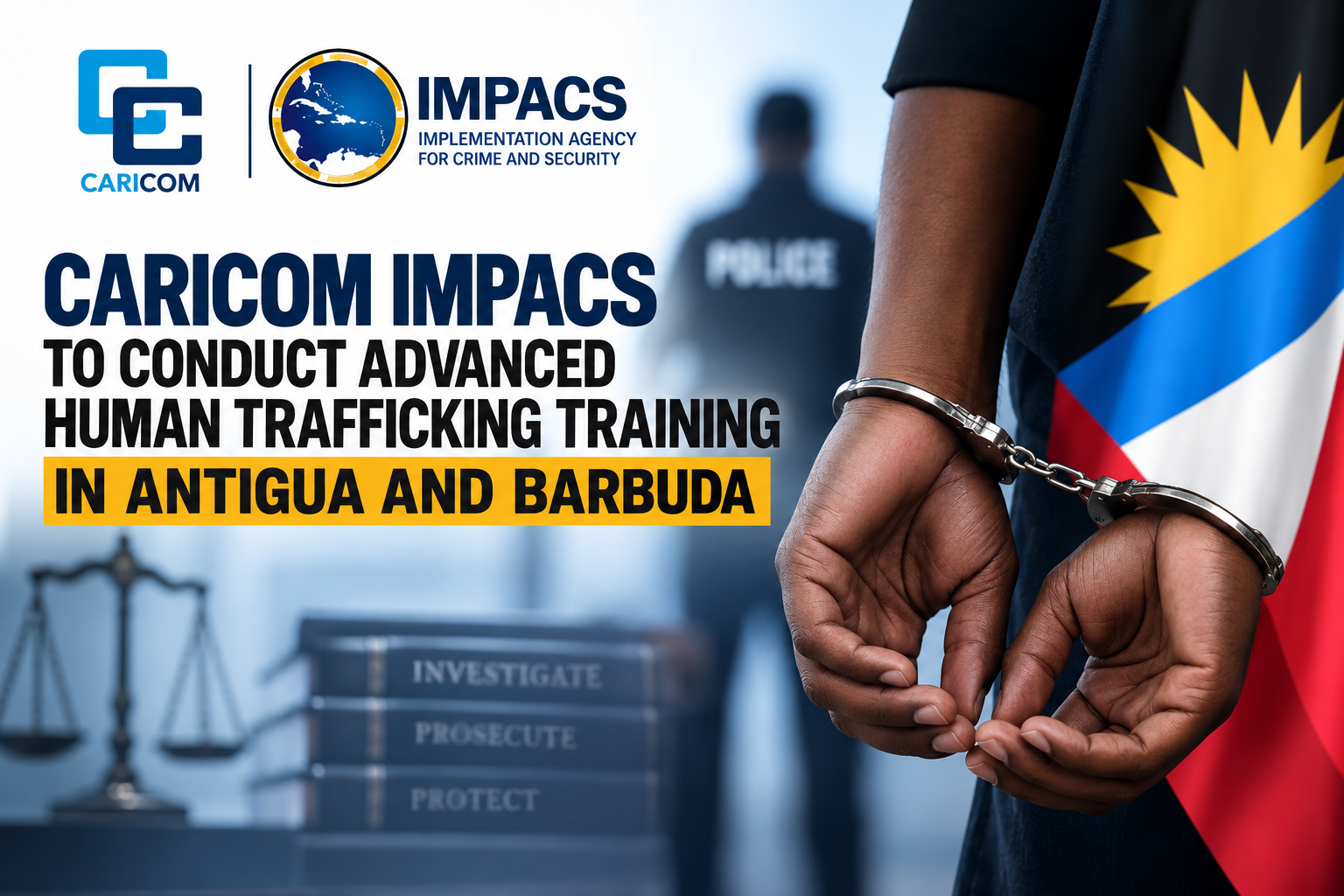
A landmark advanced specialized training focused on human trafficking response will take place in Antigua and Barbuda in September 2026, organized by the Implementation Agency for Crime and Security (IMPACS) of the Caribbean Community (CARICOM). The five-day capacity-building program, scheduled to run from September 14 to 18 at the island nation’s Customs and Excise Department headquarters, aims to reinforce cross-sector criminal justice systems to tackle complex human trafficking cases across the region.
Human trafficking stands as one of the most heinous transnational crimes of the modern era, generating billions in illicit annual revenue while inflicting irreversible harm on millions of vulnerable people globally. Perpetrators rely on fragmented law enforcement cooperation to operate, exploiting gaps in national frameworks to force victims into coerced labor, sexual exploitation, and other abusive practices. For countries across the Caribbean, where porous borders and growing transnational criminal activity have elevated trafficking risks, building coordinated professional capacity has become a top policy priority.
This upcoming multi-disciplinary workshop will be led by a team of seasoned trainers from CARICOM IMPACS alongside leading regional subject matter experts. It will bring together key stakeholders across the entire criminal justice spectrum: frontline investigators from the Royal Police Force of Antigua and Barbuda, senior judicial officers from the Antigua and Barbuda High Court of Justice, public prosecution representatives from the Office of the Director of Public Prosecutions, customs and border control officials, anti-money laundering specialists from the Office of National Drug and Money Laundering Control Policy, immigration enforcement staff, and forensic science experts. The core goal of the gathering is to break down long-standing inter-agency silos, streamline information sharing protocols, and strengthen the full pipeline of anti-trafficking work – from initial victim identification through to evidence gathering, network dismantling, prosecution, and final adjudication.
Experiences across global anti-trafficking efforts have repeatedly demonstrated that a unified, multi-sector approach is non-negotiable for securing successful convictions. Human trafficking networks often operate across jurisdictions and exploit overlapping regulatory gaps, requiring close coordination between law enforcement, border agencies, forensic teams, and the judiciary to build strong, court-admissible cases. Centering responses around the needs of trafficking survivors also ensures that vulnerable victims receive appropriate support while holding perpetrators fully accountable.
The training initiative was coordinated in partnership with Antigua and Barbuda’s national Trafficking in Persons Prevention Unit, and aligns with a formal recommendation put forward in the United States Department of State’s annual global Trafficking in Persons Report. It represents a deliberate investment in the country’s long-term commitment to upholding the three core pillars of global anti-trafficking action: prevention of exploitation, protection of survivors, and prosecution of offenders.
The Government of Antigua and Barbuda has reaffirmed its ongoing dedication to deepening inter-agency collaboration and advancing robust policy measures to eliminate human trafficking and all other forms of modern exploitation across its territory. Beyond strengthening national capacity, organizers expect the training to create a regional network of trained anti-trafficking professionals that will benefit the entire Caribbean community as it works to combat this transnational threat.