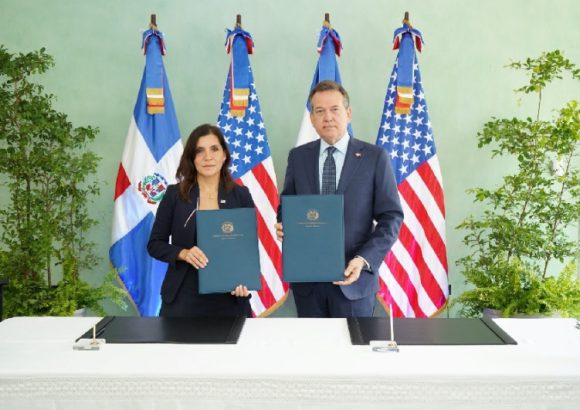
SANTO DOMINGO — In a diplomatic move aimed at reinforcing global economic and energy security, the Dominican Republic and the United States have formalized a new Framework Cooperation Agreement focused on shoring up the security and resilience of critical mineral and rare earth element supply chains, while unlocking fresh investment and development opportunities tied to the extraction and processing of these high-stakes strategic resources.
The official signing ceremony took place in the Green Room of the Dominican Ministry of Foreign Affairs, with Dominican Foreign Minister Víctor “Ito” Bisonó and U.S. Ambassador to the Dominican Republic Leah F. Campos putting pen to paper. Key senior officials including Dominican Energy and Mines Minister Joel Santos Echavarría were in attendance to mark the occasion, alongside multiple vice ministers from the Dominican foreign ministry, senior ministry directors, senior diplomatic representatives from the U.S. Embassy, and Executive Vice President Miguel Ángel Díaz of the Dominican Mining Company (Emidom).
Addressing attendees after the signing, Foreign Minister Bisonó outlined the core priorities of the new partnership. Under the terms of the agreement, the two nations will collaborate closely to safeguard their respective critical minerals and rare earths markets, co-identify mutually beneficial development projects, and streamline access to financing for initiatives across both countries’ territories. “This is an opportunity that we must approach with a long-term vision and a very clear compass: to protect our national interests and ensure that the development of our resources generates ever greater value for the country and for our people,” Bisonó emphasized.
He added that the cooperation framework aligns directly with the foreign policy agenda set by Dominican President Luis Abinader, and advances the active economic diplomacy strategy prioritized by the country’s Ministry of Foreign Affairs.
For her part, Ambassador Campos framed the agreement as far more than an industry-specific deal, framing it as a landmark commitment to shared national sovereignty, collective security, and mutual prosperity. “It guarantees that, when extracting, processing, and manufacturing the materials of the future, we do so together, as trusted partners, and not as countries dependent on the goodwill of another,” she said.
This framework is part of a broader U.S. initiative that has already been signed with 26 other nations around the world. The pact is rooted in the widespread recognition that critical minerals are an irreplaceable input for manufacturing advanced technologies ranging from electric vehicle batteries to defense systems and consumer electronics. Its core goal is to accelerate inclusive market development that strengthens supply chain resilience and security across the full value chain — from initial mining and extraction to downstream material separation and processing.
Notably, the text of the agreement clarifies that it functions as a political and programmatic roadmap for collaboration, rather than a legally binding instrument. It does not create enforceable rights or obligations under either domestic or international law, does not open the door to legal action between the parties, and establishes no binding commitments, whether explicit or implied.