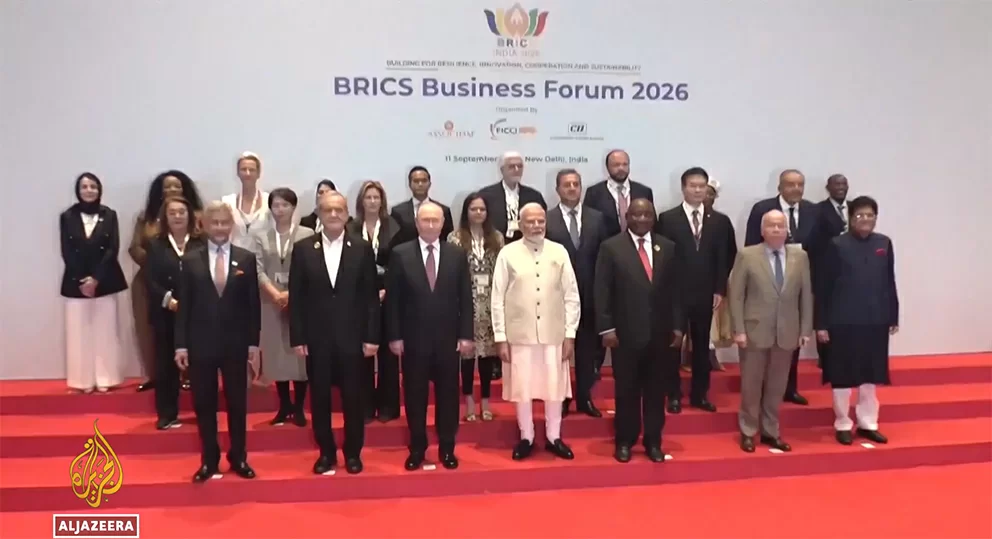
Against a backdrop of soaring global geopolitical tension driven by overlapping conflicts in the Middle East and Ukraine, the 2026 BRICS Summit convened in New Delhi this weekend, bringing together leaders of the 11-member bloc of major emerging economies to address shared global challenges and chart a new course for collective influence in the international order.
Hosted by Indian Prime Minister Narendra Modi, the summit launched on Saturday and wrapped up on Sunday, marking the handover of the BRICS rotating gavel to India. High-profile attendees included Chinese President Xi Jinping, making his first visit to India in seven years, Russian President Vladimir Putin, and Iranian President Masoud Pezeshkian. Other participating leaders included South African President Cyril Ramaphosa, Egyptian President Abdel Fattah el-Sisi, Ethiopian Prime Minister Abiy Ahmed, and Indonesian President Prabowo Subianto. The United Arab Emirates sent its Abu Dhabi Crown Prince as representative, while founding member Brazil was represented by Foreign Minister Mauro Vieira. Senior leaders from key global institutions, including World Health Organization, World Trade Organization, and UN Secretary-General António Guterres also joined the gathering.
In a landmark joint declaration adopted by all member states, BRICS leaders first prioritized the escalating crisis in the Middle East, expressing deep alarm over the ongoing spiral of tensions and calling on all parties to exercise maximum restraint. The statement specifically warned against intentional strikes on civilian infrastructure and nuclear facilities, and reaffirmed the bloc’s longstanding position on the Palestinian issue. Members issued a firm rejection of the forced displacement of Palestinian people and any attempt to alter the geographic or demographic status of occupied Palestinian territories. The declaration also called for an immediate end to Israeli military operations in Gaza, voiced full support for the United Nations Relief and Works Agency for Palestine Refugees (UNRWA), and backed full UN membership status for an independent Palestinian state.
Beyond regional conflict, the joint declaration outlined a broader agenda focused on strengthening global economic resilience, expanding cooperation among non-Western economies, and countering what members frame as unfair Western-dominated global governance structures. Key priorities included expanding cross-border alternative payment systems to reduce reliance on Western-dominated financial infrastructure, deepening collaborative research and governance frameworks for artificial intelligence, and unified opposition to unilateral sanctions and protectionist trade tariffs that disrupt global commerce.
In his remarks following his arrival in New Delhi on Saturday morning, President Xi emphasized that the ongoing conflict in the Middle East runs counter to the core interests of the entire global community, noting the catastrophic human and economic losses the crisis has already inflicted across regions. A day before the summit officially opened, Prime Minister Modi held bilateral talks with President Putin, where the two leaders agreed to deepen bilateral strategic and economic ties, and later met with Iranian President Pezeshkian to discuss critical issues of maritime navigation freedom and the safety of commercial shipping crews. During a closed-door plenary session, Egyptian President el-Sisi echoed these concerns, stressing that regional instability and disruptions to navigation in the Middle East have already caused severe spillover damage to the global economy, international trade flows, and global energy supplies.
Founded in 2009 as a cooperative forum for emerging economies seeking greater representation in global institutions long dominated by Western powers, BRICS has expanded significantly in recent years to 11 current members, growing its footprint as a leading voice for the Global South. However, the 2026 summit also laid bare the significant internal divisions that challenge the bloc’s unified action. Longstanding regional tensions between members Iran and the United Arab Emirates, who stand on opposite sides of ongoing confrontations between Iran, Israel and the United States, have created rifts over how to frame the Middle East conflict. A recent meeting of BRICS foreign ministers failed to produce a unified statement on the crisis, despite the bloc’s unified condemnation of U.S. and Israeli airstrikes on Iran last year. Beyond regional splits, BRICS also faces external pressure: successive U.S. administrations have imposed sweeping tariff measures on multiple BRICS members and labeled the bloc an anti-American actor, while the bloc’s finance ministers have pushed back against these measures, arguing they violate core WTO trade rules.
As chair, India has navigated these competing interests to push for a unified declaration, while working to strengthen the bloc’s collective influence on the global stage. Against the persistent backdrop of Middle East conflict, BRICS faces growing urgency to mitigate global economic damage and secure critical commercial shipping lanes, all while advancing its long-term goal of building alternative trade and financial systems to counter Western dominance. Despite internal challenges that make unity an ongoing struggle, the 2026 New Delhi summit has made clear the bloc’s enduring ambition to emerge as a stronger, more influential voice for the Global South in an increasingly fractured global order.