A widespread work stoppage shut down operations at Bahama Rock, a major Grand Bahama aggregates production facility owned by American construction materials giant Martin Marietta, on Wednesday, as more than 80 employees walked off the job to push the Bahamian government to greenlight a proposed expansion project that workers say is essential to keeping the plant open and protecting their livelihoods.
The industrial action comes as the company exhausts its current dredging license area, and is set to implement a mandatory 60-day temporary shutdown that will furlough all 84 affected workers if approval is not granted in time. Bahama Rock’s proposal would allow the firm to acquire and begin mining operations at a 290-acre site that previously housed the shuttered Bahamas Cement plant, but the plan has drawn pushback from nearby Eight Mile Rock residents, who have raised longstanding concerns about potential negative impacts from blasting, particulate dust pollution and increased noise from expanded operations. At a recent public town meeting held by the Department of Environmental Planning and Protection to review the project’s environmental impact assessment, residents shared accounts of existing blasting activity causing structural cracks in local homes, amplifying their calls to block the expansion.
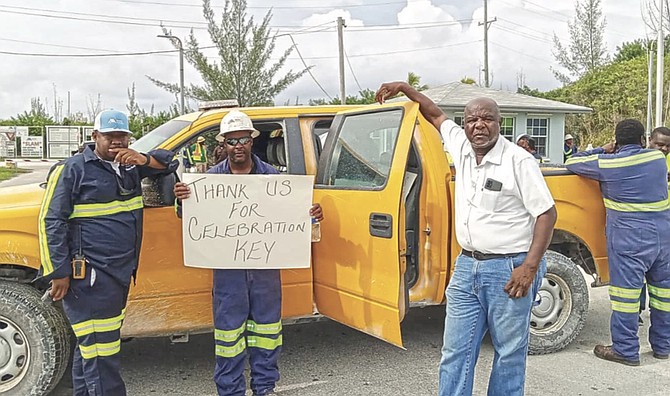
Hundreds of workers and industry stakeholders gathered outside the plant’s main entrance yesterday, holding hand-picked placards that outlined Bahama Rock’s far-reaching contributions to iconic Bahamian infrastructure projects, including the multi-billion-dollar Baha Mar resort development, Freeport Harbour, and the new Celebration Key cruise terminal. For long-tenured employees like Kevin Evans, who has spent 19 years on the plant’s workforce, the stoppage is not a protest against the company, but a urgent plea for government and corporate leadership to strike a deal that saves their positions. “We are fighting for our jobs,” Evans emphasized, adding that Bahama Rock has been a core economic anchor for Grand Bahama and the entire nation for decades.
The work stoppage has already rippled across Grand Bahama’s construction sector, leaving dozens of hauling trucks idling outside the facility gates unable to collect critical raw aggregate for ongoing projects. Independent trucker JC, who requested only his first initial be used, told reporters he had been waiting since 7:45 a.m. to pick up a load of sand for a concrete pouring crew, and said the shutdown is already cutting into his daily income. “I get paid by delivery,” he explained. “I run a 20-ton truck, make 10 runs a day, and today I’m on track to lose around $1,100. I just want the gates open and everyone back to work.” Other independent haulers who rely exclusively on Bahama Rock for aggregate supplies reported identical disruptions, putting multiple construction projects across the island on hold.
For the plant’s employees, the immediate crisis is the looming 60-day furlough that will go into effect once current dredging operations wrap up. Alvin Wilson, a 22-year veteran of the facility’s electrical department and a team lead, said workers have already received formal notification of the temporary layoffs. “We’re just out here standing together, showing our support for each other, because none of us know what our future holds or where we’re heading,” Wilson said. He added that the uncertainty around the plant’s long-term future has left workers anxious, with many unsure how they will support their families even through a two-month shutdown. “It will affect everyone here,” he said. “We all count on this paycheck to pay our bills and take care of our loved ones – no one can afford to lose two months of income.”
Workers and company advocates stress that Bahama Rock’s importance stretches far beyond its own employee payroll, as it is the largest aggregate supplier in the entire Bahamas, providing raw materials for nearly every major construction project across the archipelago. “The foundation of this country starts with us,” said Arnetta Rollins, a 12-year employee of the facility. “We supply the materials for roads, affordable homes, hospitals, local businesses, and block manufacturing. Without that material, how can any of those critical projects move forward?”
While workers acknowledge the validity of nearby residents’ concerns, they argue that the government can strike a balanced solution that addresses environmental and quality-of-life issues while protecting the economic benefits the plant provides. Harold Williams, a five-year production employee who was born and raised in Grand Bahama, said workers do not dismiss the impact of operations on local communities. “Besides being an employee, I’m a Grand Bahamian,” Williams said. “By no means would I ever want any community to be harmed by what we do here.” Even so, he emphasized that Bahama Rock is a core driver of national economic growth, supplying aggregate for the Freeport Container Port, Grand Bahama Shipyard, and Celebration Key, among other major economic hubs. “We provide the foundation that the entire country builds on,” he said. “We just want government ministers and company leadership to sit down together, find common ground, and reach an agreement that moves everyone forward.”
For younger workers like Lavado Cooper Jr., who has worked at the plant for a year while pursuing a law degree, the uncertainty is uniquely destabilizing. Cooper joined the company directly after graduating high school, and relies on his wages to cover his tuition and living expenses. He also warned that the loss of the nation’s largest aggregate supplier would have widespread consequences for all Bahamians, driving up construction material costs and creating supply shortages across the country. “When you close the biggest aggregate company in the Bahamas, where are we going to get the material we need to build?” he asked, noting that reduced supply would almost certainly push prices higher, raising costs for everything from new homes to public infrastructure. Cooper added that Bahama Rock contributes roughly $5 million annually to the local economy through power company payments alone, and supports a range of community initiatives, including donating laptops to public school students and funding upgrades to local public parks. “It’s a trickle-down effect,” he said. “At the end of the day, the people who get hurt most are ordinary Grand Bahamians.”
Workers are calling on the public to support their push for a balanced decision, asking the government to weigh residents’ quality-of-life concerns against the hundreds of jobs and billions in economic activity the plant supports. “We want to get our story out to the public,” Rollins said. “We need their support as we fight for our future.”
Bahama Rock’s General Manager TJ Mackey declined to provide comment on the work stoppage or the expansion proposal, but workers confirmed that company management supports their industrial action. The 60-day temporary shutdown is expected to go into effect as the government continues its review of the expansion proposal and a decision on whether to allow the company to extend operations beyond its current dredging area.