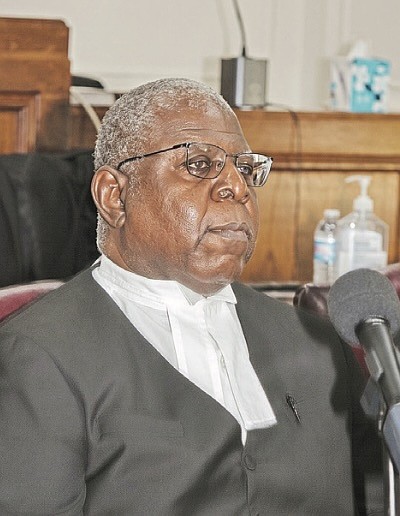
In a historic moment for The Bahamas’ judicial system, the Court of Appeal has convened proceedings in Grand Bahama for the first time in 16 years, bringing top judicial leaders face-to-face with local communities and opening the door to long-awaited reforms to expand access to justice. During the two-day sitting held September 9 and 10, Court of Appeal President Justice Milton Evans used the occasion to raise a urgent, long-simmering concern: the country’s mandatory judicial retirement rules are actively draining the judiciary of its most experienced legal minds, creating a harmful brain drain that erodes institutional knowledge.
Justice Evans explained that judicial expertise is not built overnight – it takes years of hands-on experience hearing cases, interpreting law, and refining decision-making for judges to reach the peak of their professional capabilities. Yet under current Bahamian constitutional rules, judges are forced to step down just as they hit this stride, and many go on to offer their hard-won expertise to judicial systems in other countries that allow jurists to serve longer tenures. He pointed to high-profile examples of retired Bahamian judges Dame Anita Allen and Justice Neville Adderley, who have both gone on to serve on benches in other jurisdictions after being forced to retire at home.
The current constitutional framework sets a mandatory retirement age of 65 for Supreme Court justices, with a maximum extension to 67 granted only through rare approval by the Governor-General following consultation between the Prime Minister and Leader of the Opposition. For Court of Appeal justices, the ordinary retirement age is 68, with a maximum extension to 70. A 2002 constitutional referendum that would have raised these limits – boosting the normal retirement age for Supreme Court justices to 68 (with extensions to 72) and for Court of Appeal justices to 72 (with extensions to 75) – was resoundingly defeated by voters, with 71 percent rejecting the measure.
Beyond the retirement debate, the Grand Bahama sitting itself marked a major milestone in the judiciary’s push to expand public access to justice. For decades, appellate proceedings have been held exclusively in New Providence, forcing Freeport residents, defendants’ families, and other stakeholders to travel long distances to observe cases. This two-day session, which heard two criminal matters involving local Freeport residents, was designed to change that: it gave community members direct access to watch the appellate court at work, correcting misinformation that often circulates when the public only learns about court proceedings through secondhand accounts.
“Justice must not only be done, but must be seen to be done,” said Justice Gregory Smith, one of the participating panel members. Smith noted that while virtual hearing technology, widely adopted during the COVID-19 pandemic, has proven effective for remote participation, it cannot replace the value of in-person sittings that bring the judiciary directly to local communities. Chief Justice Ian Winder echoed this commitment, framing the Grand Bahama session as part of a broader national initiative to expand meaningful access to justice across all of The Bahamas’ Family Islands. Grand Bahama already benefits from a fully established local court infrastructure with three Supreme Court justices, four magistrates, and three registrars, and the judicial branch is now moving forward to build out new court facilities in Eleuthera to cut down on the need for local residents to travel to New Providence for court business. Virtual proceedings will remain a core tool for remote participation in cases that cannot be heard locally.
The visit also brought progress on another longstanding public concern: inconsistent sentencing. Chief Justice Winder acknowledged ongoing public debate over perceived inconsistencies in punishments for similar offences, with some arguing sentences are too harsh and others saying they are too lenient. In response, the judiciary has developed its first-ever formal set of sentencing guidelines in consultation with prosecutors, the legal profession, social services, and other key stakeholders. The guidelines outline clear sentencing ranges and identify standard aggravating and mitigating factors for judges to consider. While they have not yet been implemented, once introduced judges will be required to adhere to the guidelines and provide explicit, strong justifications for any departure from the recommended ranges.
Despite the progress, Justice Evans cautioned that regular appellate sittings in Grand Bahama remain out of reach for now due to resource and logistical constraints. The Court of Appeal only has six sitting members, so bringing the full panel to Grand Bahama requires pausing all appellate proceedings in Nassau. In the longer term, the judiciary aims to find a solution that allows proceedings to run simultaneously in both locations, but that will require additional funding and revised operational arrangements. He also shared an update on the court’s backlog, noting that the panel is currently processing cases filed in 2026, with only four outstanding judgments remaining as of the start of the Grand Bahama sitting, one of which was already finalized and pending delivery.