Six months after the outbreak of open conflict between the US, Israel and Iran, tensions in the strategic Gulf region have surged to a new critical peak following a series of tit-for-tat military strikes that began in early September. The latest round of escalation started when the Islamic Revolutionary Guard Corps (IRGC), Iran’s elite military force, launched two separate attacks on a US Navy vessel within a 48-hour window, according to US Central Command (CENTCOM). The warship successfully evaded both attempts, and no US personnel were injured or killed in the strikes. The IRGC also carried out a separate attack on US troops stationed at a base in Jordan, setting the stage for a rapid US retaliation.
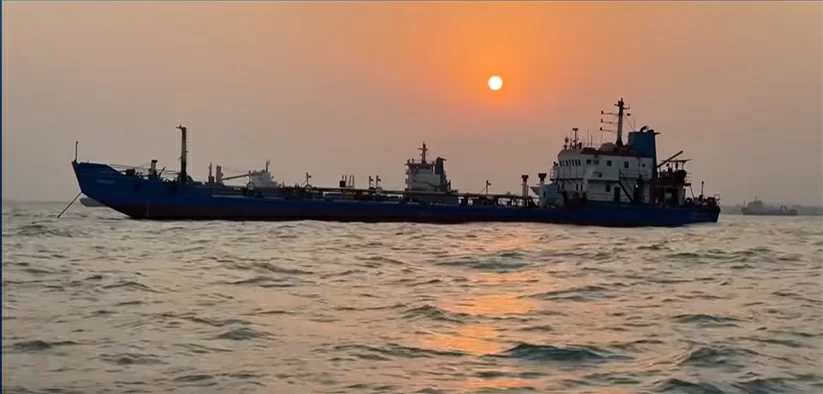
In response to the IRGC actions, US military forces carried out targeted airstrikes against five Iranian-owned oil tankers operating in the Gulf of Oman and near Iran’s Kharg Island. CENTCOM confirmed that advance warnings were issued to the crews of the targeted vessels — identified as the M/T Kaviz, M/T Charminer, M/T Horizon 1, M/T Riesco and M/T Derya — before the strikes to allow them to evacuate. Footage circulating from the strike zone confirms that the M/T Riesco has sunk following the attack.
Iran quickly confirmed the strikes on its oil tankers and launched an immediate counteroffensive. The IRGC announced it had carried out “intense rocket attacks” against the US Al-Azraq Air Base in Jordan, claiming it destroyed hangars housing US fighter jets in the strike. Iranian military officials also added that it carried out missile strikes against two US destroyers, inflicting substantial damage on the vessels, and expanded its offensive to target 10 vessels in the broader region, two of which it claims are US-owned.
Jordanian military authorities offered a separate account of the Al-Azraq base attacks, confirming that their air defense systems intercepted 20 ballistic missiles launched toward the base, destroying 18 of the projectiles mid-flight. No casualties were reported from the incident, with the two remaining missiles that evaded interception landing in unpopulated desert areas.
Beyond the direct military exchanges, the escalating conflict has already had tangible global economic impacts. On Wednesday, international benchmark oil prices climbed above $100 per barrel amid fears of disrupted shipping through the region, which handles roughly a fifth of the world’s daily oil trade. Iran has already closed the Strait of Hormuz, the world’s most critical chokepoint for oil shipments, while the US has maintained a strict maritime blockade of Iranian port facilities. Following the US tanker strikes, Iran’s foreign ministry labeled the attack a “war crime” and announced a new restricted maritime zone stretching from Iran’s Chabahar port across large swathes of the Arabian Sea, with exact coordinates of the zone set to be released in the coming days.
Separately, the UK Maritime Trade Operations, which monitors global shipping security, reported Wednesday that an additional attack was carried out against a cargo vessel off the coast of Iraq, approximately 52 kilometers south of the al-Faw peninsula.
In a confirmation of US policy during a diplomatic visit to Colombia, US Secretary of State Marco Rubio defended the strikes on the Iranian tankers. Rubio stated that Iran has continued to target American commercial and military vessels in the region, and that every hostile attempt from Tehran will result in further losses for Iran’s maritime and oil sectors.
In a separate development that adds to regional tensions, the IRGC also announced that it seized an American unmanned submarine near the entrance to the Strait of Hormuz. US officials confirmed that a drone submarine suffered a technical malfunction during a routine surveillance mission in the area, but denied that the vessel was collecting sensitive intelligence at the time of its loss.