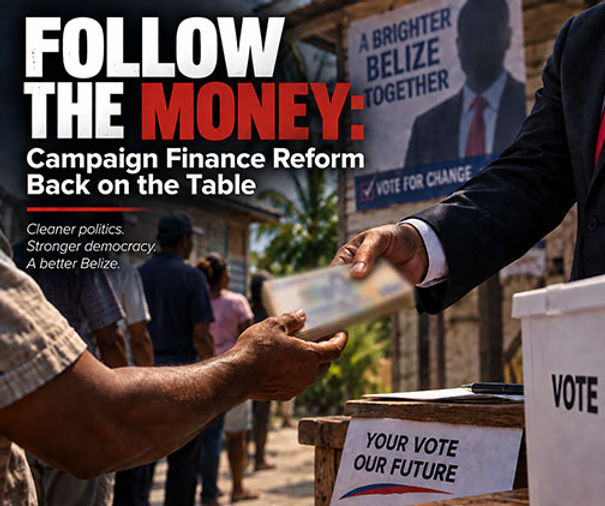
After six years of repeated failed attempts to pass comprehensive campaign finance regulation in Belize, cross-sector civil society and business leaders have reignited the push for reform with a concrete, detailed draft bill that outlines a full regulatory architecture for political campaign financing.
Leading the renewed initiative is the Belize Chamber of Commerce and Industry (BCCI), which has partnered with major national stakeholders including the National Trade Union Congress of Belize, the Belize Network of NGOs, and national faith organizations to circulate the updated 2026 draft of the Representation of the People (Amendment) Bill, a copy of which has been obtained by local outlet The Reporter. Unlike prior efforts that only called for broad reform, this draft lays out specific, actionable provisions to address longstanding gaps in Belize’s campaign finance rules.
The 20-page draft bill proposes amending Belize’s existing Representation of the People Act to build a binding legal framework for campaign financing, establish a dedicated National Election Campaign Fund, and mandate full public accounting of all contributions and expenditures by both political parties and individual election candidates.
One of the draft’s most transformative provisions is the introduction of binding spending caps. Under the proposed rules, registered national political parties would be limited to $4 million in total campaign spending per election cycle, while individual candidates would face a ceiling of $215,000. The Elections and Boundaries Commission would retain authority to adjust these amounts in the future, pending formal affirmative approval from relevant governing bodies.
To curb the outsized influence of large individual donors, the draft also sets proportional contribution caps. No single contributor can provide more than 10% of an individual candidate’s total allowed spending, while contributions to a national party are capped at 5% of the party’s total permitted expenditure.
Addressing widespread transparency concerns around unreported political funding, the draft mandates timely public disclosure of all large contributions. Any donation of $10,000 or more must be reported to the Elections and Boundaries Commission within seven days, including full details of the contribution amount, date, and donor identity. The commission is then required to publish this information promptly for public access. For corporate or other organizational donors, additional disclosure of ultimate beneficial owners, controlling stakeholders, and any shareholders holding 10% or more of the entity is required.
Cash donations would face strict new limits as well: no cash contribution over $1000 can be accepted, and all larger donations must be made via traceable financial channels including bank transfers, checks, or electronic funds transfers. A full ban on donations from prohibited sources is also written into the draft, including foreign governments, public foreign bodies, anonymous donors, and contributors using intermediaries or false identities. Any funds received from prohibited sources must be returned, and any untraceable unidentifiable contributions must be transferred to Belize’s national Consolidated Fund.
The draft also creates new reporting requirements to link political donations and government contracting. Any individual or company that makes a political donation must disclose the contribution if they held a government contract worth more than $7,000 in the two years prior to the donation, or if they enter into such a contract within two years after making the contribution.
Political parties would be required to submit annual financial statements under the new framework, and independent audits would be mandated for parties meeting a size threshold to be set by the Elections and Boundaries Commission. All campaign finance reports, declarations, and disclosures would ultimately be published online in a searchable, machine-readable format to simplify public oversight.
Third-party groups that spend money to influence election outcomes would also be brought under regulation for the first time. Any organization spending over $10,000 on election-related activities would be required to register with the Elections and Boundaries Commission, maintain detailed financial records, and comply with the same donor disclosure and campaign finance rules that apply to parties and candidates.
The draft includes strong enforceable penalties for deliberate serious violations. If the High Court finds that a candidate knowingly committed a major breach of campaign finance rules, sanctions can include forfeiture or repayment of illegal funds, and in the most severe cases, nullification of the candidate’s election victory or a ban from running for public office for up to five years.
At this stage, the document remains a working draft rather than formal legislation introduced to Belize’s National Assembly, and multiple provisions are marked for further stakeholder review and debate. Observers note that the most important contribution of the current draft is not the specific monetary thresholds it proposes, but the fact that it puts a complete, workable regulatory model—including spending limits, donor identification, public disclosure, and enforceable penalties—back onto Belize’s national policy agenda after years of inaction.