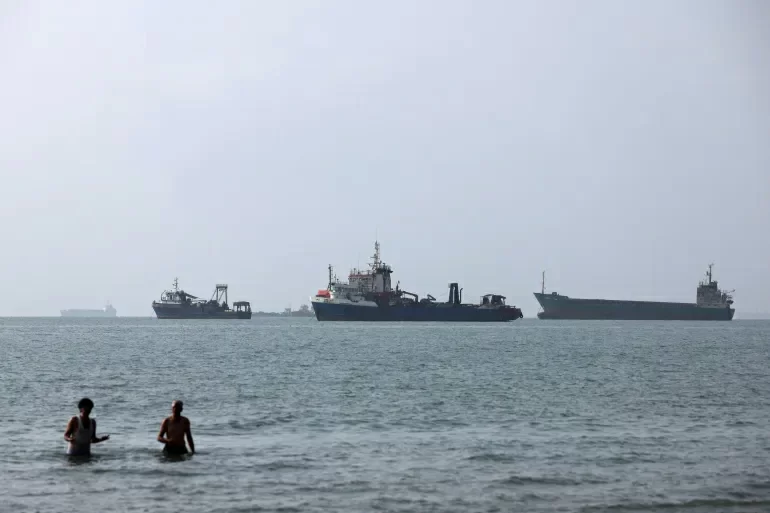
Global crude oil prices climbed to a nearly six-week peak on Monday, driven by a sharp escalation of military tensions between the United States and Iran in the strategically critical Strait of Hormuz, amplifying already persistent concerns over global energy supply shortages. As of Monday’s trading, Brent crude, the global benchmark for oil pricing, hovered around $97 per barrel. This marks a 9% jump over the past five trading days and a 19% increase over the last month, after briefly touching an intraday high of $97.93 — the highest level recorded since the end of July. U.S. West Texas Intermediate (WTI) crude also rose to settle at $92.27 per barrel.
The sudden upward swing in oil prices follows a series of recent missile exchanges in and around the Strait of Hormuz, a chokepoint that carries roughly one-fifth of the world’s total oil trade every day. The U.S. Central Command (CENTCOM) announced Saturday that it had attacked three Iranian oil tankers after U.S. naval vessels came under ballistic missile fire. Two of the targeted tankers were permanently disabled, while the third was completely destroyed. Iran issued a conflicting account of the incident, claiming it had launched strikes on three tankers and three U.S. naval vessels, and warned of far harsher retaliatory measures in response to American aggression.
This round of clashes marks the latest escalation in a long-running conflict that began in February when U.S. and Israeli forces launched strikes on Iranian targets. A June ceasefire failed to hold, and hostilities have reignited and intensified steadily since late August. “This latest escalation is a direct reflection of the ongoing cross-fire and sustained conflict, and global oil supply shortages continue to persist with little end in sight,” explained Rachel Ziemba, adjunct senior fellow at the Center for a New American Security (CNAS).
Tensions worsened further on Monday when Saudi Aramco’s refinery in Jizan was struck for the second time in just one month. Industry insiders note that the attack could delay the facility’s planned return to full production capacity. Shipping data compiled by analytics firm Kpler shows that traffic through the strait has dropped dramatically, with only an average of 10 cargo vessels transiting the strategic waterway each day — the lowest daily volume recorded since May.
American consumers are already bearing the immediate brunt of higher crude prices at fuel pumps. Data from the American Automobile Association (AAA) shows the average national price of a gallon of gasoline has jumped 7 cents in a single week to $4.15. That is 39% higher than the $2.98 per gallon average recorded before the conflict began on February 28. Even more alarming are record-breaking diesel prices, which hit $5.85 per gallon last week and climbed above $5.90 on Monday. “U.S. diesel prices have never been this high, and we are now just waiting for these higher costs to trickle down to every single product consumers purchase,” Patrick De Haan, head of petroleum analysis at fuel pricing platform GasBuddy, wrote on social platform X. Diesel is the primary fuel for freight trucking, agricultural operations and construction, meaning price increases are eventually passed through to nearly all consumer goods. Calculations from Brown University’s Watson School of International and Public Affairs find that the average U.S. household has spent an extra $764.59 on fuel since the conflict began, $418.82 above typical seasonal spending.
The disruption to Hormuz oil shipments has widespread global impact: 10 major economies rely heavily on Middle Eastern oil exports that pass through the strait, with Eritrea and Madagascar sourcing nearly 90% of their total oil supply from the region. Three of the world’s largest economies — Japan, China, and South Korea — source more than half of their oil from Middle Eastern exporters.
In the United States, skyrocketing fuel prices have become a defining issue ahead of the country’s midterm elections, scheduled for November 3 to 5. Polling shows widespread voter dissatisfaction with President Donald Trump’s handling of the economy. A recent Financial Times poll found only 17% of American voters approve of Trump’s economic policies. A separate Economist/YouGov survey found 39% of voters believe the Democratic Party offers better economic policy, compared to just 32% who favor Republican leadership. Recent economic data offers a mixed picture: the U.S. economy added 162,000 new jobs in August, and the unemployment rate held steady at 4.1%, indicating ongoing modest growth. But soaring fuel costs and broader inflation have eroded consumer purchasing power significantly, creating widespread financial strain for households.
For China, which is heavily dependent on oil imports passing through the Strait of Hormuz, analysts say the country has taken steps to buffer against supply disruptions. China maintains a large strategic petroleum reserve, has reduced domestic oil consumption growth in recent years, and benefits from close energy ties with Russia, which can meet nearly half of China’s daily oil demand. The country has also accelerated its transition to electric vehicles, with EVs now accounting for more than half of all new car sales in China, according to John Gong, an economics professor at the University of International Business and Economics. Even so, U.S. Treasury Secretary Scott Bessent warns that Iran only has roughly 30 million barrels of crude oil remaining available for export to China, and U.S. blockades of Iranian ports have already drained that stockpile rapidly. Once the remaining reserve is exhausted, China will lose access to cheap Iranian crude, a shift that could put even more upward pressure on global oil markets.