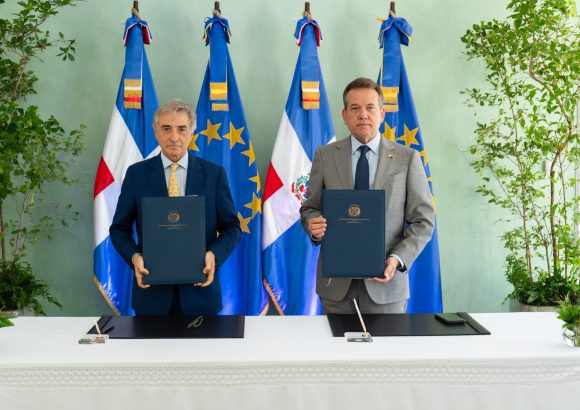
In a landmark step toward unlocking the Dominican Republic’s untapped geological resources, the national government and the European Union have formalized a collaborative agreement to conduct comprehensive scientific research on rare earth elements, gallium, and scandium located in the karst bauxite reserves of Pedernales’ Ávila Mining Fiscal Reserve. The newly signed Joint Declaration establishes a framework for evidence-based evaluation of the mineral deposits’ commercial and strategic potential, with a core focus on responsible, sustainable resource management.
The signing ceremony, hosted at the Dominican Ministry of Foreign Affairs, brought together top leadership from both sides: Dominican Foreign Minister Víctor O. Bisonó Haza signed the document on behalf of the Caribbean nation, while Raúl Fuentes Milani, the European Union’s ambassador to the Dominican Republic, signed for the bloc. Energy and Mines Minister Joel Santos Echavarría also participated as a key stakeholder in the initiative.
Speaking at the event, Bisonó underlined that rigorous, transparent mapping of the country’s mineral endowments is a foundational prerequisite for strategic decision-making. He emphasized that any future development of these deposits must be aligned with four non-negotiable priorities: long-term environmental sustainability, full operational transparency, strict protection of ecosystems, and advancement of the Dominican Republic’s national public interest.
For his part, Ambassador Fuentes Milani clarified that the EU’s partnership extends far beyond direct financial investment. The collaboration is designed to build long-term capacity in the Dominican Republic: it prioritizes generating open, peer-reviewed scientific knowledge, facilitating the transfer of cutting-edge mineral assessment technology, and strengthening the technical skills of national personnel so the country can retain full autonomy over decisions related to its own natural resources.
Central to the declaration is a pre-approved grant agreement with the University of Barcelona, which will lead the first phase of work: detailed mineralogical characterization of the rare earth elements, scandium, and gallium found in the Pedernales deposits. Beyond laboratory analysis, the project will also invest in training domestic scientific experts, developing standardized regulatory and operational frameworks for sustainable mining projects, and laying the groundwork for future non-reimbursable international cooperation initiatives focused on the Dominican resource sector.
The total budget for the characterization project totals €538,709.50, with costs split evenly among three partners: the European Union, the Dominican national government, and the University of Barcelona. All allocated funds will be directed toward on-the-ground scientific activities, including specialized geochemical testing, field survey work across the Pedernales reserve, procurement of necessary research supplies, and hands-on knowledge transfer to Dominican technical staff to ensure long-term local leadership of future efforts.
This new initiative is not a standalone effort, but rather an expansion of earlier geological research carried out under the EU’s SYSMIN II Program. Between 2010 and 2011, that earlier project first confirmed the presence of viable rare earth element deposits in the Pedernales bauxite formations, establishing the baseline scientific understanding that makes the current expanded assessment possible.
Both signing parties reaffirmed the strategic importance of advancing this work to advance global responsible mining standards. By grounding future development decisions in robust, independent scientific evidence, the partnership aims to accurately quantify the value of the deposits, identify sustainable uses for the extracted minerals, and set a precedent for equitable, environmentally conscious resource development in the Caribbean region.