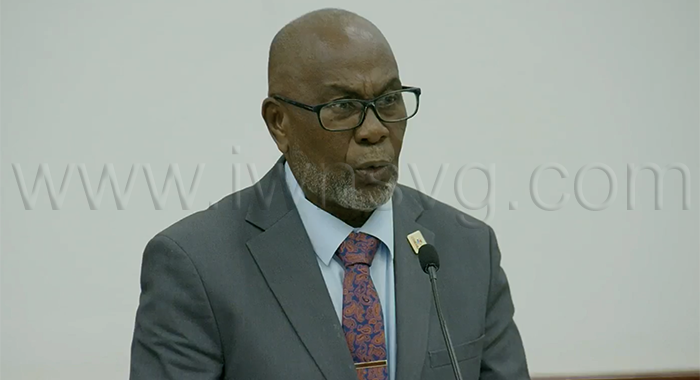
In a landmark address to Parliament Thursday, St. Vincent and the Grenadines Deputy Prime Minister and National Security Minister St. Clair Leacock has issued a clear call for senior police officers unwilling to advance the new administration’s public safety agenda to follow the lead of departing colleagues and leave their posts, as the government pushes forward with a sweeping restructuring of the Royal St. Vincent and the Grenadines Police Force (RSVGPF) to curb rising gun violence and homicides.
Since the New Democratic Party took power in November, at least two high-ranking officers have opted not to serve under the new administration and requested early retirement or leave, which the government granted, Leacock told lawmakers. He declined to name the departing officers, but made clear that more personnel changes are on the table if sitting leaders fail to meet performance expectations. “It may well be that there are one or two more who should take that example and go home and make room for others who want to do it,” Leacock said. “If they don’t deliver, believe in me, I’ll make the recommendations for those who want to serve this nation and this administration faithfully well, to be put into position. I wouldn’t hesitate in it.”
Leacock’s remarks mark the most explicit public signal yet that the new government intends to reshape top police leadership amid widespread public anxiety over violent crime. The address also served as a defense of the changes his administration has already implemented over its first nine months in office, and a sharp critique of the force’s previous leadership structure.
Current substantive Police Commissioner Enville Williams is currently on seven months’ paid leave, with Trevor Bailey appointed to serve as acting commissioner. Leacock implicitly criticized Williams’ tenure, saying the permanent commissioner took six months to recognize that his deputy deserved to accompany him on international work trips, a practice that left the deputy sidelined on too many occasions. In contrast, Leacock praised Bailey and Rapid Response Unit (RRU) head Nolan “Grandpa” Dalloway for their consistent, real-time performance on reporting crime trends to his office.
To boost operational capacity, Leacock laid out plans to reallocate new police recruits: 30 incoming trainees will be assigned to the Special Service Unit and another 30 to the RRU, a move designed to rebuild the specialized units and increase the number of uniformed officers conducting on-foot patrols across communities. Leacock also confirmed he has already identified preferred candidates to fill key leadership roles in specialized units, including the Special Services Unit and the narcotics division.
A former uniformed officer with a decade of experience training new police recruits as a lecturer, Leacock framed his leadership of the national security portfolio as a deliberate effort to fix long-standing institutional weaknesses in the RSVGPF. “I’m in this job now for about nine months, and I applied for it because I was confident I can do it better than my predecessor. And so far, I’m doing exactly that,” he told Parliament.
Despite pushing for personnel changes, Leacock struck a balance by pledging to professionalize the force and reduce routine political interference in day-to-day police operations. He noted that promotions going forward will be based on performance evidence rather than partisan political ties, even though the administration has not yet completed a full year in office to conduct formal annual performance reviews. Leacock described his role as setting policy direction and receiving operational updates, while uniformed police professionals remain in charge of executing frontline work, singling out acting Assistant Commissioner Benton Smith for his strong human resource leadership.
The personnel changes come as part of the government’s broader one-year strategic crime reduction plan, centered on intelligence-led, targeted policing, aggressive crackdowns on illegal firearms trafficking, strengthened criminal investigations that prioritize forensic evidence, expanded police presence and patrols across communities, deployment of new surveillance tools including drones and closed-circuit cameras, and deeper community policing engagement with schools, churches, youth groups and local business associations.
Leacock emphasized that the New Democratic Party administration views recent gun violence and homicide incidents as a critical national priority, noting that the success of any anti-crime strategy depends heavily on the quality of police leadership and officer morale — two factors directly tied to the ongoing personnel shakeup in the RSVGPF’s top ranks.