Against a backdrop of escalating global geopolitical friction and growing economic uncertainty, De Nederlandsche Bank (DNB) has completed a major reshuffling of its national gold reserves, moving more than $11.7 billion worth of assets from storage facilities in the United States and Canada to the United Kingdom. This strategic shift marks one of the most significant overhauls of European gold reserve holdings in recent years, tied directly to central bank efforts to strengthen crisis preparedness amid fragile international relations.
The Netherlands holds a total of 612.4 tons of gold, valued at approximately $83.8 billion spread across domestic and international storage sites. DNB announced the restructuring in an official statement Wednesday, noting the move is designed to position the country better to respond to potential severe systemic crises, though the bank declined to specify exactly which crises it is preparing for. The current global landscape includes a bitter ongoing trade war between the U.S. and Canada, a protracted U.S.-led military conflict with Iran, expanded American military operations in Venezuela and around Cuba, and worsening trans-Atlantic tensions that have strained relations between Europe and the U.S. since the Iran war began earlier this year. U.S. President Donald Trump has repeatedly voiced frustration with the cautious, non-aligned stance of European allies on the conflict, amplifying diplomatic rifts.
DNB President Olaf Sleijpen emphasized in his statement that the reshuffling improves the tradability of the country’s gold reserves. “We never expect to have to use these reserves in a crisis, but we have a duty to strengthen our resilience and preparedness,” he explained. Gold serves as a critical safety net for national economies: when conventional financial systems risk collapse during extreme crises, gold acts as trusted collateral to stabilize markets and confidence. Most nations spread their gold holdings across multiple global locations as a core risk diversification strategy, and the Netherlands is no exception. Prior to the relocation, DNB split its reserves between its own Cash Centre in Zeist, the Netherlands, and central bank vaults in London, New York and Ottawa. The old breakdown was 30.8% in Zeist, 18.1% in London, 31.3% in New York, and 19.7% in Ottawa. After the restructuring, the share held in London jumped to 32.1%, while New York and Ottawa now each hold 18.5% of total reserves, leaving the Zeist share unchanged at 30.8%.
The relocation, which involved gold valued at roughly 10.11 billion euros ($11.73 billion) at the end of 2025, was carried out through a combination of two methods to reduce operational risk and control costs. First, DNB sold approximately 59 tons of gold held in New York, then purchased an equivalent value of gold in London. Second, the bank arranged physical transport: more than 27 tons of gold were moved physically from U.S. and Canadian vaults to Zeist, and a matching volume was shipped directly from Zeist to London without requiring any recasting of gold bars. In total, around $10.7 billion in gold was moved out of New York, and just over $1 billion was relocated from Ottawa, based on December 2025 valuations. DNB officials noted that combining financial trading and physical transport reduces risk during the complex process, boosts efficiency, keeps costs down, and gives the bank practical experience with both methods for any future relocations that may be needed—directly aligning with its goal of stronger crisis preparedness.
When explaining why the country is shifting a large share of its reserves away from North America to the UK, DNB stressed that London remains one of the world’s most liquid and trusted gold trading hubs, which ensures the country’s gold remains easily accessible and tradable in a crisis. “Increasing our gold holdings in London strengthens gold’s role as an anchor of confidence,” the bank said. “Gold is widely viewed as the ultimate reserve asset, perfectly suited to hedge against extreme systemic risk. By contrast, DNB argues that reserves held in New York and Ottawa cannot be deployed quickly and directly in the event of a severe crisis, though the bank declined to elaborate on the specific systemic risks it has identified.
Many industry analysts suspect growing concerns about the stability of trans-Atlantic relations are a key unstated driver behind the move. Laurent Schwartz, president of Paris-based National Gold Counter, pointed to ongoing political and geopolitical instability in the U.S. as a growing motivator for central banks around the world to seek alternative storage locations outside American jurisdiction. Beyond the U.S.-Canada trade war that has imposed steep tariffs on steel, aluminum and automobiles since 2025, and the ongoing Iran conflict, the 2022 EU decision to freeze hundreds of billions of dollars in Russian state assets set a global precedent that has sparked widespread uncertainty among central banks about holding large reserve volumes in foreign jurisdictions. This precedent has prompted many nations to re-evaluate their storage strategies to reduce exposure to geopolitical risk.
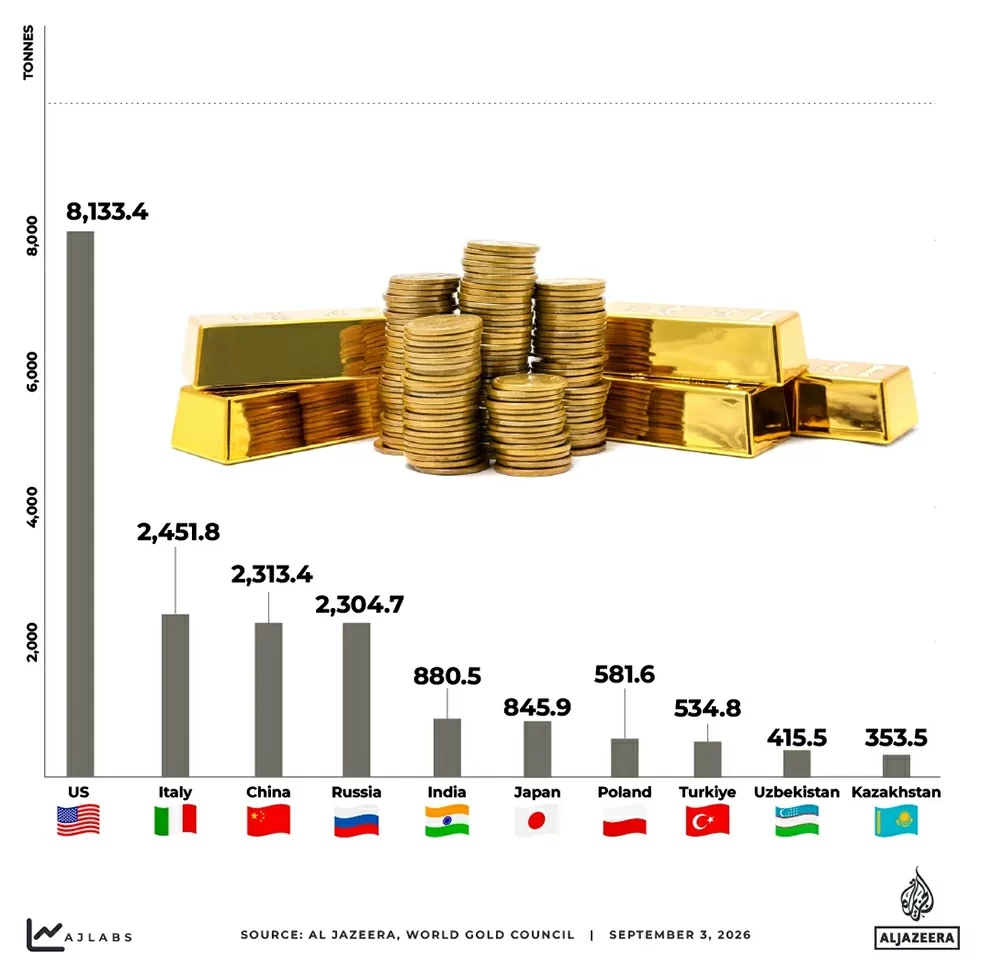
The Netherlands is not the first country to repatriate or reallocate gold reserves from the U.S. this year. Back in January, the Banque de France moved 129 tons of gold valued at $17 billion from New York back to domestic storage in France, partially citing technical upgrade needs. Most famously, Germany completed a four-year project between 2013 and 2017 to repatriate more than 600 tons of gold (valued at $77.5 billion at current prices) from New York vaults back to Frankfurt, framed explicitly as a move to improve the security of the country’s reserve holdings. Currently, the U.S. still holds the world’s largest national gold reserve by a wide margin, with more than 8,100 tons, followed by Italy, China and Russia, each holding over 2,000 tons of official gold reserves.