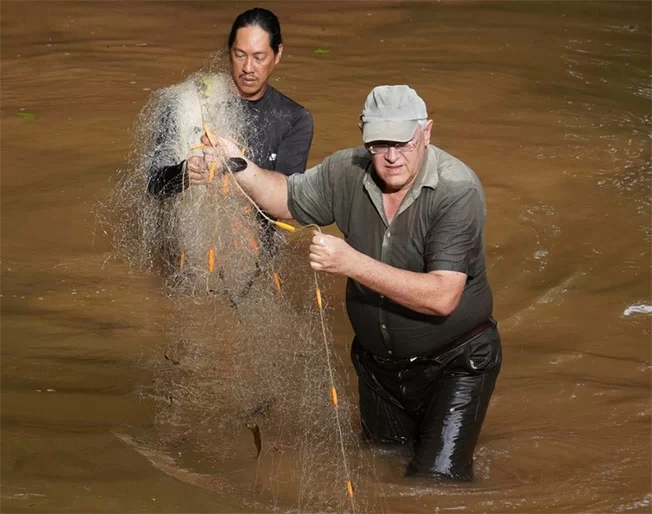
The global scientific community is mourning the passing of Jan Mol, one of the world’s leading experts on South American freshwater fish, who died in his native Netherlands in late August. His death came as a sudden shock to colleagues and collaborators, even as Mol had traveled back to the Netherlands for medical treatment just weeks earlier. The news of his passing was first shared by Mol’s assistant Kenneth Wan Tong You with his long-time colleague Dr. Paul Ouboter, who has penned this tribute to the trailblazing ecologist.
Born in Oss, Netherlands in November 1958, Mol earned his biology degree from Utrecht University before relocating to Suriname in 1987. In a striking coincidence, both Mol and Ouboter officially joined the faculty of Anton de Kom University of Suriname on the same day: June 1, 1987. The pair first connected months before their official start dates, when Ouboter was called on to help treat a green iguana Mol was keeping that had stopped eating.
In the early days of their careers at the university, which had only recently reopened after a period of violent national upheaval, the two Dutch researchers quickly built a close bond as they navigated the challenges of establishing new research programs in the South American nation. Ouboter had secured substantial Dutch funding for his doctoral work on caimans, which allowed him to organize multiple research expeditions into Suriname’s interior. Mol, whose research focused on fish populations, frequently joined these trips, and the pair collected fish specimens alongside Ouboter’s caiman research.
Through decades of rigorous field work — most notably his doctoral research on callichthyid armored catfish — and exhaustive analysis of existing literature on South American fish species, Mol rose to become one of the most respected ichthyologists working on the continent. He completed his PhD at Wageningen University in 1995, and was appointed Professor of Aquatic Ecology at Anton de Kom University a decade later in 2005. While he taught a wide range of undergraduate and graduate courses during his tenure, his greatest passion always remained field and laboratory research, a commitment that produced 57 peer-reviewed scientific publications across his career.
Among Mol’s most impactful contributions to aquatic science are a series of transformative findings. He carried out groundbreaking new research on armored catfish, the group that formed the core of his doctoral work. He also upended common assumptions about the impact of small-scale gold mining on river ecosystems, showing that sediment clouding (rather than mercury contamination) is the primary cause of harm to aquatic life. Mol documented 40 years of shifts in fish communities after the construction of the Brokopondo Reservoir, conducted comprehensive biodiversity surveys of fish populations across Suriname’s major river systems including the Coppename, Palumeu, and rivers in the Nassau and Lely mountains, and contributed to the formal scientific description of multiple previously unknown fish species.
However, Ouboter notes that Mol’s most enduring scientific contribution is likely his 889-page seminal reference work, *The Freshwater Fishes of Suriname*, published in 2012. The text catalogs 480 species of freshwater and brackish water fish found in Suriname, and remains the only comprehensive reference work on the country’s fish fauna to date.
Ouboter, who collaborated with Mol on dozens of research projects and publications over more than 35 years of partnership, remembered his late colleague as a brilliant mind and irreplaceable resource for Suriname’s scientific community. “I will miss him as a brilliant colleague; Suriname loses in him the leading expert on fish and a sharp analytical mind,” Ouboter wrote.