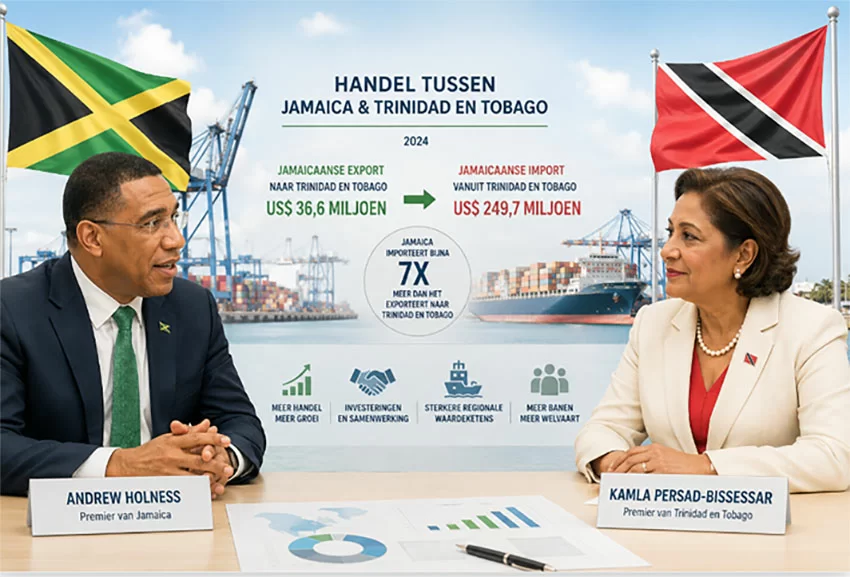
Two of the Caribbean Community (Caricom)’s largest economies, Trinidad and Tobago and Jamaica, have announced plans to deepen bilateral economic cooperation and encourage greater cross-regional business activity, aligning with longstanding regional calls to boost intra-Caribbean trade.
Deborah Thomas-Felix, Trinidad and Tobago’s High Commissioner to Jamaica, has outlined a roadmap for closer ties centered on increasing targeted trade missions, attracting mutual investment, and facilitating direct connections between entrepreneurs from both nations. The push for collaboration builds on tangible progress in bilateral trade relations in recent years, after decades of recurring disputes centered on market access for Jamaican goods in Trinidad and Tobago. In 2022, the two countries implemented a streamlined dispute resolution mechanism designed to accelerate the handling of trade complaints, laying the groundwork for improved relations.
Despite this progress, official trade data for 2024 reveals a significant imbalance in bilateral goods exchange. Jamaica exported just US$36.6 million worth of goods to Trinidad and Tobago last year, while importing roughly US$249.7 million in Trinidadian and Tobagonian goods – meaning Jamaica’s imports from its neighbor are nearly seven times the value of its exports to the country.
Thomas-Felix argues that this imbalance is not an inherently negative issue, but rather a reflection of the two economies’ complementary structural strengths. Trinidad and Tobago has long held a robust competitive advantage in manufacturing and energy production, which has positioned it as a leading goods exporter across the Caribbean. Jamaica, by contrast, has built strong market positions in high-value sectors including tourism, financial services, professional services, and digital services.
The diplomat also noted that Jamaica has already made significant gains in expanding its presence in the Trinidadian and Tobagonian market, with official projections showing Jamaican exports to the country growing by roughly 170% between 2019 and 2025. To sustain this momentum, both sides have already organized a series of reciprocal trade missions in recent years. In May 2025, a delegation from the Trinidad and Tobago Manufacturers’ Association traveled to Jamaica to explore new distribution and investment opportunities, while Jamaican business groups have conducted reciprocal visits to Trinidad and Tobago.
This bilateral push for deeper integration fits into a broader ongoing policy debate across Caricom, which created the Caricom Single Market and Economy (CSME) decades ago to facilitate the free movement of goods, services, capital and labor across member states. Despite this framework, most Caricom economies remain heavily reliant on trade with countries outside the Caribbean region.
Trinidad and Tobago has long advocated for deeper regional integration, arguing that expanded intra-Caricom trade will give small and medium-sized enterprises from across the bloc access to a larger combined market. For Jamaica, expanding goods exports remains a core national economic priority: 2024 data shows Jamaica’s total goods imports reached US$7.29 billion, while total goods exports hit only US$1.91 billion, with Trinidad and Tobago accounting for 3.4% of Jamaica’s total goods imports last year.
Thomas-Felix emphasized that Caribbean nations should shift their focus away from fixating on bilateral trade deficits and surpluses, and instead prioritize collaborative efforts to strengthen the region’s collective economic position and open up larger markets for all domestic businesses. She stressed that complementary strengths across different sectors – from Jamaica’s world-class services to Trinidad and Tobago’s energy and manufacturing capacity – create unique opportunities for mutual growth.
The High Commissioner called for trade missions to move beyond symbolic visits and discussions, and work toward building long-term sustainable partnerships between entrepreneurs, investors, and private sector organizations across both countries. The ultimate goal of this cooperation is to grow the overall volume of economic activity generated within the Caribbean region. This remains a persistent challenge for Caricom: after decades of integration efforts, most of the bloc’s total trade still consists of imports from outside the region, even as member states work to expand domestic production, strengthen food security, and build out robust regional value chains.