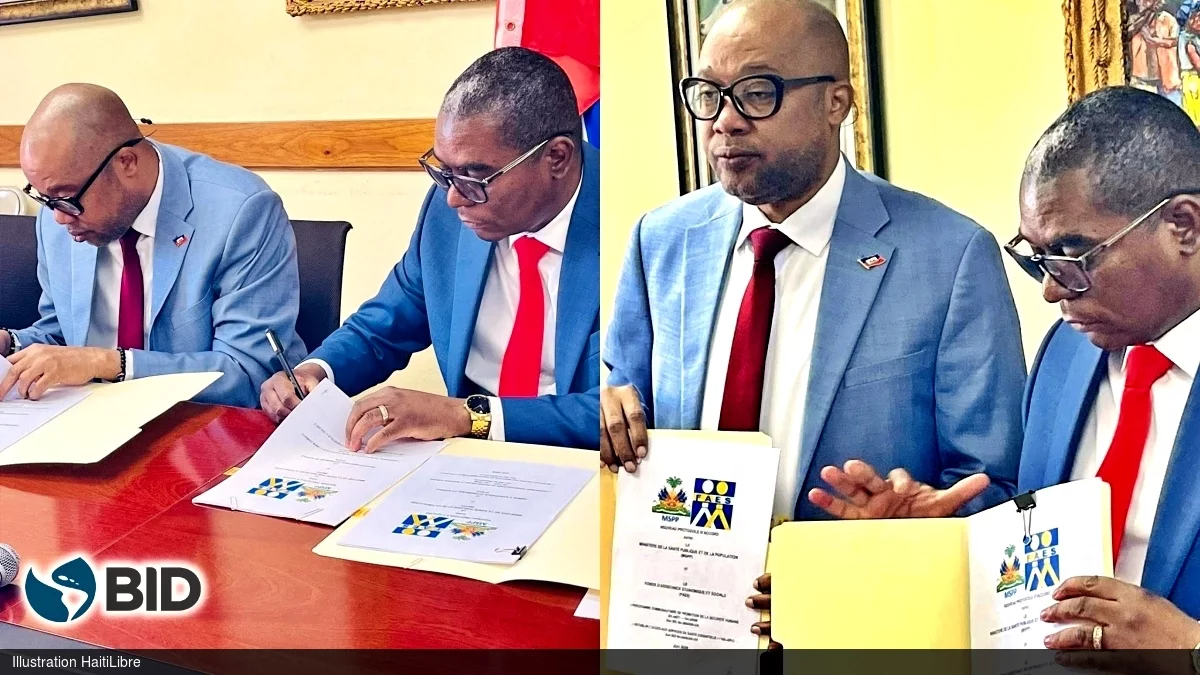
In a significant push to upgrade Haiti’s ailing public health system, Haiti’s Economic and Social Assistance Fund (FAES) and the Ministry of Public Health and Population (MSPP) formalized a new partnership this week with the signing of a Memorandum of Understanding (MoU) that paves the way for two major Inter-American Development Bank (IDB)-funded health initiatives.
The agreement, signed by FAES Director General Kesner Romilus and MSPP Minister Bertrand Sinal, outlines clear operational guidelines for the launch of the Community Program for the Promotion of Human Security in Haiti (project code HA-J0008) and Restoring Access to Essential Health Services (project code HA-J0012), both backed by IDB grant financing. The document codifies the respective roles and responsibilities of the two agencies, lays out standardized protocols for technical oversight, cross-institutional coordination, and progress reporting, and sets binding conditions for all health-focused program activities.
Speaking at the signing ceremony, Minister Sinal highlighted that the agreement represents a core priority for the Haitian government, and thanked FAES for its collaborative efforts to advance the initiative. Under the two programs, a series of critical health infrastructure upgrades are set to move forward, including capacity expansions and renovations for Haiti’s university-level and departmental hospitals, as well as local District Health Units (UAS). The MoU also explicitly authorizes FAES to lead construction and rehabilitation work on healthcare facilities across the country, aligned with the terms of the original financing agreements with the IDB.
A key focus of the initiative is addressing the longstanding shortage of frontline healthcare workers that has crippled service delivery across Haiti. Sinal confirmed that the new program budget allocates funding for the recruitment of roughly 2,000 additional Multipurpose Community Health Workers (ASCPs), on top of the 3,000 healthcare staff already hired by the ministry through the Office of the Prime Minister.
Structured around existing grant agreements between the Haitian government and the IDB, the new MoU is designed to streamline the two programs by integrating their activities under a unified institutional framework, eliminating redundant processes and strengthening collaborative ties between FAES and MSPP. Per the agreement, FAES will serve as the official implementing agency for both projects, leveraging its existing institutional mandate and operational experience to deliver results.
At its core, the partnership aims to build long-term institutional capacity to meet the unmet essential needs of Haiti’s health system, with targeted investments in three core areas: healthcare infrastructure, community-focused primary services, and expanded human resources.
With the formal signing complete, FAES and MSPP are now set to shift toward translating this institutional commitment into tangible, on-the-ground impact, continuing to work closely with the IDB to adhere to the implementation protocols laid out in the agreement.