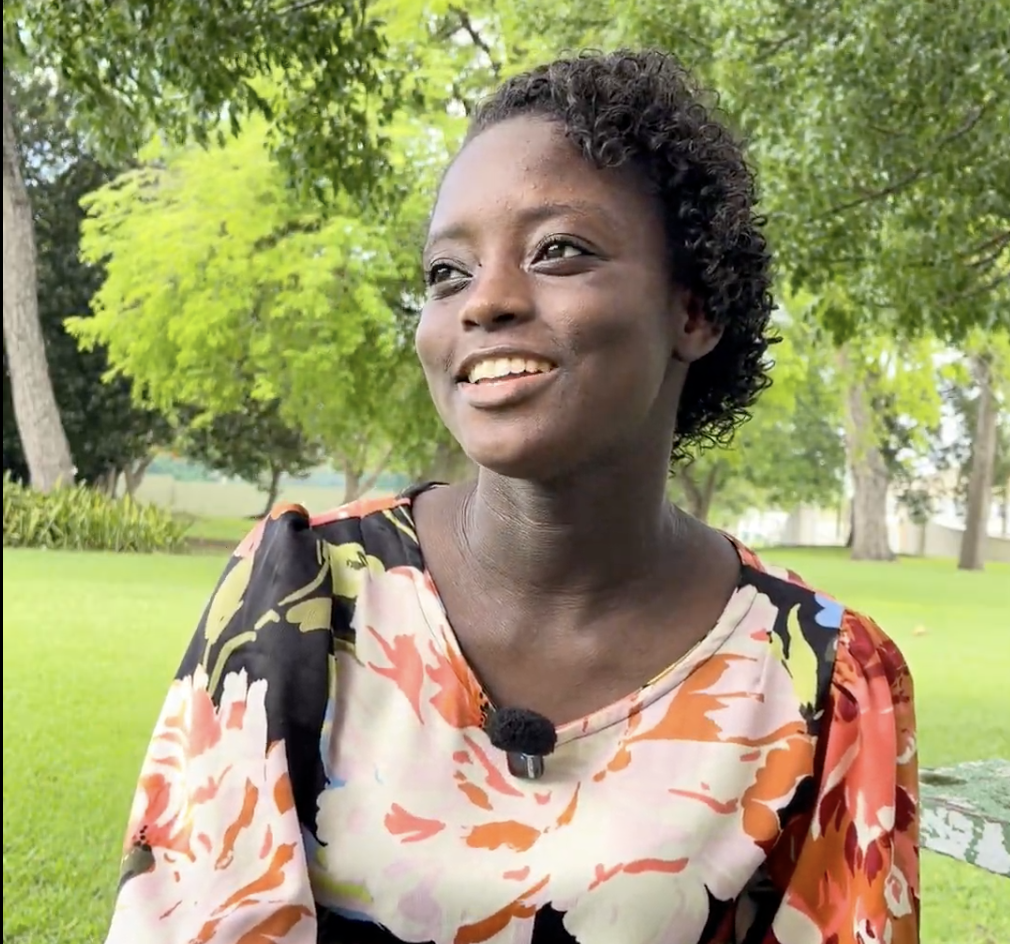
For many people, their career path unfolds in ways they never could have predicted at the start. Leah Nurse, a teaching assistant at Bridgetown Seventh-Day Adventist Primary School in Barbados, knows this experience firsthand. Two years ago, she never imagined building a career in education – but today, she describes working in schools as nothing short of a calling.
Speaking during an interview at Barbados’ Chelston Park on Friday, Nurse opened up about the winding journey that led her to the classroom. “It would not have been my first choice to teach, but since I’ve been in this field for the past two years, I can say that God definitely has plans for me here,” she explained. Currently working toward her undergraduate degree in education, Nurse adds that her decision to enter the profession was rooted in the positive impact that her own childhood teachers had on her. “I had a lot of amazing teachers in school that poured into me in so many different ways,” she recalled. “And seeing how I grew from their empowerment, I really longed to carry on that legacy and to do that for others.”
That commitment to lifting up young learners shapes every part of Nurse’s work with young children. Initially, she had planned to work with older students preparing for the Common Entrance examination, a key academic milestone for Caribbean primary school students. But after being placed with children aged three to six, her perspective shifted entirely. “Before I started, I wanted to teach Common Entrance age, but since I’ve been with these little people, I’ve really fallen in love with them, and they’re just amazing, so I really enjoy it here,” she said.
Working with young children comes with no small share of unexpected challenges, Nurse acknowledges. Lesson plans crafted days in advance can be upended by shifting attention spans, changing moods, and the spontaneous curiosity that defines early childhood. For her, flexibility is non-negotiable for any effective educator. Nurse describes her teaching philosophy as adaptable, student-centered, joyful, and persistent. “You could come with a great lesson plan, but they will also have their own plans, attention span, their moods, everything can be very different from one day to another,” she noted. “Being able to adapt to what I see in front of me and being able to adjust depending on how they’re feeling on any given day is very important to me.”
Beyond adaptability, Nurse prioritizes recognizing each child as a unique learner, rejecting the idea that every student should progress at the same pace or master content in the same way. “Not everyone is good at everything,” she said, emphasizing that effective teaching means centering each student’s individual strengths and gaps – whether that means supporting a student who is struggling to grasp a concept, or challenging a student who has already mastered the material.
This focus on meeting diverse student needs has led Nurse to develop a particular passion for supporting gifted students, an underserved group she argues needs far more attention across the Caribbean region. Her own personal experience as a gifted learner sparked this interest: she explained that she never found traditional school work challenging growing up, a experience that gave her unique insight into the unmet needs of advanced learners.
Nurse defines gifted students as children who develop far faster than their peers in specific academic areas, such as mathematics or language arts. All too often, these students are misunderstood by educators, she says. When their advanced needs are not addressed in the standard classroom, they grow bored with the curriculum, leading to behaviors that are often mislabeled as disruptive or unengaged. “Gifted students often become resentful, they often become disruptive, and then you’re wondering why you have this student in your class that’s not focusing,” Nurse explained. “It’s because they’re bored. They’re beyond the curriculum already.”
For Nurse, identifying the root cause of these behaviors is the first step to building an inclusive classroom where every learner can thrive. She argues that the needs of gifted children are “sadly neglected in the Caribbean”, and is calling for greater educator training and public awareness around how to support these students.
No matter what type of learner she is working with, Nurse says patience and persistence are the backbone of good teaching. “It doesn’t always come to them the first time that you teach it. You might have to teach it five times before they get it,” she noted. On the most challenging days – when the classroom becomes chaotic, and the work feels unglamorous – Nurse returns to the core purpose that drew her to education in the first place.
“Teaching is not always easy, so it’s important to remember why you do it. I do it because I want to inspire others the way that I was inspired,” she said. That sense of purpose is enough to keep her grounded even when “everybody’s crying”, she adds. For any new educators feeling overwhelmed, Nurse shares this advice: “So, I would say remember why you chose to teach in the first place. It keeps you grounded.”