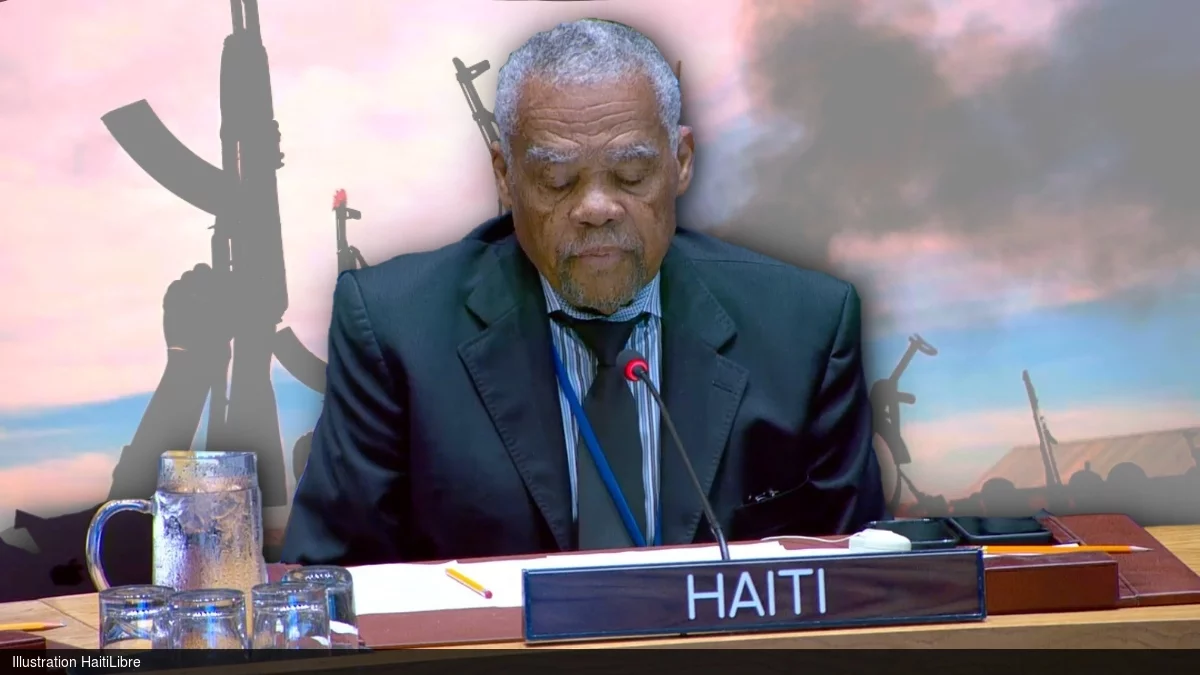
Following a deadly terrorist attack in Kenscoff, the United Nations Security Council reached a formal consensus on August 28, 2026, reaffirming the urgent need to speed up deployment of the long-awaited UN-backed Gang Suppression Force (GSF), also referred to as FRG. Haiti’s UN Ambassador Pierre Ericq Pierre emphasized that the international community must move rapidly to build the force up to its authorized 5,500-member strength and deliver critical resources for its counter-gang mission. He confirmed that Ivory Coast, Mongolia, and Chad have already finalized troop contribution agreements with Haiti, with negotiations set to conclude in the coming days with Bangladesh, Guatemala, Jamaica, and Sri Lanka. However, he made no mention of the underlying challenges that have stalled the mission’s rollout. In reality, three interconnected sets of issues — complex structural transitions, persistent funding shortfalls, and intractable political and logistical barriers — have slowed deployment to a crawl, leaving Haiti’s security crisis to deepen. Four specific factors explain the ongoing delay.
First, the GSF was created to replace the widely panned Kenyan-led Multinational Security Support Mission (MMAS), which Haitian citizens overwhelmingly deemed inadequate and ineffective. The Security Council granted the new force a far more aggressive counter-gang mandate and a higher 5,500-person troop ceiling, but fully restructuring the command chain and integrating newly arriving international contingents has taken far longer than initial planners projected.
Second, contrary to the rapid full-scale deployment that Haitian authorities and the public demanded, the approved rollout plan calls for a gradual phased build-up of forces. Contributing nations require extended preparation timelines before deploying their troops, meaning troop numbers on the ground are rising at a glacial pace, with full operational capability still months out of reach.
Third, unlike traditional UN peacekeeping operations funded through the organization’s mandatory assessed budget, the GSF depends almost entirely on voluntary financial contributions from UN member states. While the UN has established a new support office in Haiti (BANUH) to coordinate logistics, funding remains far too low to properly equip troops to confront heavily armed gang coalitions that control large swathes of the country. Full funding for the force’s first year of operations was never locked in, and the UN does not provide weapons or combat equipment directly, creating a wide gap between public political promises and on-the-ground delivery. When the GSF was formally launched under UN auspices, member states pledged more than $200 million, but annual operating costs for a 5,500-strong force are estimated between $600 million and $800 million. To date, only roughly $59 million of the pledged funds have actually been disbursed to the UN-managed trust fund, leaving the operation far short of the resources needed to cover its first year of activity.
Under GSF rules, contributing nations are required to deploy their troops with their own military equipment, with the UN reimbursing costs through the voluntary trust fund. Many smaller contributing states, such as Chad and El Salvador, lack reserve stocks of the heavy equipment required for counter-gang operations, forcing the United States to frequently issue export waivers or ship equipment directly to these countries before their troops can deploy to Port-au-Prince.
On the ground, GSF contingents alongside Haiti’s national police and armed forces (FAd’H) are facing off against the powerful armed gang coalition Viv Ansanm, which is equipped with high-caliber automatic weapons including AK-47s, AR-15s, and Galil rifles. Four categories of critical military equipment are in acute shortage for urban offensive operations:
1. **Attack and tactical transport helicopters**: Combat helicopters are needed to support ground troops in Port-au-Prince’s dense residential neighborhoods, while transport helicopters would allow rapid reinforcement of outlying areas like the Artibonite region. The limited helicopter capacity currently available, mostly supplied by El Salvador, is entirely dedicated to emergency medical evacuations after most local hospitals closed due to violence.
2. **Urban-adapted light armored vehicles**: While the United States has donated several batches of MRAP armored vehicles to the force, their design is ill-suited to Haiti’s terrain. The bulky, heavy vehicles cannot navigate the narrow, winding alleyways of gang-held slums like Cité Soleil and Bas-Delmas where armed groups are deeply entrenched.
3. **Tactical surveillance and reconnaissance drones**: Counter-gang operations require constant, real-time intelligence to avoid ambushes and fortified barricades, but frontline combat units lack integrated drone technology to track and anticipate gang movements.
4. **Heavy weaponry and armor-piercing ammunition**: Haitian police and advance GSF contingents are routinely outgunned by gang fighters. The force lacks long-range sniper rifles to counter enemy snipers, heavy machine guns for securing checkpoints, and sufficient stockpiles of small arms ammunition. Logistical bottlenecks and delivery delays for lethal equipment from donor nations have left the force chronically short of the ammunition needed to sustain large-scale prolonged offensives.
Beyond the escalating security crisis, the GSF deployment delay has already had a direct destabilizing impact on Haiti’s planned general elections, forcing officials to push key voting dates back to late 2026 or early 2027. Even with the revised timetable, Haitian electoral officials and policy experts warn that if the GSF fails to secure major roads and polling stations in the coming weeks, candidate registration and the official campaign period set to begin in October will unfold in a climate of widespread gang violence, leaving even the adjusted schedule at risk of further delay.