As Cuba gears up for the start of the 2026-2027 general education school year on September 1st, top government and party officials have toured educational and child welfare facilities in Havana to verify final preparations and reaffirm the nation’s commitment to leaving no young learner behind.
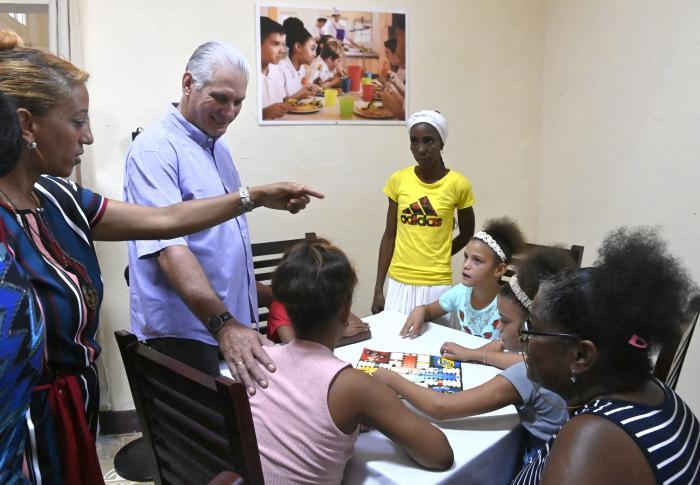
On Wednesday, August 27, Miguel Díaz-Canel Bermúdez, First Secretary of the Central Committee of the Communist Party of Cuba and President of the Republic, led an inspection tour through sites under the Víbora People’s Council in Havana’s Diez de Octubre municipality. Accompanied by Deputy Prime Minister Eduardo Martínez Díaz, Education Minister Naima Ariatne Trujillo Barreto, and other senior officials, the tour began at residential care facilities for children and adolescents without parental guardianship before moving to local schools and the country’s new emergency shelter model for at-risk youth.
Speaking to the presidential press corps during the visit, Minister Trujillo Barreto confirmed that roughly 1.5 million children and adolescents across Cuba are expected to return to classrooms when the new academic term kicks off next week. She noted that preparation work actually started earlier this month, with education professionals cutting short their vacation periods to retrofit campuses, update learning materials, and finalize enrollment plans ahead of the first day of classes.
“Every school is ready to welcome both new and returning students, alongside their family members,” the minister stated. This year’s curriculum framework is designed to incorporate input from all social and economic sectors across the country, with a strong focus on flexible scheduling, individualized learner support, and complementary out-of-class programming that complements core institutional and group learning objectives.
Against Cuba’s current national context, Trujillo Barreto explained that differentiated support will be tailored to the specific needs of each educational level, regional community, classroom cohort, and individual student. To accommodate enrollment demands, many schools will operate double session scheduling where local infrastructure allows. Beyond traditional classroom instruction, the new school year will roll out innovative complementary training projects led by local youth and education professionals, designed to expand learning opportunities outside core lesson times.
As examples of these innovative initiatives, the minister highlighted partnerships with university students specializing in computer science and artificial intelligence, as well as new extracurricular programs focused on arts, music, and sports. She emphasized that local education authorities will retain autonomy to design programming that aligns with their community’s unique resources and needs, ensuring programs remain practical and sustainable over the full academic term.
Trujillo Barreto added that early inspections across the island have already revealed high levels of commitment from education professionals at all levels, as well as strong engagement from cross-sector partners. Moving forward, rigorous ongoing monitoring will be prioritized, particularly to support students who have been disconnected from formal education and require targeted, personalized interventions to re-engage with learning.
The tour through the Víbora community carried deep symbolic meaning, as the area hosts a network of child protection institutions established under Cuba’s recently implemented Children, Adolescents, and Youth Code. After visiting the Víbora II residential home for youth without parental care, where Díaz-Canel asked detailed questions about daily operations, community partnerships, and the children’s academic and recreational schedules, the delegation traveled to the Víbora I Infant Home. There, the president praised the facility’s 10-person staff, noting that their work caring for vulnerable young children requires extraordinary empathy and selfless dedication.
The final stop on the tour was the new Urgent Shelter, a transitional care space designed to provide immediate, safe housing for children and adolescents facing extreme vulnerability, while child protection specialists develop long-term personalized care plans. From the shelter, youth can transition to foster care, live with biological family members prepared to assume guardianship, or move to long-term residential care, depending on what arrangement best serves the child’s needs.
As the new school year approaches, new backpacks and learning supplies already wait in classrooms across the community. During the tour, Díaz-Canel reaffirmed a core principle of Cuba’s revolutionary education system: that every child, regardless of their family background or personal circumstances, deserves access to quality education and protection. The visit underscored the government’s ongoing commitment to upholding this promise, ensuring no young Cuban is left without support as the new academic year begins.