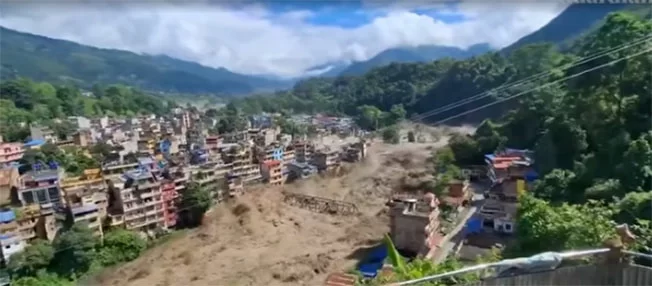
A catastrophic glacial flooding disaster across the Himalayan region has claimed at least 359 lives, according to the latest official updates from Nepalese authorities, with more than 1,000 people still unaccounted for as rescue operations continue through challenging terrain. Among the missing are 517 foreign nationals, including dozens of pilgrims who had recently traveled to the sacred Mount Kailash in Tibet, a site of profound religious significance for communities across South Asia and the world. Officials and disaster response experts warn that the final death toll is expected to rise, with ongoing risks of additional catastrophic flood surges in the coming days.
The disaster unfolded when a massive surge of water, ice, mud, and rock suddenly cascaded down from high-altitude Tibetan regions toward northern Nepal’s border areas, the zone hardest hit by the event. Entire homes, paved roadways, and critical bridge infrastructure were swept away in the rush of debris, cutting off dozens of small mountain communities from outside aid and communication. Growing evidence points to the collapse of a large section of a glacial ice formation or a massive ice avalanche as the trigger for the destructive flood wave. Satellite imagery analyzed by glaciologists confirms that a large segment of a Himalayan glacier has broken off, though researchers are still conducting investigations to pinpoint the exact underlying causes of the collapse.
The disaster zone lies along the primary pilgrimage route to Mount Kailash and adjacent Lake Manasarovar, two sites that draw thousands of religious travelers annually. Mount Kailash is considered a holy site for Hindu, Tibetan Buddhist, Jain, and Bon religious communities, attracting pilgrims from across the globe every year. Indian spiritual leader Sadhguru Jaggi Vasudev has confirmed that his organization, the Isha Foundation, has lost contact with 80 participants and volunteers from a Kailash pilgrimage it organized. When the flood struck, 77 of the group were staying in Gyirong on the Tibetan side of the border, while three were in Timure on the Nepalese side, and there has been no confirmation of their status as of Tuesday morning.
The missing foreign nationals represent a wide range of nationalities, including citizens of the United States, Canada, Australia, the United Kingdom, and one Dutch national who was part of the Isha Foundation pilgrimage group.
Rescue teams from Nepal, China, and international disaster response organizations have been working around the clock to locate survivors and recover bodies, but their operations have been severely hampered by the widespread destruction of transport infrastructure. Widespread landslides triggered by the initial flood event and the collapse of communication networks have also slowed search efforts. Key public infrastructure, including hydropower facilities and electrical transmission lines, has also been damaged in the disaster, leaving many local communities without power or clean drinking water.
Authorities have stressed that the danger is not yet over. Unstable glacial ice formations, residual standing water, and loose rock at high elevations create a continued risk of additional flood surges that could downstream impact rescue teams and already affected communities. With hundreds of people still missing, disaster response officials are bracing for a significant increase in the confirmed death toll as search operations progress and access to remote areas improves. Beyond affecting local communities in Nepal and the Tibetan Autonomous Region of China, the disaster has taken on an international dimension due to the large number of foreign travelers and pilgrims impacted in the event.