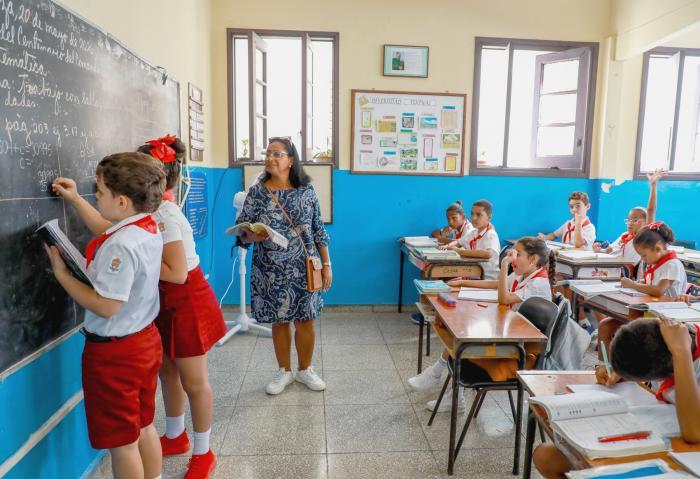
As Cuba prepares to kick off the 2026-2027 academic year across all education tiers on September 1, education officials are rolling out localized, flexible strategies to keep learning continuous amid widespread national challenges, including persistent energy shortages and resource limitations that have disrupted daily life for Cuban families.
During an inspection tour of pre-term preparation work across the country, Cuban Minister of Education Naima Trujillo Barreto confirmed that institutional and community stakeholders are working collectively to deliver a “dignified and sustainable” school year, prioritizing the core educational needs of children and adolescents within the bounds of available local resources.
Reports from the Cuban News Agency (ACN) quote the minister stressing that one-size-fits-all approaches cannot work in the current context. Instead, education leaders are calling for innovative, adaptive solutions customized to the unique conditions of each school, neighborhood, municipality, and province. This approach ensures that existing resource constraints do not undermine the delivery of efficient, high-quality teaching and learning.
The core challenge extends far beyond classroom walls, as systemic obstacles including fuel scarcity, unreliable transportation, frequent power outages, limited basic supply chains, and material shortages have directly impacted household stability. Education authorities have responded by developing context-appropriate alternative frameworks that keep teaching activities on track while accounting for regional variation in conditions.
Higher education institutions across Cuba will also launch their 2026-2027 academic calendar on September 1, building on successful decentralized, territory-focused organizational models tested during the previous semester. For the upcoming term, all enrollment processes—including new student registration, readmission for returning learners, and enrollment renewal—will be administered locally at students’ places of residence. Students may complete these procedures either in person or online, aligned with the digital and personnel resources available at each university, Municipal University Center (CUM), and Municipal University Branch (FUM).
University coursework will combine blended and distance learning structures. In-person instruction will be scheduled when local conditions allow, prioritizing daytime students, and classes can be hosted at a range of local sites beyond main university campuses, including CUMs, FUMs, and regional production and service entities. Blended programs plan to host in-person gatherings at least once per month, while fully distance learning courses will continue to operate under their established structures.
The aligned strategies for both K-12 general education and post-secondary higher education share a single core mission: preserving uninterrupted access to education through increased organizational flexibility and more intentional, efficient use of limited existing resources. Rejecting uniform policies that fail to account for divergent local conditions, the new framework centers local needs in all organizational decisions.
The upcoming school term will require coordinated extra effort from teachers, students, families, and local government authorities. Lead education agencies emphasize that their end goal is not just to avoid an interruption to the educational process amid current challenges, but to build a reorganized system that is responsive to the specific context of every Cuban community.