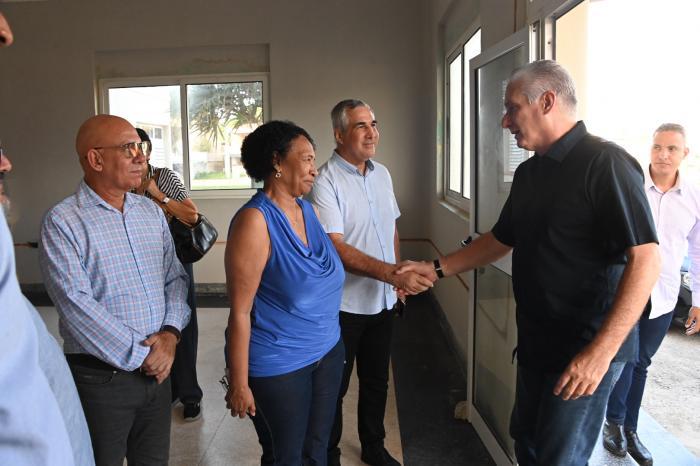
On a Thursday morning in late August, Cuban President Miguel Díaz-Canel Bermúdez, who also serves as First Secretary of the Central Committee of the Communist Party of Cuba, carried out an official working visit to two key institutions in Havana’s coastal Playa municipality: the future permanent headquarters of the Higher Institute of Design (ISDI) at the University of Havana, and CETA S.A., a university-linked science and technology interface enterprise attached to Havana’s José Antonio Echeverría Technological University.
During his first stop at the historic Art Deco building, steps from the Caribbean Sea, Díaz-Canel was greeted by ISDI Dean Dr. Sergio Luis Peña Martínez, who walked the president through the extensive renovation work completed to transform the space into Cuba’s new flagship hub for design education. After touring the light-filled, multi-purpose open-concept facilities, which are being finalized ahead of the new academic year, Díaz-Canel encouraged the institute’s community to infuse the new campus with their own creative vision and energy. He predicted the space would ultimately become both architecturally striking and deeply functional for emerging Cuban designers. To add student perspective and buy-in to the final stages of the project, Díaz-Canel proposed inviting recent ISDI graduates to contribute to refining and finishing the campus ahead of the first cohort of students moving in.
Speaking to reporters after the presidential tour, Dean Peña emphasized the significance of the project, noting that after years of planning and work, Cuba’s leading design program will finally have a purpose-built, permanent home. Even amid the country’s ongoing economic challenges, Peña explained that coordinated resources, collective effort and national commitment have made the renovation possible. He stressed that a high-quality design education cannot thrive in a substandard space: “You can’t learn to make beautiful and useful things in a space that isn’t beautiful, that doesn’t have, as its philosophy or focus, the concept of being a well-conceived space.” The dean added that the renovated campus delivers major gains in operational coherence, educational quality, and intentional design, framing the project as a deliberate investment to deliver the design school that Cuban students, and the Cuban design sector, deserve.
A state construction ministry-led team has overseen the renovation work, with multiple contracted crews contributing to the project. While final finishing touches are still ongoing, Peña confirmed that the institute plans to welcome students for in-person classes in some completed spaces when the new semester begins in September, with additional facilities including design labs and performance spaces opening in phases as work wraps up. The four-year degree program at ISDI will eventually accommodate roughly 500 design students on the new campus, and Peña shared his belief that students are the core of the university’s mission. For this reason, the institute plans to involve current and recent students in the final stages of campus development, to ensure the space meets the needs of the community it serves. At the close of his visit, Díaz-Canel expressed sincere satisfaction with the progress of the project, with his warm farewell embrace of Dean Peña reflecting widespread optimism about the institute’s future in its new home.
Following his tour of the ISDI campus, Díaz-Canel traveled to the second stop on his itinerary: CETA S.A., the science and technology interface society that connects Cuban universities to the country’s productive and service sectors. Meeting with the company’s leadership, the president urged CETA’s directors to leverage the full range of new powers granted to private and semi-independent enterprises under Cuba’s ongoing economic reforms.
Founded in August 2020, CETA S.A. operates as a critical two-way bridge between academic research and industry: it transfers science and innovation outcomes developed at Cuban universities to domestic businesses, while bringing real-world industry challenges back to university research teams to address. CETA President Danae Pigueiras Otero outlined the company’s progress for the president, noting that the firm has achieved solid organizational consolidation and made major advances in engineering, architecture, international partnership building, and export activity in its first six years of operation.
Pigueiras emphasized that CETA has a central role to play in Cuba’s ongoing national economic transformation, not only as an enterprise subject to these reforms, but as a key partner that can help the entire productive sector implement changes effectively and deliver tangible benefits to Cuban businesses. She identified export growth as one of CETA’s top strategic priorities, noting that expanding non-traditional exports is a critical national goal that the company is prioritizing through intentional, targeted work.
CETA’s core partnership network currently includes interface societies in nearly every Cuban province and all of the country’s major universities, along with the Cuban Chamber of Commerce, which provides critical support for enterprise activity. Pigueiras noted that Cuban universities are the foundation of CETA’s mission, and the company has built robust in-house capabilities through intentional, efficient management. Its core value proposition lies in integrating academic scientific expertise to solve pressing practical challenges faced by Cuban companies. Looking ahead, Pigueiras framed Cuba’s ongoing economic and social transformations as a major opportunity for CETA to position itself as a trusted ally for the productive sector as it adapts to new policy frameworks and market conditions.