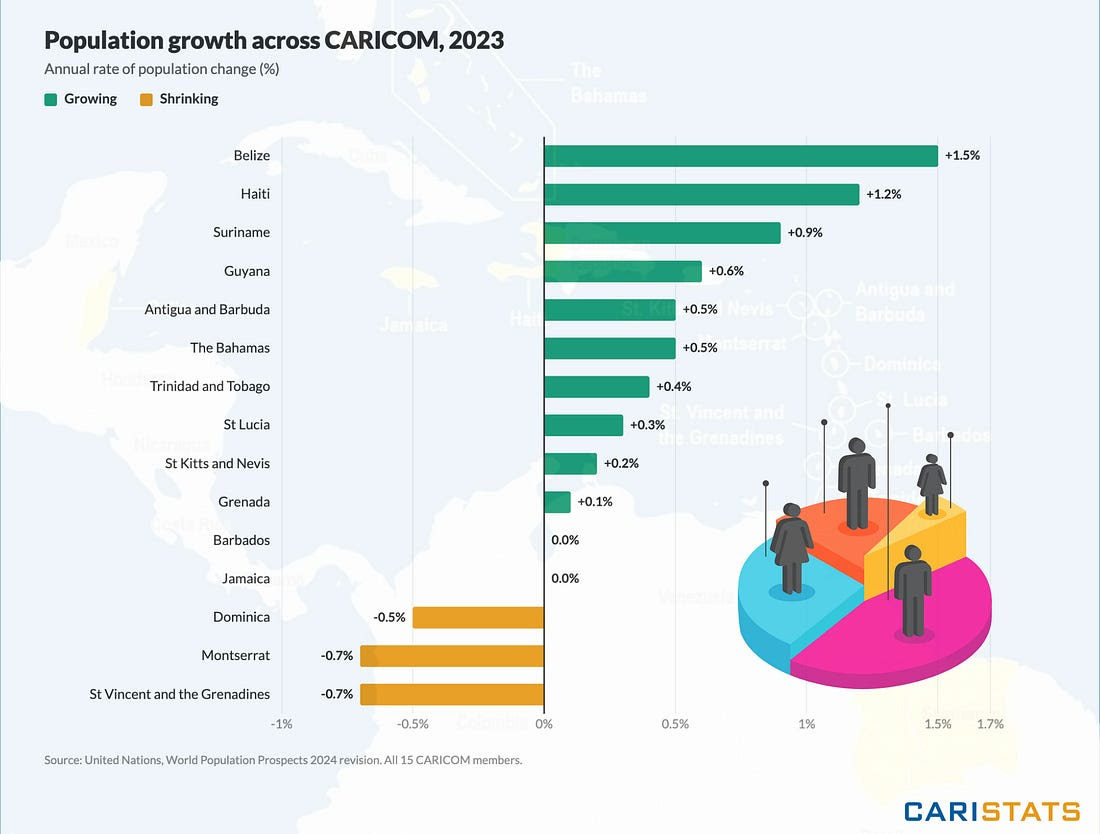
Population growth trajectories act as a silent foundational force shaping the long-term trajectory of every national economy, dictating critical metrics from future labor force size to the scale of consumer demand, and the required capacity of core public assets including housing, educational institutions, and government services. Broadly speaking, consistent population expansion and sustained population contraction pull economic development in fundamentally opposing directions, creating vastly different policy priorities for nations on each end of the spectrum. In 2023, the most recent year for which the United Nations has released population estimates, the 15-member Caribbean Community (CARICOM) blocs displayed this divide in stark terms, with member states scattered across every point of the population growth spectrum. At the upper end of the growth ranking, Belize recorded the bloc’s fastest annual population increase at 1.5%, with Suriname and The Bahamas joining it in the group of CARICOM nations still experiencing positive population growth. On the opposite side of the divide, three CARICOM members registered outright total population decline in 2023: Dominica, Montserrat, and St. Vincent and the Grenadines, with annual contraction rates ranging between 0.5% and 0.7%. Jamaica and Barbados fell between these two extremes, posting effectively zero net population change for the year. All population shifts can be traced back to two core driving factors: the balance of births versus deaths, and the balance of immigration versus emigration. Jamaica offers a clear illustration of the demographic squeeze hitting many CARICOM nations: while the number of births still exceeded the number of deaths in 2023, high levels of net emigration completely offset this natural increase, leaving the total population unchanged. St. Vincent and the Grenadines posted the highest net emigration rate across the entire CARICOM region in 2023. For Dominica and Montserrat, the demographic shift is even more advanced: natural population change has already turned negative, with annual deaths outnumbering births, and ongoing emigration compounds this annual population loss. For a growing number of CARICOM member states, the long-held assumption that population will automatically grow to expand the domestic labor pool and consumer base can no longer be taken for granted, forcing policymakers to reimagine long-term economic planning around new demographic realities.
Antigua and Barbuda’s Population grew, Dominica’s population shrank in recent years