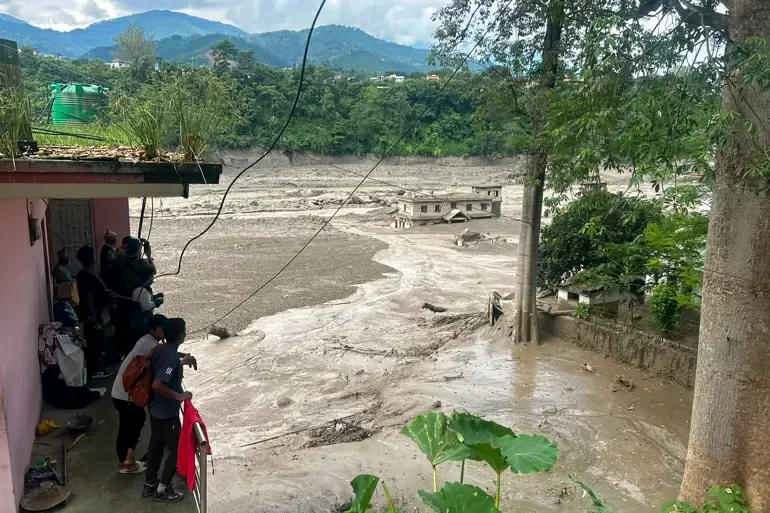
Devastating sudden flash floods and mudslides have torn through mountainous northern Nepal and cross-border regions of Tibet, leaving at least 22 people dead and hundreds unaccounted for, according to official statements from regional and national authorities.
The disaster struck the Rasuwa district of Nepal on Wednesday, heavily impacting the populated local areas of Syapru Besi and Timure, which are home to roughly 50,000 residents. Unsafe, rapidly rising floodwaters have grounded rescue helicopters, severely delaying the delivery of life-saving aid to affected communities. Among those reported missing are 384 tourists, including 291 visitors from nations spanning the United Kingdom, the United States, India, and Malaysia.
Narendra Pariyar, chief administrator of Rasuwa district, has issued an urgent warning for all residents living along the Bhote Koshi River to evacuate immediately to higher ground. The surging floodwaters have already swept away entire nearby villages and critical infrastructure projects, leaving extensive destruction in their wake. The disaster has also spread to neighboring districts including Dhading and Nuwakot, where roads have been submerged, local properties damaged, and rescue operations are underway to reach trapped residents.
Across the border in Tibet’s Gyirong port area, a destructive mudflow has also caused major damage, disrupting road access, cutting communications, and knocking out power supplies to local communities. Chinese President Xi Jinping has called for full mobilization of search and rescue efforts, while emphasizing the urgent need to strengthen early warning systems to prevent secondary disasters after the initial event.
In response to the crisis, Nepali Prime Minister Balendra Shah has convened an emergency meeting of the country’s National Disaster Management Authority. Nepali armed forces have already been deployed to the affected regions, mobilizing helicopter assets and dedicated ground rescue teams. The Nepal Electricity Authority confirmed that around 430 megawatts of hydropower generation capacity has been damaged by the floods, resulting in widespread power outages across affected areas.
International stakeholders have also been drawn into the response: eight South Korean workers at a local hydropower project in Nepal are currently missing, with another 10 trapped at the site. The South Korean government has already established a dedicated task force and is preparing to deploy a rapid response team to support Nepali rescue operations.
Climate and glacial experts suspect the disaster was triggered by a glacial lake outburst flood (GLOF), a phenomenon that occurs when an avalanche of ice and rock blocks a river, creating a sudden, catastrophic burst of trapped water when the barrier fails. This event mirrors a similar outburst flood that hit the same cross-border region last year, killing nine people and destroying the key Friendship Bridge connecting Nepal and China.
Researchers warn that climate change is driving a steady increase in both the frequency and intensity of these glacial outburst events across the Hindu Kush Himalaya region. The annual monsoon season, which runs from June to September across South Asia, already brings regular severe flooding and landslides that threaten lives, destroy livelihoods, and cripple local infrastructure each year. As of Tuesday, rescue operations and damage assessments are still ongoing, meaning the full scope of human and economic loss from this latest disaster remains unclear.