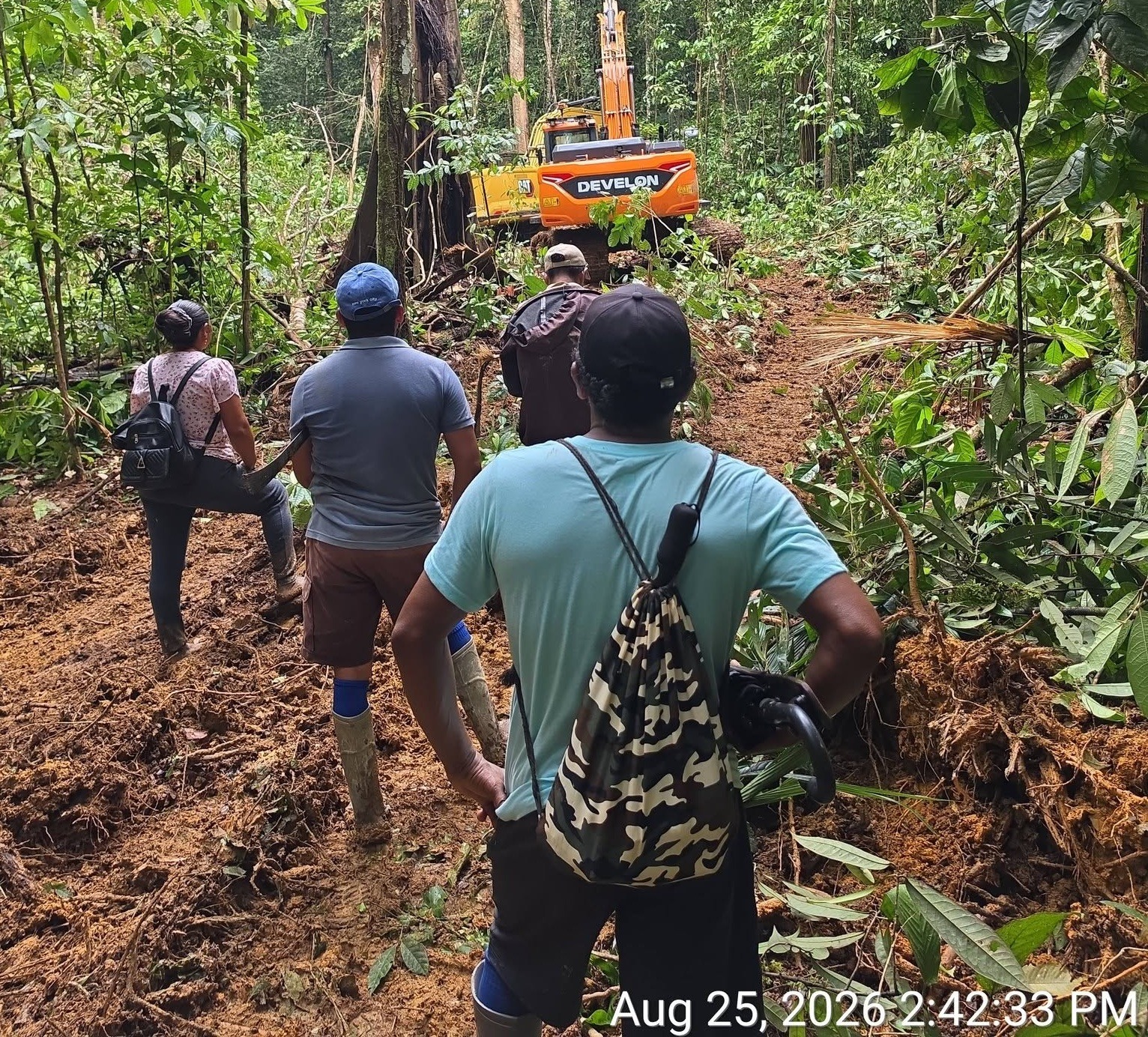
On Tuesday, August 25, 2026, the Guyana Human Rights Association (GHRA) issued an urgent formal appeal to the United Nations Development Programme, the European Union, and top global and regional human rights bodies calling for immediate intervention from the United Nations and Inter-American human rights systems to defend the territorial and human rights of Indigenous Amerindian communities in Guyana’s Chinese Landing region, where a controversial gold mining expansion is set to begin imminently.
The appeal targets a broad roster of senior global leaders, including the UN Secretary-General, UN High Commissioner for Human Rights, President of the UN General Assembly, President of the UN Security Council, head of the UN Permanent Forum on Indigenous Peoples, UN Special Rapporteur on the Rights of Indigenous Peoples, Secretary-General of the Organization of American States, Chair of the Inter-American Commission on Human Rights (IACHR), the President of the European Union, and Guyana’s Permanent Representative to the UN. GHRA is pushing for global bodies to pressure the Guyanese government to immediately enforce long-ignored interim precautionary measures ordered by the IACHR to protect Indigenous lands, and to rein in private mining actors that have disregarded regional human rights recommendations.
GHRA has framed the situation as a rapidly escalating crisis, warning that the imminent expansion of mining threatens to destroy Indigenous communities’ traditional lands, way of life, and physical assets. The rights group emphasized that the urgency of international intervention stems directly from the Guyanese government’s refusal to comply with the IACHR’s July 24, 2023 order for interim protection measures for the Indigenous communities that hold legal and traditional ownership of the contested lands. Far from enforcing the court-ordered measures, GHRA says the government has allowed a private mining operator to move heavy excavation and extraction equipment onto the territory despite widespread protests from local residents. “The situation is fraught with danger for the Indigenous Peoples and their lands and properties. Indigenous Lives are at risk. And the Government of Guyana is a silent witness to these events, instead of providing protection to the Indigenous Peoples affected,” the association stated in its appeal.
The organization also highlighted systemic gaps in the protection of Indigenous rights across Guyana, noting that the country’s existing legal framework is not aligned with the UN Declaration on the Rights of Indigenous Peoples, and that a formally established national Commission on Indigenous Rights has never exercised its mandate to protect Indigenous communities. “Indigenous peoples are without protection, notwithstanding the existence on paper of a Commission on Indigenous Rights – which has never acted in protective mode,” GHRA said. The group is calling for the immediate establishment of an international monitoring regime to oversee compliance with global Indigenous rights norms in Guyana, and for an urgent situation report to be submitted to both the UN Human Rights Council and UN Security Council.
Local Indigenous leaders have corroborated the GHRA’s warnings, detailing the mining operator’s repeated attempts to sneak heavy equipment onto their titled territory despite a lack of free, prior, and informed consent required under Guyana’s Amerindian Act and national constitution. In a public statement posted to Facebook, the Chinese Landing-Tassawini Village Council reported that mining operators recently redirected excavators that were blocked from entering Chinese Landing territory, offloading the machinery at nearby Kariako, a part of the village’s titled land, without notifying or gaining approval from the village council.
“The excavators were ordered to leave Kariako lands immediately because the village council were not informed and no consent was given by the Kariako VC. It seems as though the miners would not leave but using all options to enter into Tassawin,” the council’s statement read. Over recent days, villagers have staged peaceful protests to block access to the Tassawin backdam, after recording the entry of at least nine excavators, two bulldozers, and multiple dredge engines transported via barge, all without formal village approval. The council confirmed all equipment is registered to a private miner that holds claims to several disputed mining blocks within the village’s official title.
The village council noted it has been participating in good-faith mediation talks with the miner while a formal court case over the mining claims remains pending, and that the operator’s push to advance mining preparations during negotiations undermines the entire mediation process. “We consider it inappropriate for (the named miner) to prepare for or carry on mining activities while these discussions are ongoing, as these actions undermine the legitimacy and fairness of the mediation process,” the council said.
After the on-duty officer from the Guyana Geology and Mines Commission (GGMC) told the village council he lacked the authority or willingness to block the equipment from entering the disputed blocks, villagers made the decision to stage a physical blockade to stop the machinery from advancing deeper into their traditional lands. The village council has formally called on the Ministry of Natural Resources and GGMC to suspend all mining operations in the area until mediation concludes and the village grants formal consent for extraction activities. Mining on the site first resumed in March 2026, with the council only notified of the restart during the National Toshaos Conference held this past July.
Responding to the escalating conflict, Vickram Bharrat, Guyana’s Minister of Natural Resources, told local outlet Demerara Waves Online News that the government is currently facilitating dialogue between the Indigenous community and the mining operator.