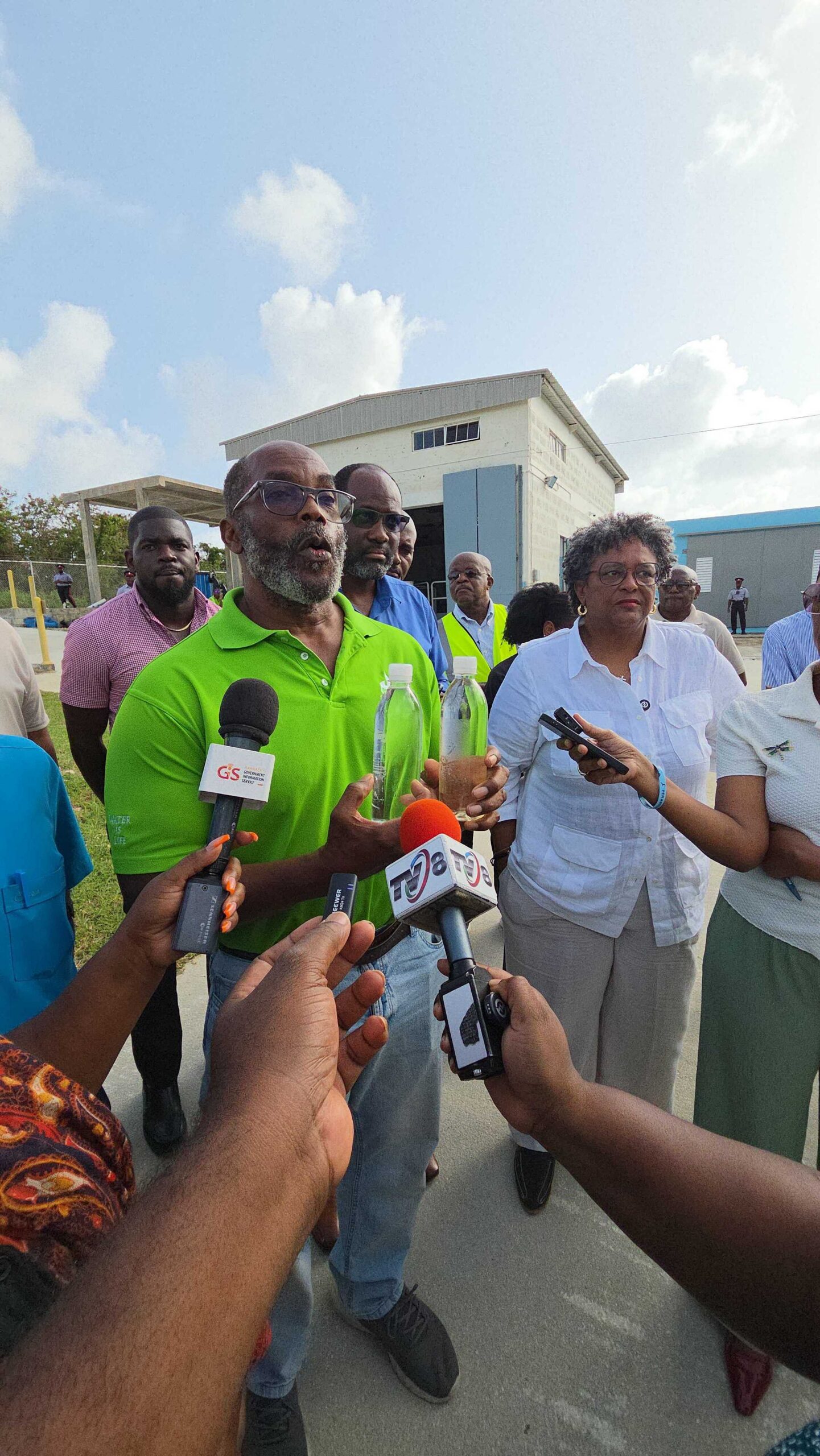
Residents of Barbados’ St Lucy parish have received formal reassurance from the Barbados Water Authority (BWA) that their tap water remains safe for human consumption and fully compliant with World Health Organization (WHO) health standards, even as persistent discolouration affects portions of the region. During an on-site press briefing at the Alleynedale Pumping Station Tuesday, BWA Water Resources Manager Alex Ifill clarified that the only regulatory threshold being violated relates to aesthetic guidelines for water clarity, not any safety metric that poses a risk to public health.
“The only standard this breaches is the colour limit,” Ifill explained. “Is it safe? It is absolutely safe to drink… Colour itself is not a health-related standard for drinking water; it is simply an aesthetic standard to ensure consumer comfort.”
Ifill noted that the water discolouration issue has already improved dramatically thanks to a dual-pronged mitigation strategy rolled out by the BWA. In addition to systematically corroded outdated water mains across the parish, the authority has temporarily re-routed water production for affected zones to the Villa Maria treatment facility in St Joseph. This shift has already delivered clearer water to multiple impacted communities, including sections of Six Mens and Checker Hall.
The ongoing infrastructure overhaul to resolve St Lucy’s long-running water quality issues has required hundreds of millions of dollars in public investment. BWA Engineering Director Charles Leslie revealed that the authority has already spent roughly $43 million to replace 43 kilometers of aging water mains, working out to an average cost of $1 million per kilometer of pipe. A further $5 million is being invested in a new purpose-built water treatment facility at Alleynedale, designed to permanently resolve the discolouration problem.
“Just about $5 million covers all the different components, getting the facility set up and integrated into the existing distribution system,” Leslie said.
As of mid-progress updates, the new custom filtration system for the facility has not yet been fully installed. All equipment for the project is being transported to Barbados in five shipping containers, but global logistical disruptions have pushed back the facility’s launch timeline. Prime Minister Mia Mottley explained that the delays stem from multiple factors: widespread global supply chain holdups affecting shipping, plus an unplanned need to relocate the equipment’s proposed site at the Alleynedale facility. International shipping challenges, including congestion at the Panama Canal and ongoing trade disruptions linked to tensions in the Middle East, have not driven up the contracted cost of the treatment equipment, Leslie confirmed.
Officials now target commissioning the new treatment facility between late December 2024 and the end of February 2025. To support affected residents during the extended construction period, Prime Minister Mottley announced the government will continue covering basic water rates for all St Lucy households until the filtration project is fully operational. The subsidy was originally scheduled to expire in September, but the extended relief will cost the Ministry of Finance approximately $150,000 each month.
“Logistical shipping issues, combined with having to move the equipment between locations on site, have led us to decide we will continue carrying the subsidy until this project is finished,” Mottley stated.
Across St Lucy, there are roughly 4,700 registered residential and commercial water connections. Officials report that a large share of these households are already receiving clear water as incremental upgrades progress, with full resolution expected once the new treatment facility comes online.