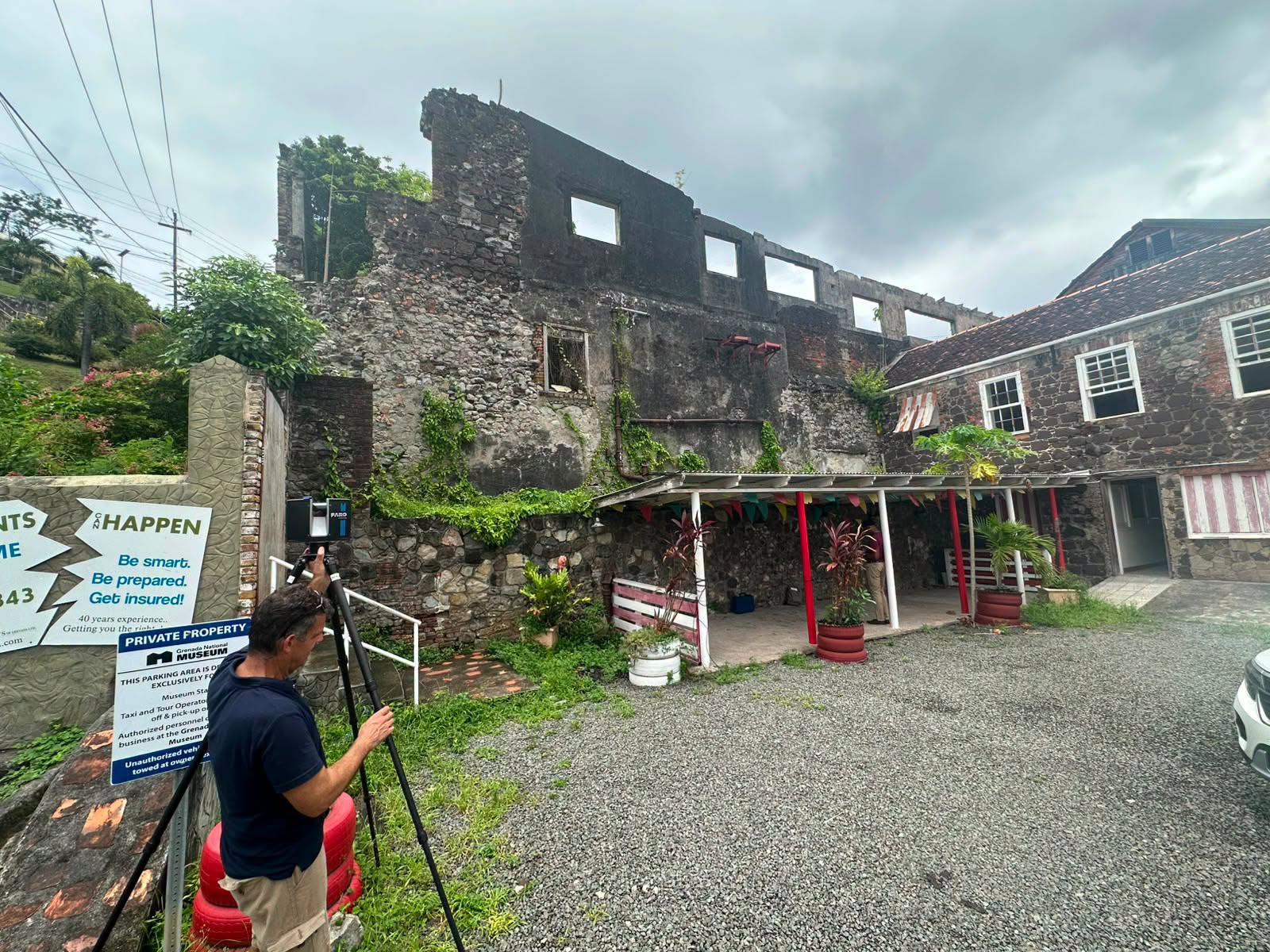
A landmark legal ruling in Grenada has temporarily blocked the planned demolition of one of the country’s most culturally significant historic sites, opening the door for a global team of heritage conservation specialists to launch a comprehensive assessment of the Drill Yard’s preservation potential. Located within the Antilles Complex, the Fort George precinct, and the heart of historic St George’s, the site holds deep layered connections to Grenada’s colonial past, enslavement systems, Fedon’s Rebellion, military history, and centuries of civic life.
The interim injunction, granted by Grenada’s Supreme Court in a case brought by the Grenada National Trust (GNT), orders that no demolition work can proceed until the technical assessment is formally underway, with a mandatory deadline for on-site work to commence by 31 August 2026. Per the court’s Consent Order, GNT was tasked with coordinating with UNESCO and relevant global heritage bodies to assemble the specialist assessment team and complete urgent hoarding works to secure the deteriorating structure and protect the public from safety risks.
Currently, the first phase of on-site assessment is being led by an international delegation organized in partnership with GNT and the International National Trusts Organisation (INTO). The project is coordinated remotely from the Netherlands by Mark van den Bos, who previously contributed to a desk-based document review of the Drill Yard organized jointly by GNT and INTO. Leading the in-country technical work is Bas Notenboom, a Dutch civil engineer and 3D scanning specialist and managing director of Lead 3D, joined on the ground by Robin Koot, a construction engineer focused on heritage site conservation, and Isabella van den Bussche. Both Koot and van den Bussche bring hands-on experience from similar ongoing heritage projects across the Dutch Caribbean islands of Curaçao and Bonaire. The team has already begun examining the Drill Yard’s structural condition and mapping the technical requirements for potential stabilization and rehabilitation.
GNT First Vice President Dr Ezra Matthias emphasized that the court-ordered pause represents far more than a reprieve for a single historic building on Young Street. “This has become a national opportunity,” Matthias noted, clarifying a common misinterpretation of the 31 August deadline: the court only requires that the specialist team be on site and assessment work commenced by that date, not that the full review be finalized. This timeline creates a critical window to secure the structure, bring in global expertise, and evaluate all viable options for the site, he explained.
For GNT, the core of the dispute has never been a choice between public safety and heritage preservation. “The Trust has not argued that public safety should be ignored,” Matthias said. “It has been argued that safety and preservation must be handled together.”
The court process has already sparked unprecedented international collaboration around the Drill Yard’s future. Beyond the initial technical team, the International Council on Monuments and Sites (ICOMOS) International Scientific Committee on Fortifications and Military Heritage (ICOFORT) has offered high-level specialist support, with a team scheduled to visit Grenada from 2–4 September 2026. ICOFORT’s contribution will include structural safety assessments, exploration of preservation, rehabilitation and adaptive reuse options, development of a cost-effective long-term management plan, and guidance on heritage assessment and salvage protocols.
Proposed assessment measures include a high-resolution 3D laser scan of the entire structure, which will create a permanent detailed digital record that allows global specialists to analyze the site remotely and preserves an accurate archive for future generations. Matthias also highlighted the opportunity for local capacity building through the international mission: the presence of global experts offers a unique learning chance for local Grenadian engineers, architects, planners, students, historians, museum staff, builders, tour guides, and cultural practitioners to gain firsthand experience in heritage preservation engineering, historic masonry assessment, 3D scanning, building archaeology, conservation architecture, and adaptive reuse planning. Matthias called on the government to organize formal knowledge-sharing initiatives, including technical briefings, student observation opportunities, public workshops, and lectures to maximize this benefit.
Beyond the Drill Yard itself, Matthias framed the case as a critical warning about the broader state of heritage protection across Grenada, including the islands of Carriacou and Petite Martinique. Dozens of historic sites – ranging from forts and churches to indigenous petroglyphs, monuments, and entire historic districts – lack systematic documentation, sustained maintenance, and dedicated funding. Without proactive systems including a dedicated maintenance budget, regular condition audits, an emergency stabilization fund, a national heritage risk register, and a formal pre-demolition assessment protocol, Matthias warned that every at-risk site on Grenada’s national heritage inventory faces the same harmful trajectory: gradual neglect, structural decay, safety concerns, and ultimately irreversible demolition.
He argued that Grenada has a unique opportunity to use the Drill Yard process to build a systematic, proactive framework for heritage protection, rather than continuing to only respond when sites reach a crisis point. The outcome of this process could set a precedent for other Small Island Developing States, Matthias noted, pointing out that Grenada has already demonstrated how local legal action, statutory heritage protection obligations, public advocacy, citizen engagement, and international collaboration can create a pause to avoid irreversible loss and require evidence-based decision-making before demolition proceeds.
At this stage, the immediate priorities remain clear: secure the site, launch the full assessment, document the existing structure, and let expert findings guide future decisions. “The Drill Yard has not yet been saved,” Matthias acknowledged. “But Grenada has gained time, allies, expertise and a path.” This court-ordered pause is not the end of the controversy, but the start of what could become a transformative national heritage initiative. “The pause is not a victory,” he said. “What Grenada does with the pause will determine the victory.”