On August 25, the United States took a major step in its long-running pressure campaign against Iran, with Treasury Secretary Scott Bessent announcing a sweeping new round of sanctions codenamed “Operation Economic Outcast.” The explicit goal of this action is to fully isolate Iran from the global financial and trading system by cutting off all remaining economic lifelines connecting the Iranian government to international markets.
Under the terms of the new sanctions framework, nearly 60 entities, individual actors and vessels have been added to the US sanctions blacklist. The administration has also expanded secondary sanctions, which penalize third-party entities that do business with sanctioned parties, to cover key sectors of Iran’s economy including shipping, gold trading, aviation, technology and digital assets. In parallel with the formal announcement, former President Donald Trump has been personally contacting global leaders to request that they end all commercial trade with Iran, though the administration has declined to name specific countries targeted by the request or set a formal deadline for compliance.
This new escalation comes against a backdrop of two decades of sustained Western sanctions on Iran. Over that period, Tehran has progressively pivoted its trade relations away from Europe, shifting the bulk of its commercial activity to a smaller network of Asian and regional partner economies. The most recent full-year trade data from 2024 illustrates the current structure of Iran’s global trade ties, which the new US sanctions are designed to disrupt.
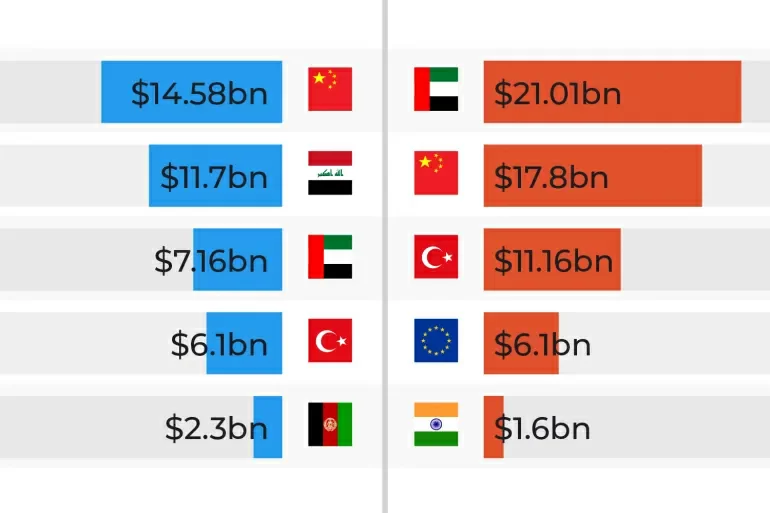
In 2024, Iran exported approximately $56 billion worth of goods to at least 112 countries and territories. Its top five export partners were China, Iraq, the United Arab Emirates, Turkey, and Afghanistan, each accounting for a critical share of Iranian export activity:
– China led the list at $14.58 billion, and remains the world’s largest buyer of Iranian crude oil, handling more than 80% of all seaborne shipments of Iranian oil. Most of this oil is sold at a steep discount and transported via unregistered “shadow fleets,” meaning very little of the trade appears in official customs statistics.
– Iraq ranked second with $11.7 billion in Iranian imports. Iran supplies large volumes of natural gas to Iraq for power generation, as well as electricity to Iraq’s southern provinces, and is also a key supplier of food, construction materials and industrial goods to its neighbor.
– The United Arab Emirates (UAE) came third at $7.16 billion, having long served as a key financial and re-export hub for Iranian trade, accounting for roughly 13% of total Iranian exports. However, Abu Dhabi recently implemented an unlimited trade embargo on Iran following unproven allegations that Iran launched rocket attacks on UAE territory – claims Tehran has repeatedly denied.
– Turkey followed with $6.1 billion in Iranian imports. Iran supplies pipeline natural gas to Turkey via the Tabriz-Ankara pipeline, alongside petrochemical products, food and construction materials.
– Afghanistan rounded out the top five at $2.3 billion. Iran supplies Afghanistan with fuel, food and construction materials, while Afghanistan relies heavily on Iranian ports and overland trade routes to access global markets.
On the import side, Iran purchased roughly $68.5 billion worth of goods from 87 countries and territories in 2024. Its top import partners reflect the critical supply routes that keep the Iranian economy functioning:
– The UAE topped the list at $21 billion, accounting for more than 30% of all Iranian imports. Most of these goods are re-exports that give Iran indirect access to Western-produced machinery, electronics and consumer goods. Abu Dhabi’s recent full trade embargo has now closed this key supply route entirely.
– China ranked second at $17.8 billion, and is now Iran’s largest supplier of industrial machinery, electronics, vehicles and industrial components. China has become Iran’s most important economic partner following the collapse of most trade with Western economies.
– Turkey came third at $11.1 billion. Its shared border and long-standing commercial ties have made it a critical overland supply route for Iran, providing machinery, chemicals, vehicles and industrial products. Two-way trade between the two countries has already declined significantly since recent regional escalations.
– The European Union followed at $6.1 billion. Current EU trade volumes are only a small fraction of pre-2018 levels, and are now almost entirely limited to pharmaceutical products, medical equipment and industrial machinery.
– India rounded out the top five at $1.6 billion. Bilateral trade between Iran and India has fallen sharply in recent years, with New Delhi maintaining limited commercial ties focused largely on agricultural goods such as rice and tea, plus pharmaceutical products.
Analysts note that this new round of sweeping US sanctions represents one of the most aggressive efforts to date to cripple Iran’s international trade, with unpredictable ripple effects for global energy markets and regional diplomatic relations.