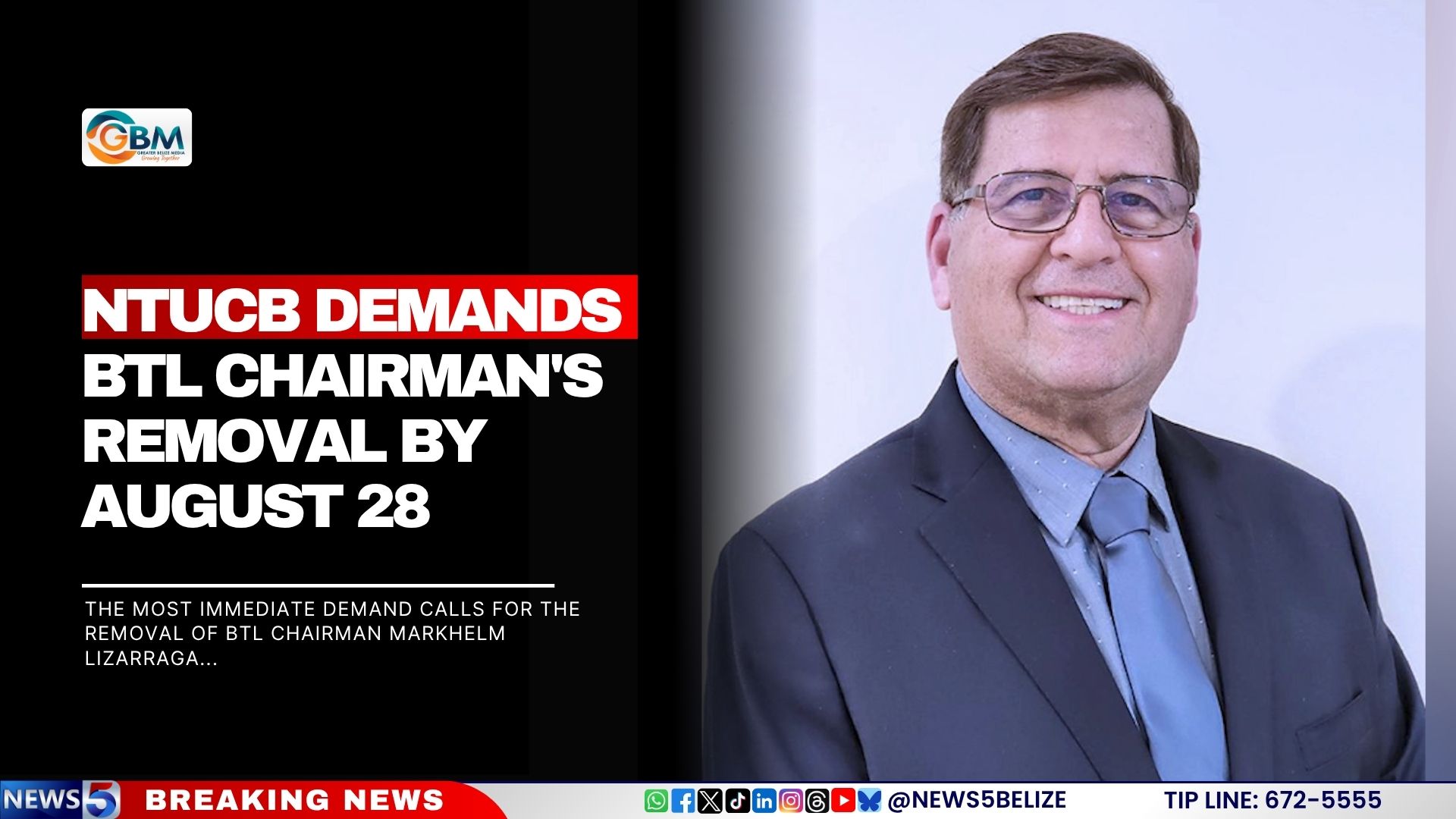
As the Caribbean nation of Belize navigates mounting labor and governance tensions, the National Trade Union Congress of Belize (NTUCB) has tabled a sweeping 11-demand package to Prime Minister John Briceño, locking in a hard August 28 deadline for a formal written response from the administration. With the Prime Minister currently out of the country attending official bilateral talks in Honduras, the ultimatum has thrown a sharp spotlight on governance and accountability issues roiling the country’s key public and regulated sectors.
The most urgent and high-stakes demand at the top of the union’s list is the immediate removal of Belize Telecommunications Limited (BTL) Chairman Markhelm Lizarraga, alongside four sitting board members: Moises Cal, Arturo Lizarraga, and Eric Eusey. The NTUCB anchors this call for leadership ouster in three core grievances. First, the Belize Communications Workers Union (BCWU), the primary labor body representing BTL employees, has already passed a formal vote of no confidence in the current board leadership. Second, the board approved a $90 million cable acquisition deal that the NTUCB claims has direct ties to Chairman Lizarraga and the Prime Minister’s own office, raising red flags over conflict of interest. Third, the board pushed forward an $80 million acquisition of Speednet/SMART that was ultimately rejected, basing its approval on just one year of financial due diligence – far shorter than the industry-standard three to five year review period required for major telecom mergers.
Beyond the BTL leadership shake-up, the NTUCB has laid out a series of mid-term demands to be completed within a 90-day window. These include establishing a new tripartite governance framework for BTL that reserves formal seats for both the Belize Chamber of Commerce and Industry (BCCI) and the NTUCB itself, as well as a full restructuring of Belize’s Public Utilities Commission. The union is calling for the restructured regulator to include voting representatives from the NTUCB, BCCI, Belize National News (BNN), the National Energy Association of Belize (NEAB), and the national government, to ensure broader stakeholder oversight of critical utility sectors.
Governance reform demands top the NTUCB’s list beyond the telecom sector. The union is calling for the immediate appointment of a dedicated dedicated liaison embedded within the Prime Minister’s Office to coordinate labor and stakeholder concerns, alongside legislation to strengthen whistleblower protections and overhaul campaign finance regulations, both to be delivered within 90 days. It is also demanding full, robust enforcement of the 2023 Civil Asset Recovery and Unexplained Wealth Act, a landmark law that grants the Financial Intelligence Unit the power to pursue civil recovery of illegally obtained assets without first securing a criminal conviction – a tool the union says is critical to rooting out public corruption.
Other institutional demands include filling the long-vacant national Ombudsman post within 90 days, and supporting the Public Service Union’s (PSU) call to pull the controversial 2026 Revenue Authority Bill back to parliamentary committee for full, inclusive public consultation before any further progress on the legislation.
The NTUCB has also advanced a slate of targeted demands focused on improving working conditions and funding for Belize’s education sector. For primary and secondary educators, the union is calling for a standardized, national vacation schedule of a full July break plus a three-week August recess to be rolled out within 90 days. It is demanding adjustments to the salary scale for vocational and technical (Vo-Tech) teachers within 45 days, full repayment of withheld salaries for teachers who were placed on interdiction within 60 days, and a formal government response within 45 days to longstanding calls to repay salaries that were incorrectly clawed back from teachers whose teaching licenses had expired.
For tertiary education, the union is calling on the government to raise the annual government subvention for the University of Belize, incrementally increasing it toward a target of $15 million in time for the upcoming fiscal budget cycle. It is also calling for the creation of an independent oversight body to manage university scholarship allocations, removing political discretion from the award process to ensure fairness and transparency.
As the deadline approaches, the Briceño administration has not yet issued a formal response to the demands, with the Prime Minister still engaged in official diplomatic engagements in Honduras as of the release of the NTUCB’s ultimatum.