Across the encrypted messaging platform Telegram, a sprawling network of secret underground groups dedicated to the trade of non-consensual and child sexual exploitation material has continued to operate with near-impunity in Trinidad and Tobago, even as victims and journalists face repeated delays and stonewalling from local law enforcement seeking information about ongoing probes.
In a recent interaction documented by the *Sunday Express*, a user operating under the alias “David” joined one such group, self-named “Trini-bad,” to advertise his personal collection of child sexual abuse materials. The group, which counts more than 400 members, is just one small node in a far larger network: other similar communities have amassed tens of thousands of members, with entry priced at hundreds to thousands of Trinidadian dollars for vetted new participants. David invited members to contact him privately to access graphic imagery and videos of pre-teen children being sexually assaulted, offering to trade 100 images of rape for 100 additional exploitative files from other users. “I got good stuff,” he boasted alongside a screenshot showing dozens of exploitative videos, urging followers to connect directly for access. While some groups have enacted superficial bans on overtly graphic child exploitation content to evade detection, operators like David regularly slip past these safeguards to continue trading.
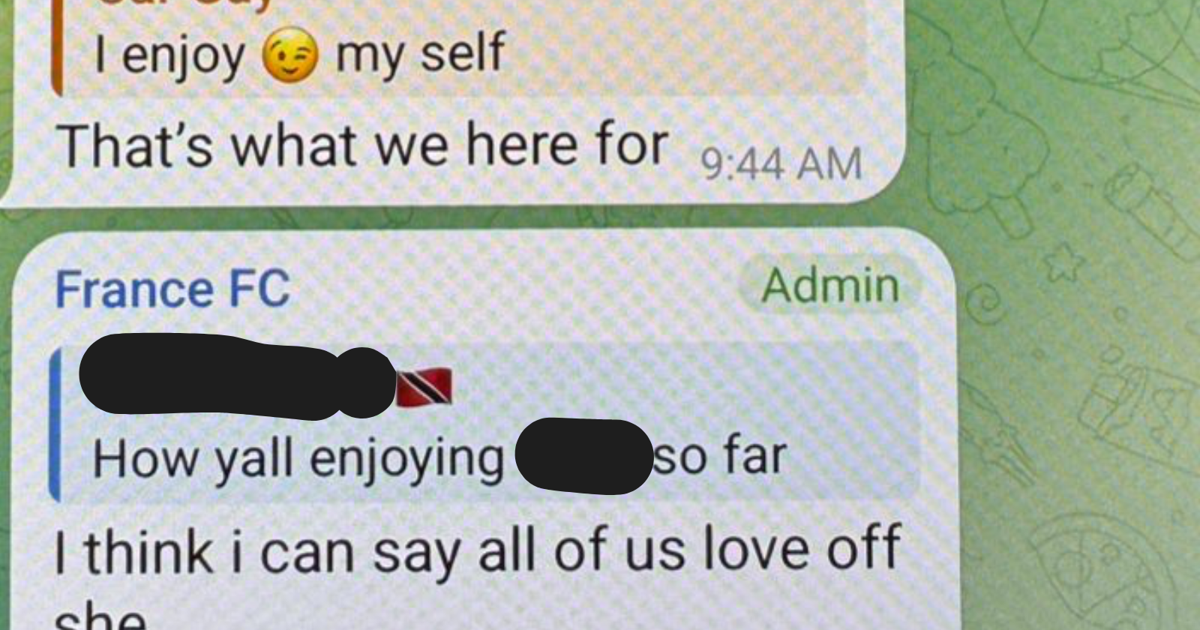
Inside these closed communities, exploitative content of local women and children is treated as a collectible commodity to be traded, sold, or auctioned off to members. Images and videos of adult women can be purchased for as little as a TT$250 phonecard, with one operator selling weekly access to segregated, race-specific targeting groups for TT$250 per week, or TT$2400 for a three-month all-access package. Group members regularly mock the abuse their victims suffer, often framing the trade of non-consensual content as a hobby or a tool to punish former romantic partners. Many openly joke about avoiding arrest, pointing to what they see as a widespread lack of police awareness or action against their activities. Beyond the trade of content, participants coordinate systematic harassment: they publish victims’ personal phone numbers, workplace details, and family contact information to encourage stalking, threats, and blackmail, while craft fabricated background narratives to destroy victims’ social standing. Tech consultant Shivam Teelucksingh, who infiltrated multiple groups as a decoy for the *Sunday Express*, described the communities as “objectification engines,” where victims’ explicit images are paired with public polls asking members to vote on ways to sexually degrade them, generating hundreds of toxic comments and permanent, localized harassment threads that persist online. To evade platform moderation, members continuously create and abandon burner accounts, rebuilding their networks after bans to target new victims.
These networks are not a new discovery. Victims have filed reports about them with the Trinidad and Tobago Police Service (TTPS) for years, and the issue reached the national appellate court earlier this year in a constitutional motion brought by the Humanitarian Foundation for Positive Social Change (HFPSC) on behalf of affected victims. In one landmark case, an anonymous victim reported finding explicit images of herself, taken when she was a child, uploaded to an exploitative website in 2020. After reporting the abuse to local police and seeing no action, she infiltrated multiple underground rings in 2021 to gather evidence, turning over a flash drive with links to hundreds of additional victims’ files to law enforcement—only for police to later report the evidence had been lost. The court ultimately ruled that police had failed to protect the claimant, awarding her TT$100,000 in damages, noting that her report had fallen “into a black hole” with no effective investigation between 2020 and 2022. While the court acknowledged that the TTPS had made some limited procedural changes to address the issue after the case received media attention, police have told the court they face significant hurdles to infiltrating the rings: investigators must be invited into the closed groups by administrators, requiring female officers to create covert undercover identities, and the service claims it needs additional resources including specialized devices, virtual private networks, and ongoing tech-focused training to effectively pursue probes.
Three months ago, the *Sunday Express* filed a formal Freedom of Information Act (FOIA) request with the TTPS Legal Department seeking basic public information about the status of investigations into these rings: whether probes remain open, which unit is assigned to the case, how many arrests have been made, how many suspects have been interviewed, and how many cases have been referred to the Director of Public Prosecutions (DPP). The request also asked for aggregated data on child pornography reports received by the TTPS between 2020 and the present, including the number of investigations opened, charges filed, and cases referred to the DPP. Under Trinidadian law, public authorities are required to respond to FOIA requests within 30 days of receipt. To date, 114 days and counting after the request was filed on April 30, the TTPS has yet to release any of the requested information, instead granting three consecutive extensions to the deadline, pushing the final response date to September 21—144 days after the initial request was submitted.
After acknowledging the request in early May, the TTPS first set a response deadline of June 8, then extended the deadline to July 10, claiming it was still gathering information from relevant departments. A second extension pushed the deadline to August 10, citing the need to extract data from a “decentralized unit.” When no response arrived by mid-August, the TTPS requested a third extension, ignoring questions about the 10-day gap between the expiration of the second extension and the new request, and declining to identify the decentralized unit holding the requested information. Multiple follow-up calls and emails from the *Sunday Express* to TTPS spokespeople and the Legal Department have gone unanswered, with the only communications being successive requests for more time.
For victims of the exploitation rings, the multi-month delay for a journalist’s FOIA request pales in comparison to the years of inaction they have already endured. In an April 2025 email to the TTPS, one victim wrote that she has been forced to repeat her report to dozens of different officers across the service, a process she described as emotionally devastating, with no progress on her case. “It is of great concern to me that over the last few years I had to endure the experience of speaking to several different officers across the TTPS about the same report and incident,” she wrote. “This constant run-around is not the right procedure. It has also been very emotionally tasking for me as these are sexual offences.” She has not received a response to her inquiry. Another victim told the *Sunday Express* that repeated attempts to get updates on her case have left her disillusioned: “I think something in me kind of retreated because I really tried my best to have something done,” she said.