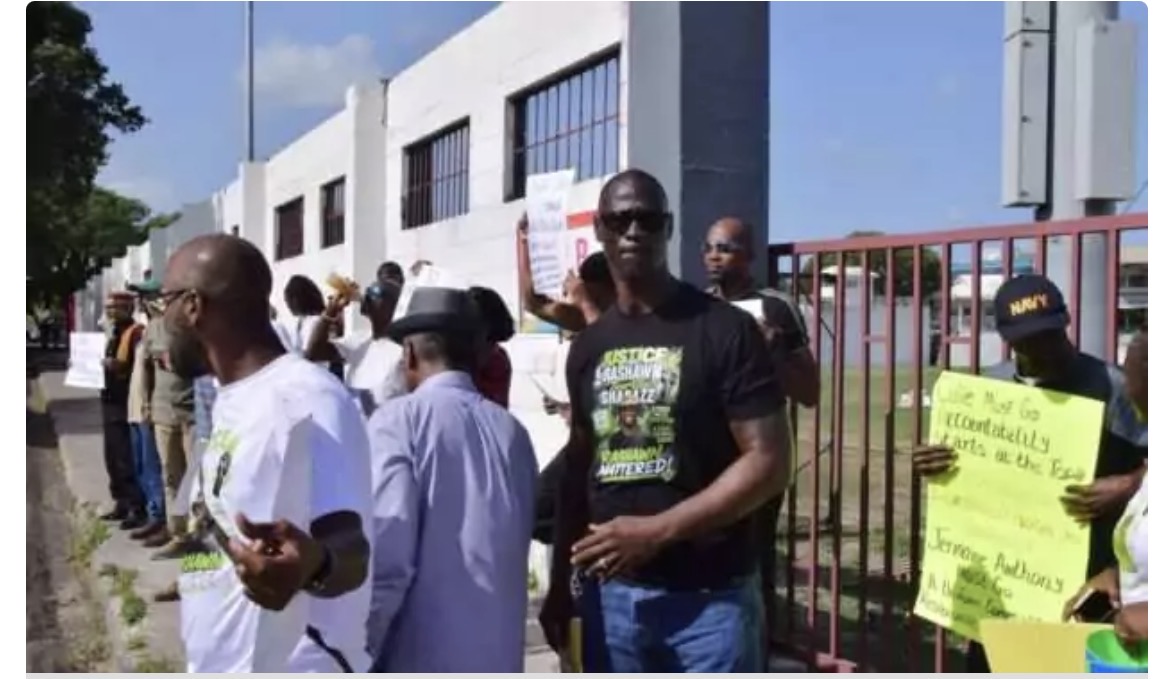
On the heels of a well-attended “Justice for Rashawn” demonstration held Thursday outside His Majesty’s Prison 1735 and the Ministry of Legal Affairs, Khalid Shabazz is intensifying his years-long fight to uncover the full truth surrounding his son Rashawn Shabazz’s death while in state custody.
More than 50 activists and community supporters joined the initial public protest, and event organizers confirm that dozens of additional residents arrived after the official march concluded to express solidarity and sign up to participate in upcoming advocacy actions. For the bereaved father, however, this movement has never been limited to a single demonstration — it has grown into a broader push for systemic change that extends far beyond his own family’s search for closure.
Rashawn died shortly following an altercation with law enforcement during his time in state custody, leaving his relatives with no clear, official account of the events that led to his passing. Remembered by his father as a gentle, big-hearted young man who adored children and dedicated his free time to supporting neighbors in his community, Khalid says he is determined to cement that public image of his son, even as unanswered questions about his death continue to hang over the case.
Khalid’s campaign has expanded to address two overlapping crises affecting Antigua and Barbuda: the lack of transparency for families of people who die or go missing while in state care, and deep, long-standing shortcomings in the country’s mental health care system. He notes that hundreds of families across the twin-island nation still wait years, even decades, for official updates about their lost loved ones, and says public authorities have a binding moral and legal obligation to deliver clear, timely information to these grieving households.
Mental health reform sits at the core of his advocacy, shaped directly by his son’s lived experience. Rashawn lived with a documented mental health condition that sometimes led him to stop taking his medication, triggering episodes that required targeted, professional care and long-term management. According to Khalid, late Magistrate Conliffe Clarke had formally ordered Rashawn to be placed in residential care at Clare Vue Psychiatric Hospital, but he was ultimately released early due to widespread overcrowding and a lack of available long-term accommodation for patients.
That outcome, Khalid argues, lays bare the urgent need for sweeping overhauls to how the nation supports people living with mental illness. He is calling for the construction of adequate, accessible treatment facilities, expanded training for all personnel working in mental health care, and a shift away from ad-hoc, temporary fixes that leave vulnerable patients without consistent support.
As things stand, the Shabazz family remains in limbo, waiting for official updates on the investigation into Rashawn’s death. A formal inquest is already underway, with a post-mortem examination planned, but Khalid is demanding a fully independent investigation into the full chain of circumstances that led to his son’s death. He stresses that because Rashawn died while in state custody, his family is owed a process that is fully transparent, fair, and uncompromising in its pursuit of the truth.
He is also pushing for greater accountability for public officials, arguing that leaders and civil servants must face meaningful consequences when they fail to fulfill the core responsibilities entrusted to them by the public. What began as a personal quest for justice for his son has become a movement for all marginalized families across Antigua and Barbuda: for those still waiting for answers about lost loved ones, and for all people who rely on state institutions for care and support.
As official investigations move forward at a slow pace, Khalid says he remains unshakable in his commitment. He will not stop until he secures full justice and clear answers for Rashawn, and will continue pushing for the systemic reforms that he believes are necessary to stop another family from enduring the same senseless pain that his has.