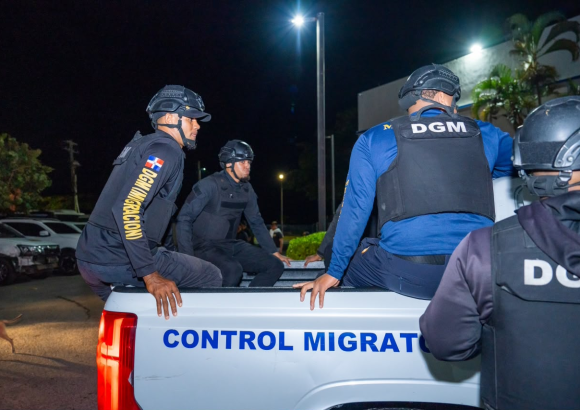
Santo Domingo – The Dominican Republic’s General Directorate of Migration (DGM) has released new official data outlining its immigration enforcement progress for 2026 to date, revealing that the agency has processed more than 250,000 foreign nationals residing in the country in irregular immigration status. Of this total, 186,139 individuals have been deported, while another 64,290 have undergone formal voluntary repatriation processes, per the agency’s official records.
Breaking down deportation demographics, DGM data shows men account for the overwhelming majority of deportees, at 143,182 people or 76.92% of all deportations. Women make up the remaining 23.08%, totaling 42,957 individuals. All processing and removal procedures are conducted in coordinated partnership between DGM personnel, the Dominican military, and other national state security agencies, with operations taking place across dedicated migration processing facilities and official border checkpoints scattered throughout the country.
Geographically, the highest volume of irregular migration cases has been concentrated in specific regions. The municipality of Haina recorded the largest number of cases at 74,948, followed by the northern border province of Dajabón with 67,308 cases. Elías Piña, another border province along the Dominican-Haitian border, reported 29,155 cases, while the major central city of Santiago logged 14,728 processed cases.
For formal repatriation processes, the distribution of cases differs by crossing point. The Jimaní border crossing, one of the busiest official entry points between the Dominican Republic and Haiti, handled the vast majority of formal repatriations at 30,603 cases. Pedernales followed with 16,888, Dajabón with 8,514, and Elías Piña with 8,285.
DGM officials detailed that all foreign nationals detained during nationwide immigration enforcement sweeps are first transferred to government-designated processing centers, where they undergo mandatory biometric registration and identity verification procedures before any removal or repatriation is finalized.
Beyond routine enforcement, the agency is ramping up targeted security measures to manage migration flows across the shared Dominican-Haitian border, particularly at binational trade markets that see regular cross-border movement. DGM Director General Vice Admiral Luis Rafael Lee Ballester announced that new technological and operational upgrades have been rolled out to strengthen border controls.
As a key pilot upgrade, a temporary container-based processing office has been installed at the Dajabón border crossing. The facility is designed to improve biometric registration for Haitian nationals who receive official authorization to enter the Dominican Republic for scheduled binational trade days, using advanced facial recognition technology to log entries.
Vice Admiral Lee Ballester confirmed that the new digital identification system is currently in its final testing and evaluation phase. The agency has already procured specialized networked equipment integrated with a central national platform, which leverages artificial intelligence tools to quickly cross-check and verify the identity of all individuals seeking entry into the country.
The DGM chief added that coordinated joint monitoring operations, conducted in partnership with both civilian law enforcement and military border authorities, are ongoing. The operations target unregulated alternative border routes that are allegedly used by human trafficking smuggling networks to move undocumented migrants across the border and evade official security checkpoints.