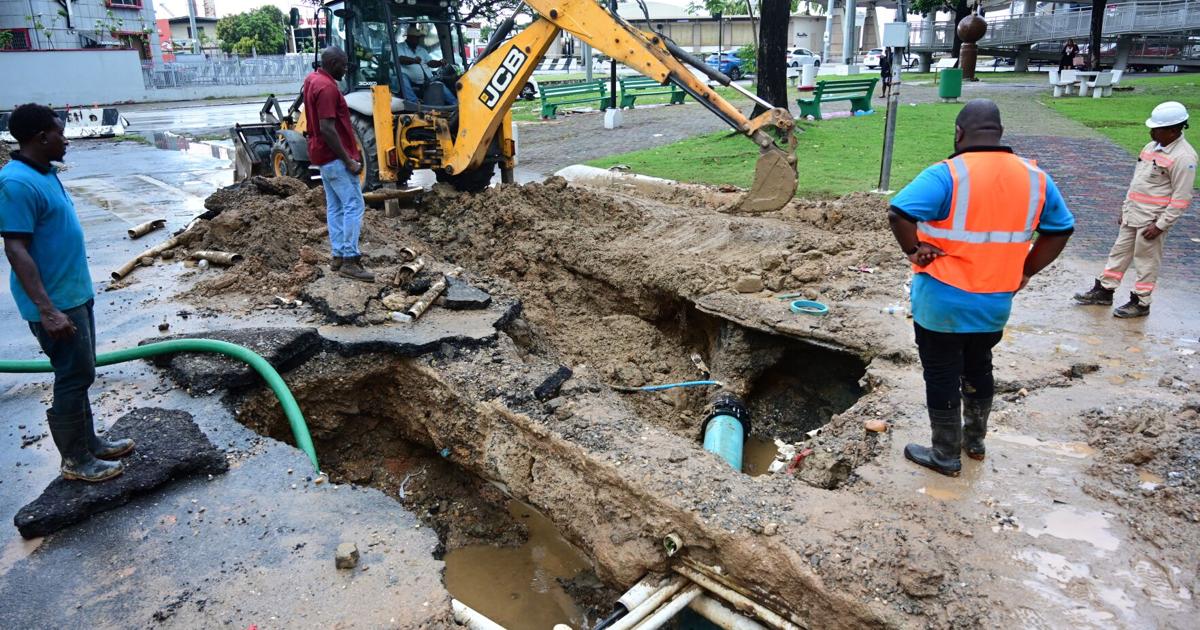
A sudden underground pipeline leak in downtown Port of Spain triggered widespread water outages across most of the central business district on Wednesday, forcing local businesses including popular fast-food chains to source emergency water from private trucked supplies while prompting fresh demands for long-overdue upgrades to the capital’s aging public utility network.
The leak was detected along Independence Square North, near the intersection of Richmond Street, prompting the Water and Sewerage Authority (WASA) to immediately shut off water flow to the entire affected district to allow excavation and repair work to proceed. In its initial public advisory shortly after the outage was reported, the Downtown Owners and Merchants Association (DOMA), which represents hundreds of local businesses including 30 food service outlets, confirmed that the full downtown area had been left completely without piped water. WASA initially told DOMA that it could not provide an estimated timeline for restoring service, leading the association to urge all commercial and residential property owners and occupants to implement immediate water conservation measures. Food businesses in particular were advised to arrange alternative water sources to top up their storage and keep operations running.
Repair work wrapped up faster than initially expected, with WASA confirming it completed fixes at the leak site by approximately 3:30 p.m. DOMA later updated its advisory to note that full water service began to be restored to the downtown area shortly after 4:50 p.m., with normal pressure returning just after 5 p.m. WASA did not release any further details about the cause of the leak or the scope of the damage beyond confirming completion of repairs.
In the wake of the incident, DOMA president Gregory Aboud emphasized that while unexpected equipment failures are unavoidable, the outage exposes a long-running, unaddressed problem: the critical state of disrepair of Port of Spain’s core public water infrastructure. Aboud noted that while downtown has historically had reasonably consistent water access compared to other parts of the country, frequent low-pressure events and multi-hour unplanned outages have become a regular drain on local business operations. He added that this latest disruption is just one example of a national-scale water management crisis, with widespread unaddressed leaks across the country leading to massive waste of treated potable water that could otherwise support communities during periods of dry weather.
Aboud’s call for proactive infrastructure upgrades comes as the region prepares for looming dry conditions. Earlier the same week, the Trinidad and Tobago Meteorological Service issued a drought watch for Trinidad set to take effect in September, and a more severe drought warning for Tobago scheduled for October. Aboud stressed that urgent, preventative upgrades and leak management are critical to avoid widespread panic and more severe service disruptions if drought conditions develop as forecast.