Nestled in the rural heart of Grenada, connected to a network of neighboring settlements including Brooklyn, Mt Dor, Concord and Cotton Bailey, Woodford has long been a community shaped by its natural landscape. For generations, local livelihoods have been rooted in agriculture, fishing, and sustainable use of the region’s abundant freshwater resources, with the area holding deep historical, cultural and environmental value. It boasts fertile agricultural lands, active fishing grounds, intact freshwater systems, and tangible remnants of its colonial plantation past. Even during Hurricane Ivan, when major public water sources became contaminated, the region’s natural streams served as a lifeline for desperate villagers, providing clean drinking water when all other options failed.
Today, Woodford continues to support small-scale farmers, artisanal fishermen and diverse native aquatic life, from snapper to wild shrimp. But the quiet rhythm of this rural community has been upended by large-scale industrial development spearheaded by Rayneau, a private construction and industrial firm. Local activists and residents warn that if the project irreparably damages these critical natural resources, generations of locals who have built stable lives close to home will be forced to leave their communities and compete for work elsewhere. As development progresses, three urgent questions hang over the future of Woodford: What costs is the country willing to sacrifice in the name of economic progress, who will actually reap the benefits of this project, and what will be left for the generations of Woodford residents who call this place home?
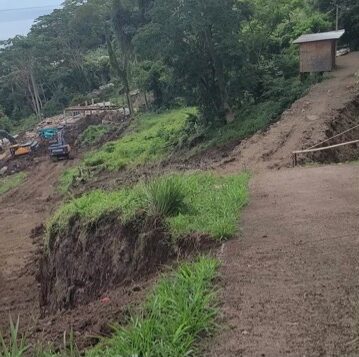
The first major crisis of the project has already emerged: the public Mt D’Or road, which runs directly alongside Rayneau’s development site where heavy excavation and land clearing work has been carried out, has suffered three major structural collapses. The damage has cut off vehicle access to residential neighborhoods and left local farmers stranded, unable to reach their farm plots to tend crops or harvest produce. Instead of addressing the root cause of the collapses, the government of Grenada has proposed a quick-fix solution: rerouting the damaged public road directly through the active Rayneau industrial site.
Critics argue this plan raises life-threatening safety concerns. The proposal to route regular public traffic through an operating industrial zone is unprecedented, and the risks are far from theoretical: back in 2017, a deadly explosion at a Rayneau-owned quarry in Cul-de-Sac, St Lucia killed four workers and injured more than 20 others. To date, no independent safety certification has been presented to prove the proposed route is safe for ordinary motorists, pedestrians and local residents. Key questions remain unanswered: What barriers will separate public passenger vehicles from heavy industrial trucks and ongoing works? Which entity will be responsible for ongoing maintenance of the new road? If another landslide, collision or serious injury occurs, who will be held legally liable — the government, Rayneau, or both?
Beyond safety, there are fundamental questions about what actually caused the road collapses. Prime Minister Dickon Mitchell has attempted to downplay any connection between the road damage and Rayneau’s development work, but the three failures all occurred along the exact stretch of road where the company carried out large-scale excavation and boulder removal. Residents raised concerns about the link before any official investigation was launched, yet the government has pushed ahead with the reroute plan without waiting for results from the geotechnical investigation it commissioned. Critics are now demanding answers: What technical evidence supports the government’s claim that a new route through the adjacent industrial site is safe?
A host of unresolved legal and planning issues also cast doubt on the proposal. If the new public road crosses land owned by Rayneau, what legal agreement grants the public permanent right of access? Is the government acquiring the land through eminent domain, establishing a legal right of way, leasing the property, or is the project relying on informal permission from the developer? Is the reroute only a temporary diversion, or will it become a permanent part of Grenada’s public road network? Under Grenada’s existing planning laws, the construction of new public roads is explicitly classified as a development activity that requires formal regulatory approval. Has the Physical Planning and Development Authority formally reviewed the proposal? Has an environmental assessment been required, or has approval already been granted? Or is the government attempting to classify the project as exempt from standard planning rules?
Critics point out that the current crisis is the direct result of the government’s unseemly haste to push the project forward, even skipping a mandatory full Environmental Impact Assessment (EIA) for the multi-faceted industrial development — which includes a quarry, asphalt production facility, concrete plant and new jetty. During a post-Cabinet press briefing in January 2024, the prime minister publicly stated that the EIA process was moving too slowly, and that he had accepted the developer’s verbal assurance that the facility would be environmentally friendly. Critics argue that if the government had not rushed to skip the EIA, the assessment would likely have identified critical risks: whether the project was sited too close to the public road, and whether boulder removal and excavation should have been restricted given the area’s unstable topography. Now, taxpayers may be forced to foot a multi-million-dollar repair bill for the damaged road, while local residents are left wondering whether the government rushed to fix one problem, only to create a series of worse problems that officials do not know how to solve.
Local farmers have borne the brunt of the chaos so far. With no access to their fields, harvested produce is at risk of rotting before it can reach markets, and long-established commercial relationships are in danger of being lost permanently. Farmers also report being unable to deliver seeds, fertilizer and other essential inputs to their lands. While the proposed reroute may restore some limited access, many residents say it will still not provide direct vehicle access to their homes. The government has stated it commissioned an independent engineering firm to investigate the road collapses, but critics are questioning whether the assessment will cover all three failure points and the damage that has already spread onto private property, including one resident’s severely damaged private driveway. With results from the investigation still not publicly released, why has the developer already begun clearing land for the new road?
In a recent interview on *The Bubb Report*, Rayneau’s head Gagadhar defended the approach, arguing that sometimes progress requires “taking the risk and make it happen.” While that may be an acceptable philosophy for private business decision-making, critics say it cannot be the standard that the government uses to approve a public road that will be used by ordinary residents. One Woodford resident summed up the growing fear in the community: “Our road is now on Rayneau property; our homes will follow.” If not for the very real harm the crisis has inflicted on residents, the situation would be almost absurd.
Mandatory EIAs exist for a reason: to identify unforeseen risks before projects break ground, protecting communities and preventing costly future damage. Now, Grenada may be forced to spend millions of dollars repairing damage that could have been avoided, and Woodford’s residents are left waiting, wondering if this safety crisis is only the first of many to come.