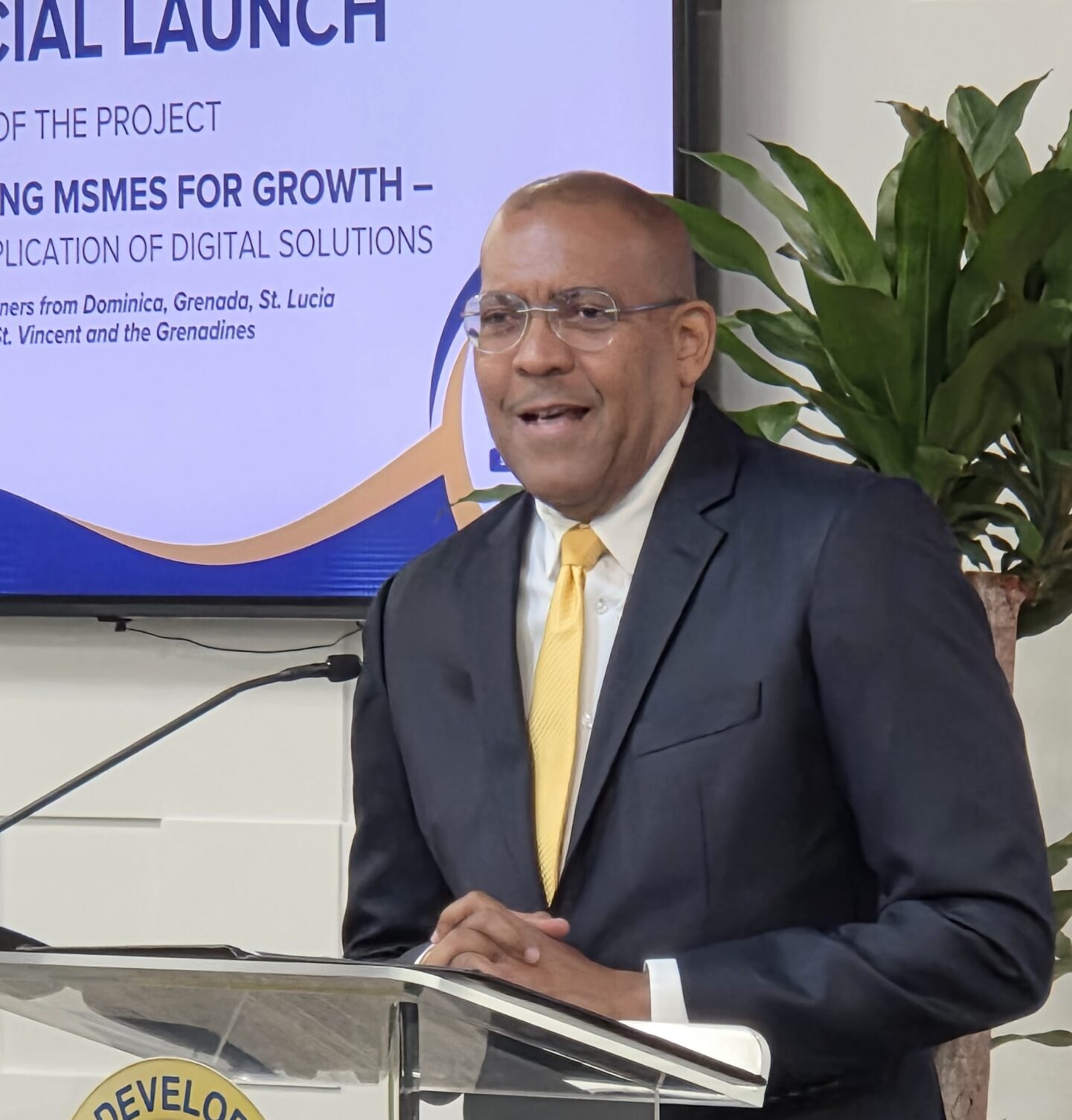
The Caribbean region faces urgent pressure to close its digital commerce gap with North American markets, according to senior Barbadian government official Kerrie Symmonds, who outlined stark disparities and structural barriers holding back small and medium-sized enterprises (MSMEs) from regional and global competitiveness. Speaking at the dual launch of the Small Business Association’s (SBA) capacity-building initiative *Reengineering MSMEs for Growth – Adoption and Application of Digital Solutions to Build Resilience and Global Competitiveness* and Small Business Week 2026 hosted by the Caribbean Development Bank (CDB), Symmonds highlighted that digital transactions make up just 4 to 5 percent of all business activity across the Caribbean, compared to 18 to 19 percent in the United States and 16 percent in Canada – two key markets Caribbean firms are targeting for expansion.
Even more notably, 70 percent of all retail trade in the region still relies on in-person, brick-and-mortar transactions, a sign that the region’s pace of digital transformation has fallen far behind what is needed to compete. Symmonds, who serves as Minister of Business Development and Consumer Affairs, emphasized that closing this gap is not a challenge for individual small businesses alone; it demands coordinated, cross-regional policy action to drive widespread adoption of digital and mobile commerce frameworks.
MSMEs form the backbone of Caribbean economies: in Barbados alone, 98 percent of all businesses are MSMEs, contributing $5 billion to the country’s $16 billion total gross domestic product. Symmonds argued that this substantial contribution could grow far larger if enterprises overcome cultural and structural barriers to digital adoption, noting that many small business owners remain risk-averse and overly conservative about integrating new technologies into their operations.
Among the most pressing systemic challenges identified is the region’s dependence on externally controlled cross-border payment systems. In the current volatile geopolitical environment, Symmonds warned, external third parties can sever or block payment processing at any time, leaving businesses unable to complete transactions and threatening their survival. Even when payments go through, reliance on foreign-managed systems comes with steep costs: processing fees, interchange charges, and elevated interest rates add up to 24 to 25 percent of transaction values in Barbados, a burden that erodes small business profit margins. This dependence on traditional credit and debit cards, which consumers prefer for their built-in confidence and consumer protection frameworks, further locks the region into a high-cost digital commerce model.
Symmonds also pointed to widespread financial exclusion as a major obstacle to progress. Across the Caribbean Community (CARICOM), an estimated 30 to 35 percent of the population is completely unbanked, with another 40 to 50 percent classified as underbanked. In the Organization of Eastern Caribbean States (OECS), unbanked rates range from 20 to 25 percent. These figures create a large pool of consumers who cannot participate in digital commerce, stifling demand for digital business models. Compounding this issue is the total lack of interoperability between regional digital payment wallets: if a merchant uses one provider and a customer uses another, no transaction can be completed, even when both parties are ready to do business. To resolve this, Symmonds called for a unified regional approach rather than fragmented country-by-country solutions, arguing that fragmented systems will never deliver the scale needed for growth.
On the business side, Symmonds exposed a critical gap in how Caribbean MSMEs adopt digital tools: while 78 percent of businesses use social media and customer-facing digital platforms to engage with buyers, only 14 percent use digitized inventory management software, just 13 percent have adopted digital payroll systems, a mere 8 percent use customer relationship management (CRM) tools, and 25 percent of businesses rely on no digital management tools at all. This pattern shows that businesses are willing to engage customers digitally, but are slow to adopt back-end tools that would improve operational efficiency, productivity, and long-term competitiveness. Many MSMEs cite the high cost of digital tools and a lack of technical knowledge as barriers to adoption, but Symmonds warned that remaining stuck in informal, analog, and digitally immature business models will permanently limit MSMEs’ ability to contribute to the region’s emerging digital economy. “While we may argue about whether that is a reasonable answer or whether that answer is something that you can’t agree with, what you cannot do is to disagree with the consequences,” he said. “The consequences are that there are still, therefore, too many of our MSMEs, which are locked into a state of being very informal and being analogue, and therefore being digitally immature and digitally underdeveloped, and in that state, they cannot give birth to the new economy that we want to be able to create through the application of the digital solutions that we’re talking about here today.”
CDB President Daniel Best echoed Symmonds’ call to action, stressing that the Caribbean cannot afford to remain on the sidelines of the global digital economy. Best highlighted the new capacity-building project, which will support 150 MSMEs across five Caribbean nations – Barbados, Dominica, Grenada, St Lucia, and St Vincent and the Grenadines – to strengthen their digital capabilities, adopt new technologies, and compete more effectively in regional and global markets. “The Caribbean cannot afford to remain on the sidelines of the digital economy, but participation will not happen by chance. This is not a pipe dream. It requires entrepreneurs who are ready to adapt, institutions that are ready to support them, and partners who are prepared to invest in the systems that make digital business possible,” Best said. He urged all participating MSMEs to take full advantage of the initiative to build new skills, adopt digital tools, and access the new markets that digital transformation opens up.
The project centers on inclusive growth, with targeted support for women-led enterprises and underserved small businesses that face disproportionate barriers to expansion. Best noted that digitalisation offers a unique opportunity for small Caribbean states to overcome longstanding structural disadvantages that come with operating small, geographically isolated markets. “For small states and firms, digitalisation offers a powerful opportunity to overcome traditional constraints, strengthen resilience, increase productivity, and expand participation in regional and global markets,” he explained. Beyond skills training, the initiative also provides grant funding to help selected entrepreneurs implement their digital transformation plans and scale their operations, addressing the cost barrier that many MSMEs cite.
SBA First Vice Chairman Donna Hope reinforced the importance of the initiative, pointing to 2025 research commissioned by the SBA and funded by the Inter-American Development Bank, which found that MSMEs make up 98 percent of formal businesses in Barbados and account for 55 percent of all private-sector employment. “These figures reinforce a fundamental point: when our small businesses are stronger, more productive, and more competitive, our economies are stronger,” Hope said. Small Business Week 2026 carries the theme *Beyond Borders: Positioning Small Businesses for the Global Economy*, reflecting the region’s growing focus on helping small enterprises expand beyond domestic markets.