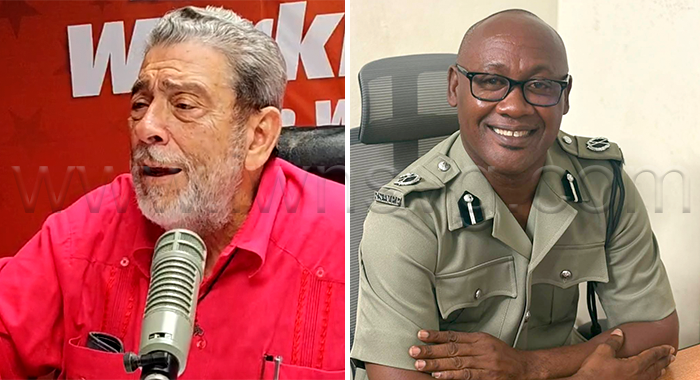
A heated political controversy over police service appointments has erupted in the country, with Opposition Leader Ralph Gonsalves launching sharp criticism of the ruling New Democratic Party’s elevation of a partisan ally to a senior acting leadership role in the national police force. Gonsalves is pushing to escalate the dispute to regional and international bodies, arguing the appointment sets a dangerous precedent that undermines the integrity of national law enforcement.
The controversy stems from a recent round of senior leadership appointments announced earlier this week, which saw Trevor “Buju” Bailey named acting Commissioner of Police, Junior Simmons tapped for acting Deputy Commissioner, and Brenton Smith promoted to Acting Assistant Commissioner of Police. This is not the first time Gonsalves has objected to Smith’s pending promotion: he first raised red flags in May, when National Security Minister St. Clair Leacock first announced the career officer was in line for advancement. At that time, Gonsalves argued that other more qualified long-serving officers were overlooked for the role.
Smith’s path back to the police force is steeped in political history. In 2021, when Gonsalves’ Unity Labour Party (ULP) held power, Smith was fired from the service after refusing to comply with the government’s mandatory COVID-19 vaccination policy for all frontline public workers, which included police officers, educators and medical staff. Following his dismissal, Smith moved directly into partisan politics, winning election as General Secretary of the then-opposition New Democratic Party (NDP). When the NDP secured victory in the November 2025 general election, Smith was quickly reinstated to the police force just months before his surprise senior promotion.
In comments made during his weekly radio program on Wednesday, two days after the new appointments were formalized, Gonsalves argued the promotion is a clear case of politically motivated advancement that cuts across decades of institutional hierarchy. “If you want to demonstrate that you take the professionalism of the police force seriously, how can you elevate a figure like Smith?” Gonsalves asked. Five years ago, Smith held only the rank of station sergeant. After leaving the force in 2021, he did not work his way back through the institutional ranks; instead, he skipped the entire role of assistant superintendent to jump directly to Assistant Commissioner, a senior command position. Gonsalves stressed that Smith’s rapid advancement is solely the result of his political loyalty to the ruling NDP, not his professional experience or qualifications.
For Gonsalves, this appointment is not just an internal personnel dispute – it poses tangible risks to international security cooperation. He warned that regional security bodies within CARICOM and global law enforcement partners will face major complications working with a police leadership that includes politically aligned unvetted figures. “The DEA, the FBI, British intelligence services, French security agencies – they are all going to face serious difficulties working with loose-tongued politicians who don’t understand what information can be disclosed, who now hold senior police uniforms,” Gonsalves said.
To address what he called the “dangerous politicization” of the national police service, Gonsalves confirmed he plans to send formal letters raising the issue to both the Caribbean Community (CARICOM) and the Commonwealth, the two major regional and international bodies the country is affiliated with.
Gonsalves was careful to draw a clear distinction between Smith and the two other newly appointed senior police leaders. He acknowledged that Bailey is a skilled and professional police officer, and noted that he has no personal animosity toward Smith. In his role as Opposition Leader and a former National Security Minister, Gonsalves pledged he is willing to work collaboratively with Bailey and Simmons on all matters of public safety. The key difference, he argued, is that neither Bailey nor Simmons are partisan political figures embedded in the force’s leadership. “They are not politicians in police uniform, but Smith is,” Gonsalves said. “It is the equivalent of placing a partisan politician directly in judicial robes – it compromises the entire neutrality and integrity of the institution.”
Subordinates serving under Smith already see him first as a politician, not a professional commander, Gonsalves added, a perception that will erode trust and discipline within the rank and file of the police service.