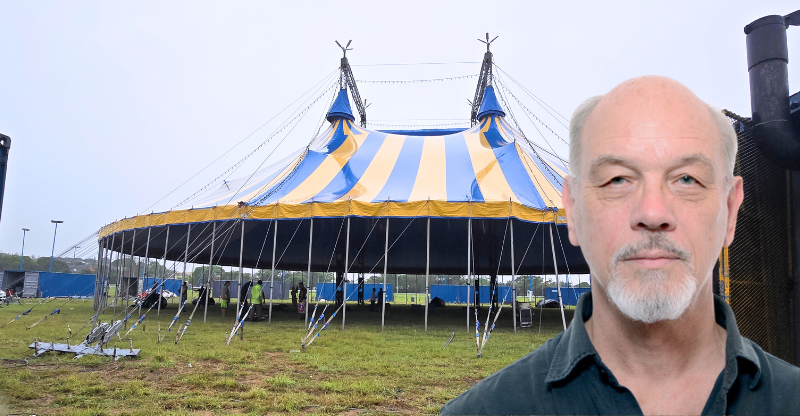
A leading Caribbean environmental expert has backed the government’s decision to relocate the Suarez Brothers Circus from a protected groundwater site in Barbados, while suggesting circus operators may have received incomplete guidance on the strict permitting requirements for the sensitive location.
Dr. Adrian Cashman, former director of the University of the West Indies’ Centre for Resource Management and Environmental Studies (CERMES), clarified that public health risks stemmed not just from the site’s location, but from the circus’s day-to-day operations near one of the country’s most important drinking water sources. Speaking after government officials outlined the rationale for the move at a recent press briefing, Cashman emphasized the site sits within Zone A, the highest classification of water protection area designed to shield the country’s primary Belle aquifer from contamination.
“It’s not so much the physical location; it’s the activities that would go on in that location, as the minister was pointing out. You not only have hundreds of members of the public visiting each day, but you also have the performers who would be living on-site, and that all takes place in a Zone A water protection zone,” Cashman explained. He added that recent heavy rainfall across Barbados drastically speeds up the movement of pollutants into the groundwater, cutting short the 90-day buffer period that Zone A designation is designed to provide. “If you have activities generating wastewater or leaving pollutants on the ground, these recent intense downpours would wash those contaminants into the aquifer far faster than the 90-day protection window the zone is supposed to provide. This is an unambiguous public health risk,” he said.
When asked how the circus was initially permitted to set up at the International Botanical Gardens at the Belle, Cashman suggested the multi-step permitting process across multiple government agencies may have left operators without clear guidance on all required approvals. “Different activities require different levels of clearance from different bodies. It seems to me that they were ill advised. Maybe it wasn’t made clear to the Suarez Brothers team when they were applying just how broad the set of permissions they needed to obtain actually was,” he noted.
The relocation incident has already sparked internal government reflection on inter-agency coordination. Deputy Prime Minister and Minister of Environment Santia Bradshaw referenced the controversy during closing remarks for the 2026 Environmental Summer Internship Programme on Monday, stressing that natural resource protection depends on breaking down silos between government departments. “We have seen what a circus can be made of when we do not communicate effectively,” Bradshaw told interns, adding that collaboration across agencies and disciplines is non-negotiable for protecting Barbados’ limited natural resources.
Cashman also addressed public concerns surrounding two other developments sited in the same Zone A protection area: a new geriatric hospital and a reported incinerator. He noted that the hospital, which is not connected to the Bridgetown or South Coast sewage systems, would have undergone rigorous statutory consultation with the Barbados Water Authority during the planning process, requiring strict on-site wastewater collection and treatment protocols that keep contamination risk extremely low.
“Any planning permission for a major development like this is legally required to include consultation with the Barbados Water Authority. Any concerns would have been raised and incorporated into the permit’s conditions. I would be extremely surprised if all of the relevant matters had not been taken into consideration, resulting in an extremely low contamination risk,” Cashman explained. He declined to comment on the proposed incinerator, noting that it falls outside his area of expertise.
Cashman praised the Barbados Water Authority and other involved government agencies for their consistent commitment to protecting public water supplies, noting that their high level of professionalism often flies under the public radar. “I’ve worked with the Barbados Water Authority and some other government agencies over many years now, and I think it is underrecognised the degree of professionalism that they exercise in these cases,” he said, adding that agencies should be more proactive about sharing their work with the general public: “I would say, blow their own trumpet a little bit more.”
The circus relocation controversy unfolded over roughly two weeks: On July 25, Suarez Brothers Circus announced its return to Barbados, with performances set to begin August 7 at the Belle’s International Botanical Gardens. The circus opened as planned on August 7, but just one day later, authorities notified management of contamination risks linked to the Zone A location and the lack of approved hygienic water access. The circus was granted limited permission to sell pre-packaged food on August 9, with all on-site food preparation banned, before the site was shut down entirely that same day, cancelling the scheduled 5 pm performance. By August 10, crews began dismantling the circus grounds while management met with officials to review five potential alternative locations. On August 16, Garrison Savannah was selected as the new site, and equipment relocation began immediately. In an August 17 interview with Barbados TODAY, circus manager Ivan Suarez said the company had already completed and paid for permitting through multiple government agencies for the original Belle site, and was now forced to repeat the entire process for the new Garrison Savannah location. During an August 18 press conference, Minister Marsha Caddle confirmed that while the circus had obtained permission from the Ministry of Environment to operate at the Belle, it failed to secure all required clearances from other relevant authorities, including water access approval from the Barbados Water Authority and approved on-site accommodation for performing staff.