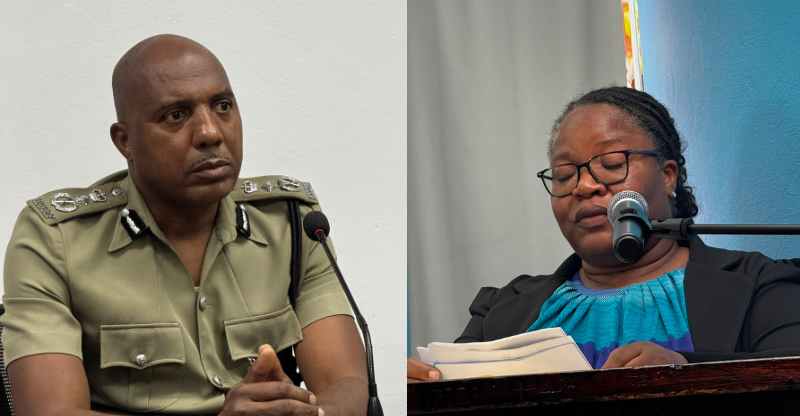
A tense standoff unfolded between reporters and senior leadership of the Royal Saint Lucia Police Force (RSLPF) at a Wednesday press conference, as journalists pressed officials over the handling of the high-profile Joy St Omer killing and responded to the victim’s family’s demand for an independent public inquiry into systemic gaps in the country’s response to gender-based violence.
The confrontation came one day after St Omer’s family revealed they had submitted a formal petition to Saint Lucia’s Governor General, requesting the creation of a formal commission of inquiry. The probe would not target the question of who killed St Omer — a criminal trial for that case is already underway — but would instead examine the failures of state systems that failed to protect St Omer despite her repeated pleas for intervention before her death. Specifically, the family wants a review of how domestic violence protection orders are monitored and enforced, how critical case information is shared across police, court, and prosecution agencies, and whether frontline institutions have sufficient resources and training to respond to gender-based violence threats.
Opening the press briefing, Acting Superintendent Annanthar Wilson, head of RSLPF’s Central Division, offered formal condolences to the St Omer family and acknowledged the legitimacy of their right to demand institutional reform and an independent inquiry. “I extend my sincere condolences to the family of the late Joy St Omer,” Wilson stated. “I acknowledge the concerns raised by the family and I respect the right of the family to advocate for reforms and for the call for a Commission of Inquiry.”
Wilson clarified that under Saint Lucia’s existing Commissions of Inquiry Act, the power to convene such an inquiry lies exclusively with the Governor General, not the police force. She added that if a commission is ultimately appointed, the RSLPF would commit to full transparency and complete cooperation with the probe. “Should one be appointed, we will give it our full support; we’ll cooperate and give the assistance wherever required,” she said. Until the Governor General makes a decision, Wilson noted, the force would not comment on whether the family’s request is ultimately justified.
But journalists quickly shifted the conversation to pressing, unresolved questions about the police’s own actions after St Omer’s death, starting with whether the force had launched an internal review to identify gaps in its response, given the family’s confirmation that St Omer had reached out to authorities for help multiple times before she was killed. Wilson admitted she could not confirm whether any targeted internal review had been completed, though she noted that agencies involved in the case had likely held informal discussions about process improvements to prevent similar tragedies and improve response protocols across police units and stations.
Reporters next pressed Wilson on the controversial bail decision for St Omer’s accused killer, who was released on bail less than one month before her death — even after prosecutors at the lower Magistrate’s Court had formally opposed bail. Journalist Dale Elliot questioned why the opposition to bail put forward by police prosecutors at the lower court did not carry over to the High Court bail hearing. “I cannot give a definitive answer,” Wilson responded, “but I can say that there are circumstances where lack of communication causes circumstances like that to happen.” She quickly walked back the implication, adding that she was not confirming that a communication breakdown had occurred in the St Omer case specifically.
As the questioning grew more intense, RSLPF Commissioner Verne Garde stepped in to address the bail questions. He explained that procedural rules shift once a case moves from the lower Magistrate’s Court to the High Court: while police prosecutors handle matters at the lower court level, all prosecutorial authority transfers to the Office of the Director of Public Prosecutions (DPP) once a case is elevated. “When a case is elevated to the High Court, the matter is transferred to the direction of the Director of Public Prosecutions,” Garde said, noting that questions about the High Court bail decision should be directed to DPP Daasrean Greene instead of the police.
That answer did little to defuse tensions, with reporters pressing Garde on who bore responsibility for the conflicting stances on bail that ultimately allowed the suspect to be released before the killing. “The fallout from somebody not doing their job was a life,” Elliot said, repeating his question about why bail was not opposed at the higher court. Garde stuck to his position that the question was outside the police force’s remit and should be directed to the DPP.
When reporters followed up by asking whether the RSLPF accepted any responsibility for St Omer’s death, Garde referred back to a previous police press conference that published a full timeline of the force’s involvement in the case. “In my view, the police played the role that they were required to play,” he said. When pressed directly to answer who was responsible for the failures that led to St Omer’s death, Garde repeated that the police had fulfilled all required obligations in the case.
The press conference clash comes amid growing public scrutiny of Saint Lucia’s state institutions over their repeated failures to protect survivors of domestic and gender-based violence. St Omer’s mother Bertillia St Omer confirmed earlier this week that her daughter had reached out for help to multiple police stations, court bodies, and other state agencies, and had already secured a formal protection order against her accused killer at the time of her death. In a final question, reporters asked whether officers assigned to the RSLPF’s Vulnerable Persons Unit receive specialized training to handle domestic violence cases, with police officials confirming that all officers across the force have completed required training for this work.