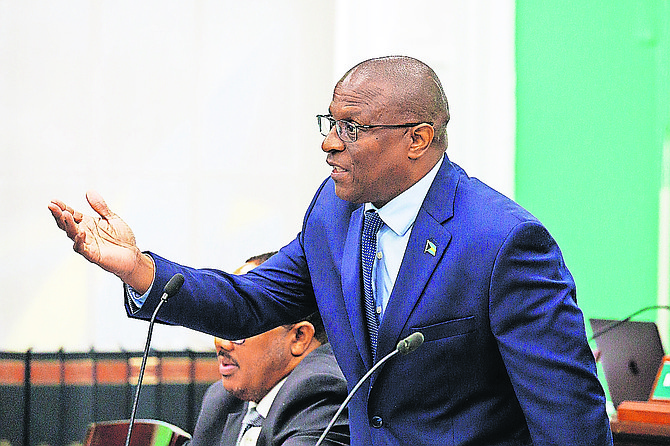
A deep political rift has erupted in The Bahamas over the country’s worsening electricity crisis, with Opposition Leader Michael Pintard launching a scathing attack on Prime Minister Philip Davis this week, accusing the ruling administration of using a controversial $20 million annual overtime scandal at state-owned Bahamas Power and Light (BPL) to deflect public anger from years of unreliable power service.
The clash followed a national address delivered Monday by Davis, who drew public attention to exorbitant overtime payouts at BPL to frame the issue as a long-unaddressed failure he was now moving to fix. During his speech, the prime minister highlighted staggering irregularities in a single BPL department, where three employees collected a combined $600,000 in overtime pay over one year. Records show one employee logged 18 hours of work on Christmas Day, followed by 24-hour shifts across the next three consecutive days – a set of claims that has raised widespread questions about payroll oversight.
In response to the revelations, Davis announced new strict oversight measures: going forward, overtime for technical staff will face heightened scrutiny if it exceeds 30% of an employee’s base salary. The prime minister also used the address to defend his administration’s broader energy reform agenda, laying out a roadmap for grid upgrades and generation capacity improvements. He acknowledged that the BPL system was inherited in severe financial and physical disrepair, warned that persistent outages would not be resolved overnight as aging infrastructure is gradually replaced, and outlined long-term plans to cut reliance on costly rented power generation, introduce liquefied natural gas to the national energy mix, and strengthen financial controls over BPL spending. In a striking moment that underscored the ongoing crisis, however, a national blackout interrupted Davis’s address before he could finish his remarks on energy reform.
But Pintard rejected the prime minister’s framing outright, dismissing the focus on BPL overtime as a “despicable distraction” designed to draw attention away from the ruling party’s failure to resolve power outages after almost five years in office. The Opposition leader argued that all ultimate responsibility for approving the excessive overtime rests with BPL’s management, board, and executives, all of which were appointed by the current Davis administration.
Pintard pressed for clear accountability, asking: “The question is: if there are problems with scheduling, whose responsibility is it, and what penalties are going to be put in place to make sure that they do their job? Who will be held accountable?” He added that the government’s framing of the overtime issue as a standalone crisis is a deliberate tactic to shift focus away from broader unaddressed problems, including sky-high cost of living, stagnant wages, and the persistent power instability that has disrupted daily life across the archipelago.
The Opposition leader pointed to widespread outages that have plagued major islands including Grand Cay, Abaco, Eleuthera, and New Providence, noting that the disruptions go far beyond mere inconvenience. For residents who rely on electric refrigeration for critical medication or power-dependent medical equipment, persistent blackouts pose direct risks to health and safety. Pintard also questioned the results of more than $430 million in infrastructure spending allocated to BPL over the past three years, asking “Where has the money gone, and why are the results worse, not better?”
Seizing on Davis’s own statement that “the buck stops with me” as prime minister, Pintard argued that the line also requires Davis to accept full responsibility for BPL’s current dysfunction. He noted that Davis has held direct oversight of BPL as either prime minister or deputy prime minister for nearly 14 years across different tenures, saying “If the buck truly stops with him, so does the responsibility for the mess that BPL is in.”
Pintard also highlighted the ironic blackout that interrupted Davis’s national address, saying the moment perfectly encapsulates the daily frustration felt by millions of Bahamians. “That moment captures what so many Bahamians feel every single day,” he said, “the frustration, the helplessness, and the loss of confidence across our country.” While Davis has framed his reform agenda as the most ambitious infrastructure challenge The Bahamas has faced since gaining independence 50 years ago, with the goal of building a more affordable, reliable power system to support long-term economic growth, Pintard dismissed the administration’s promises and issued a blunt call for action: “You are in the chair. Fix it.”